Styles / Staged & conceptual
UV-induced visible-fluorescence botanicals
- Key: a flash on the camera, from the camera, hard.
The flash reaches only what is near it, so shadows and background fall to black.
Schematic, not to scale: worked out from the style’s choices. No set-up of this style has been rendered yet.
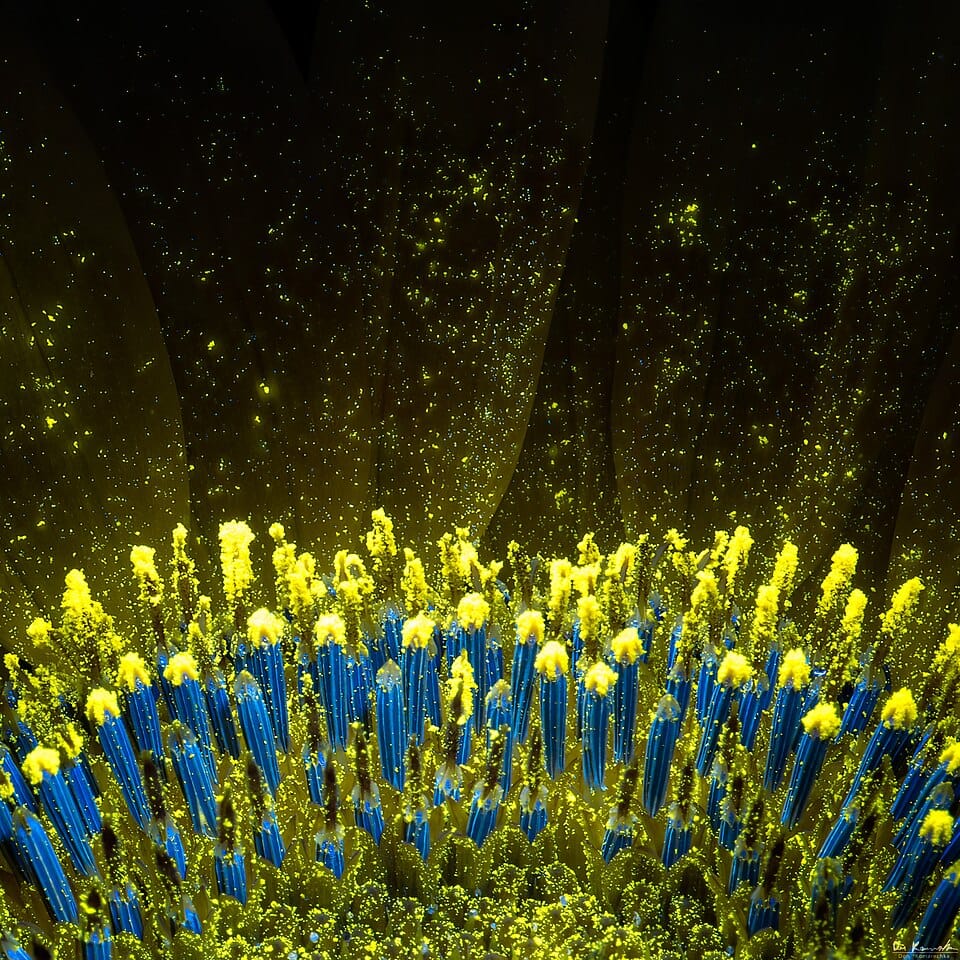
Starfield
Don Komarechka, Starfield, 2022, CC0, via Wikimedia Commons. Source: Starfield at Wikimedia Commons (from the maker's Flickr, CC0)

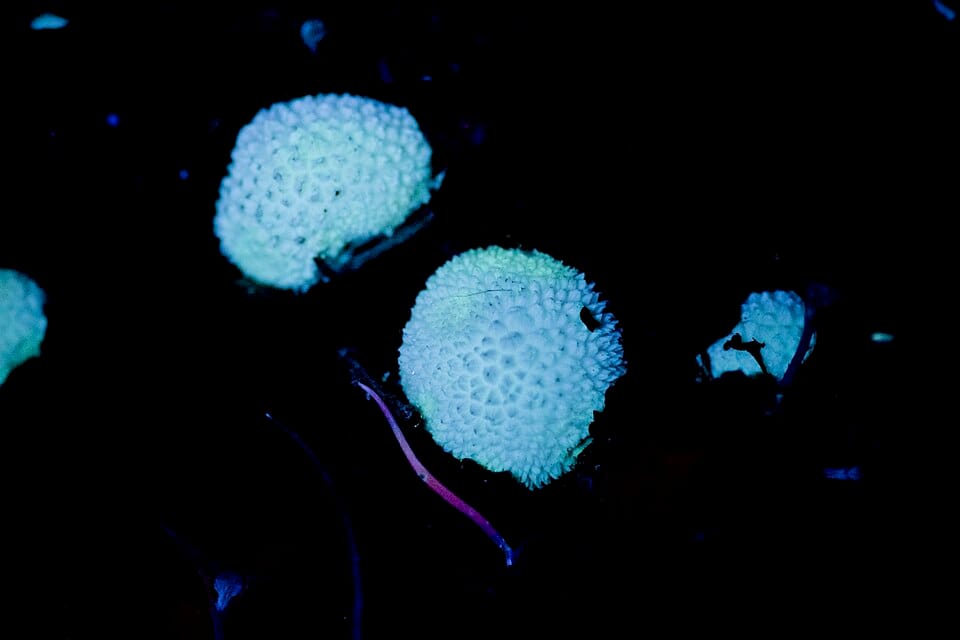
UVIVF of Lycoperdon perlatum (Texas, USA)
Michelle W. (iNaturalist), UVIVF of Lycoperdon perlatum, 2020, CC BY 4.0, via Wikimedia Commons. Source: UVIVF of Lycoperdon perlatum (Texas, USA) at Wikimedia Commons (from iNaturalist, CC BY 4.0)

Flowers lit by a 365 nm ultraviolet torch or UV-modified flash in a dark room, photographed in close-up so that only their visible fluorescence reaches the sensor: pollen, stamens and petals glow blue, yellow, green or red out of a black field. A macro lens, a UV-blocking filter and a long or flash exposure turn a stationary specimen into a saturated, otherworldly colour picture, shown singly or as a series.
Built mostly on one system: Macro on black. What systems are.
Shoot sheet for your kit A prompt for an image model The photographs
How the look is made
- Work in full darkness and light the flower only with a 365 nm UV source, so that the only light the camera records is the fluorescence.
- Put a UV-blocking or UV-bandpass filter in front of the lens (or choose a source below 400 nm) so that reflected ultraviolet and the torch's violet glow stay out of the picture.
- Go close with a macro lens and fix the flower and the camera on supports: exposures run for seconds, so there is no room for movement.
- Let the dark fall to near-black behind the flower and crop to the structures that glow (pollen, stamens, nectar guides) rather than the whole bloom.
- Expose for the fluorescence, not the torch: raise ISO or add UV-modified flash at close range, and keep each colour as the flower gave it.
- Choose flowers that fluoresce (pollen often does; some species do not) and say what the picture is: fluorescence under UV, not what a bee sees.
Shoot sheet for your kit
Fill in your camera, lenses and lights, and the sheet says which light plays each part, what to work around and where to start on your camera. Without a kit it starts on a full-frame camera.
Light
Key: a flash on the camera, from the camera, hard.
- The flash reaches only what is near it, so shadows and background fall to black.
- Shadow depth
- Dark shadows that still hold some detail (a high lighting ratio, about 4:1 to 8:1: the shadow side two to three stops darker). Shadows with no fill at all that fall to pure black with no detail, so parts of the subject disappear.
How the style is lit
- A 365 nm UV LED torch in a fully dark room, aimed at the flower from one side or above, with a UV-blocking filter on the lens.
- UV-modified flash units fired at close range and full power, with the room dark, for faster exposures.
This plan is worked out from the style’s choices, so it is drawn as a schematic. One way to get the light, not a record of how any photograph was lit.
Lens and settings
Start at
On a full-frame camera: the same depth of field and exposure as the style’s own numbers, in the same light. Then meter and adjust.
- Then
- 90–150 mm · f/8–f/16 · 1/4–30 s · ISO 100–3200 on full frame, inferred from the gear and the look. Inferred from the macro lens and tripod work these photographs call for. One openly licensed file records 1/3 s at ISO 100 on a Panasonic DC-S1R; one maker's page says ISO 3200 at about f/11 with three UV-modified flashes, from memory. Exposures with a torch alone run for seconds; flash allows faster ones. Focal length is a typical macro range, not a stated one.
- White balance
- Fixed daylight balance on the dark field: the flowers keep their own blue, yellow and green glows, and the torch violet is filtered out.
- Focal length
- Very close focus: small things at life size or larger.
- Distance
- Within arm’s reach: faces, hands and details fill the frame.
- Crop & fill
- The edges cut into the subject: heads, limbs or objects run out of frame. A small subject in a large empty field.
- Duration
- An unmoving scene, exposed slowly and carefully. Seconds or more: water turns to mist, lights become trails.
Direct
Nobody in the picture.
- Without a pose
- No people at all, or people so small or far off that their pose does not read (hands alone are Hands alone).
- The set-up
- A scene staged and directed like a film still or a painting.
Style the set
Spare: one bloom or a few parts on black, with no props, vase, backdrop colour or table setting. The flower is cut or collected as found and the dark field is kept empty; any arrangement is only for the angle of the glowing parts.
- How much is styled
- Nothing dressed, made up, moved or added for the picture.
- Look of the styling
- Few, simple elements on clean surfaces, with space around them.
Finish
- Colour
- Strong, dense colours. The colour of ordinary things treated as the point of the picture.
- Digital & other
- A modern digital camera: clean, detailed, neutral.
- Texture
- Smooth tones with no visible grain.
- Shown as
- Pictures made and shown as a set.
Stay away from coloured gels, infrared & false colour, golden hour, overcast & flat daylight, visible grain, candid & unobserved, black & white, full range, eyes to the lens, available light in the dark and document & record.
Before you shoot it
The photographs show plants, not people, but the colours are a recording of fluorescence under ultraviolet, not what a bee, a person or the flower looks like in daylight; do not present them as pollinator vision. Ultraviolet at 365 nm can harm eyes and skin: wear UV-blocking glasses and avoid pointing the torch at people or animals. These pictures are art, not evidence or documentation.
A prompt for an image model
No prompt for this style
Behind its pictures: a small living community of named photographers.
Its caution asks to credit and commission them, and a fake would pass as scientific evidence.
The photographs show plants, not people, but the colours are a recording of fluorescence under ultraviolet, not what a bee, a person or the flower looks like in daylight; do not present them as pollinator vision. Ultraviolet at 365 nm can harm eyes and skin: wear UV-blocking glasses and avoid pointing the torch at people or animals. The look belongs to a small living community of named photographers; credit and commission them, never prompt by name, and do not present an AI-generated image as one of their photographs or as scientific evidence of a species' fluorescence. These pictures are art, not evidence or documentation.
Work with photographers of this tradition, or take only its light and lens (the shoot sheet above) without its people, places or rituals.
Where to see it
From open collections, shown whole with their credits. Later photographs are linked, not shown, while they are in copyright.
With other styles
The opposite: Aerochrome false-colour infrared. Both turn familiar plants into unfamiliar colour, but Aerochrome records reflected infrared by daylight in landscape; UVIVF records emitted visible light from a flower in darkness.
Pairs with Light painting photography. Both work in darkness with a hand-held light source over a long exposure; here the torch excites the flower rather than drawing marks.
The opposite: Blackwater macro photography. Both isolate a small nature subject against black with one source, but blackwater macro reflects light off its subject, while UVIVF records only the light the flower emits under ultraviolet.
Sources
- Craig P. Burrows, FAQ: https://cpburrows.com/frequently-asked-questions/ (365 nm LED sources; a UV-bandpass filter such as Schott UG11 or Hoya U340; UVIVF work must reject as much UV as possible from the sensor). Fetched.
- Don Komarechka, Glowing Blooms: https://www.donkom.ca/glowing-blooms/ (Scilla siberica under UV; three UV-modified flashes at close range and full power; ISO 3200, about f/11 from memory; image uploaded 2017, page copyright 2018). Fetched.
- Interview with Craig P. Burrows, Material Source: https://www.materialsource.co.uk/interview-craig-p-burrows/ (discovered UVIVF around 2014; UV LED source; professional in 2017). Fetched.
- Illuminating nature's spectrum, National Geographic paid content (20 March 2024): https://www.nationalgeographic.com/photography/article/paid-content-illuminating-natures-spectrum (365 nm LEDs, third-generation method; a source below 400 nm lets only fluorescent emissions form the image; flower names). Fetched.
- Wikimedia Commons, Starfield by Don Komarechka (CC0; 23 July 2022; EXIF: Panasonic DC-S1R, 1/3 s, ISO 100): https://commons.wikimedia.org/wiki/File:Starfield_-_Flickr_-_Don_Komarechka.jpg