Styles / Pictorialist
Victorian combination printing
- Key: a window, about 60° to the camera’s left, soft.
Open shadows: bright surroundings (walls, ground, sky) fill them; no reflector needed.
Schematic, not to scale: worked out from the style’s choices. No set-up of this style has been rendered yet.
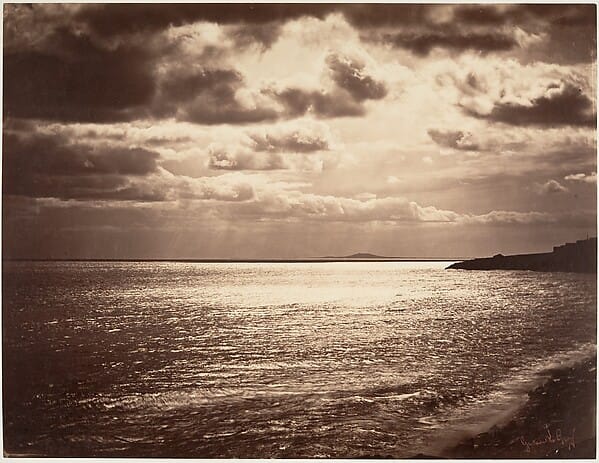
Mediterranean Sea - Sète
Gustave Le Gray, Mediterranean Sea - Sète, 1857. The Metropolitan Museum of Art, Gilman Collection, Purchase, Robert Rosenkranz Gift, 2005. Source: Mediterranean Sea - Sète at The Metropolitan Museum of Art
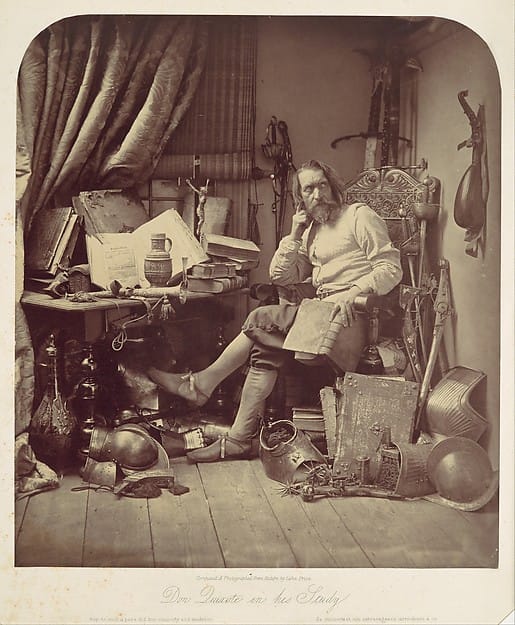
Don Quixote in His Study
William Frederick Lake Price, Don Quixote in His Study, 1857. The Metropolitan Museum of Art, Gift of A. Hyatt Mayor, 1969. Source: Don Quixote in His Study at The Metropolitan Museum of Art
Pictures built from several negatives, planned from a sketch like an academic painting. Costumed models act out allegory, moral stories and rural idylls; the pieces are joined seamlessly so that the print reads as one sharp, evenly lit scene, and skies are printed in from a separate negative. The result is a large, warm albumen print, framed and hung as art. The method was argued over: critics held that a photograph should not tell a made-up story.
Built on two systems: Costumed tableau and Albumen view. What systems are.
Shoot sheet for your kit A prompt for an image model The photographs
How the look is made
- Sketch the whole picture first, as a painter would, and decide each figure's place before any negative is made.
- Pose costumed models in a pyramid or in layered planes, one gesture and one emotion each, so that the group reads as a story.
- Light every piece the same way, from one side window or open shade, so the joins cannot be seen when the negatives are printed together.
- Keep every figure and prop sharp from front to back; do not use soft focus to hide the seams.
- Print a separate sky or sea negative into the empty part of the frame, matched in direction of light and in tone.
- Make a large albumen print, tone it warm, and mount and frame it as a single picture for the wall.
Shoot sheet for your kit
Fill in your camera, lenses and lights, and the sheet says which light plays each part, what to work around and where to start on your camera. Without a kit it starts on a full-frame camera.
Light
Key: a window, about 60° to the camera’s left, soft.
- Open shadows: bright surroundings (walls, ground, sky) fill them; no reflector needed.
- Shadow edges
- Shadows that fade gradually from light to dark, cast by a large or diffused light: a window, a softbox, a cloudy sky.
- Shadow depth
- Shadows kept light and full of detail by a reflector, a fill light, bounce or bright surroundings (a low lighting ratio, up to about 3:1: the shadow side at most a stop and a half darker).
- Shape & form
- Light turning gradually into shade across faces and objects, so their volume shows.
How the style is lit
- North-facing skylight or large side window, one fixed direction for every piece, with a white reflector opposite.
- Open shade outdoors, no direct sun on figures.
- A separate overcast sky or sea negative, printed in later.
This plan is worked out from the style’s choices, so it is drawn as a schematic. One way to get the light, not a record of how any photograph was lit.
Lens and settings
Start at
On a full-frame camera: the same depth of field and exposure as the style’s own numbers, in the same light. Then meter and adjust.
- The style’s f/11 on Whole plate gives about the depth of field of f/1.8 on full frame.
- Then
- 45–85 mm · f/8–f/16 · 2–30 s · ISO 0.1–1 on Whole plate, inferred from the gear and the look. Worked out from the process: wet-collodion plates exposed for seconds in a skylit studio or open shade, stopped down for depth over a staged set, from portrait lenses of about 12 inches on whole-plate or larger glass. No source records Rejlander's or Robinson's exact stops, so the numbers are estimates.
- Focus
- Everything sharp from the nearest stone to the horizon.
- Angle
- The camera at the height of a standing person or of the subject.
- Distance
- Whole figures and their immediate surroundings.
- Crop & fill
- The subject shown small within its setting, which explains it.
- Depth
- Separate events in the foreground, middle ground and background.
- Duration
- An unmoving scene, exposed slowly and carefully.
Direct
Direct each figure like an actor in a tableau: models hold one clear, readable gesture and emotion (grief at a bedside, a hand to the brow, a sewing girl's lowered eyes, an arm pointing down a road), faces turned to a neighbour, a book or the floor rather than the lens. Group them in a pyramid or a loose cluster and shoot each figure or small group on its own, with exposures of several seconds so that everyone must hold still. Keep a model's pose and eye line matched to the neighbour who will be printed beside them.
- Head & gaze
- Looking down, or eyes shut: inward, modest, asleep or praying.
- Line & energy
- Large, readable gestures and attitudes, as on a stage or in a silent film: a feeling or a story acted out. Rigid and motionless, sometimes braced against a head rest or gripping a chair: held for a long exposure or a solemn occasion.
- Expression
- Tears, grief, anger, fear or elation shown openly on the face and in the body.
- Several people
- Bodies close together, overlapping and leaning in: friends, a band, a family on a sofa.
- The set-up
- A scene staged and directed like a film still or a painting.
Style the set
Dress models in costume and period dress, in plain white or cream gowns, shawls, smocks, armour or Greek robes, and place them among props chosen to say the story: a pillow and a chair for a sickbed, books and a lute for Don Quixote, a spinning wheel, a cottage door, a basket of sticks. Backgrounds are a draped cloth, a painted backcloth or a studio corner, and the landscape or sky is added later from other negatives. Nothing is left as found: every garment, prop and fold is placed.
- Clothes
- Period dress, fancy dress, stage costume or someone else’s clothes, worn to play a part rather than as one’s own.
- Set & props
- The stock furniture of a portrait studio, standing in for a setting: a posing chair, a column, a balustrade, a draped table, a potted palm. A painted, cloth, paper or seamless backdrop behind the subject.
- How much is styled
- Clothes, hair, make-up, props and set all chosen and placed by a team to one idea.
Finish
- Monochrome
- A monochrome image tinted sepia, brown, selenium purple or cyanotype blue.
- Colour
- An overall yellow, orange or red cast.
- Early processes
- Warm-brown prints of the 19th century, made from negatives.
- Film
- A view camera on a tripod: great detail, slow and deliberate.
- Texture
- Smooth tones with no visible grain.
- Post-production
- Several photographs combined into one picture. Perfected skin and surfaces.
- Shown as
- Each picture stands on its own.
- Shown in
- Large prints on the wall, like paintings.
Stay away from soft focus & diffusion, platinum & palladium, gum & pigment processes, candid & unobserved, snapshot, straight print, direct on-camera flash, saturated colour, deadpan and visible grain.
Before you shoot it
Its pictures show real, often young, women posed as the dying, the fallen or the allegorical, and Rejlander's The Two Ways of Life, with its bare-breasted and draped figures, was attacked as indecent and the models were wrongly said to be prostitutes; Fading Away scandalised some reviewers, who believed its subject was really dying. The moralising subjects (the fallen woman, the dying consumptive, the contented poor) carry Victorian class and gender attitudes: do not use them to romanticise poverty or illness.
A prompt for an image model
A ready prompt that describes this look to an image model: where the lights stand, the lens, the framing and the colour. It starts on the style’s own choices; change any of them and the prompt and the notes follow.
The prompt
Notes on this prompt
- How the style uses it: light every piece the same way, from one side window or open shade, so the joins cannot be seen when the negatives are printed together. Image models put the light in the wrong place more often than anything else, so the prompt says where each light stands: which side of the picture, and how high. Keep to one light pattern per prompt, or the model splits the difference.
- Describe an invented person by age, clothes and pose. Never name a real or famous person, and never write “looks like”.
- Black and white: colour words in the subject (a red dress, green leaves) can pull the model back to colour, so leave them out.
The model makes a new picture, not a photograph of anything that happened. Label it as AI-generated, and don’t pass it off as the style’s history or as a real person.
Photographs that define it
From open collections, shown whole with their credits. Later photographs are linked, not shown, while they are in copyright.
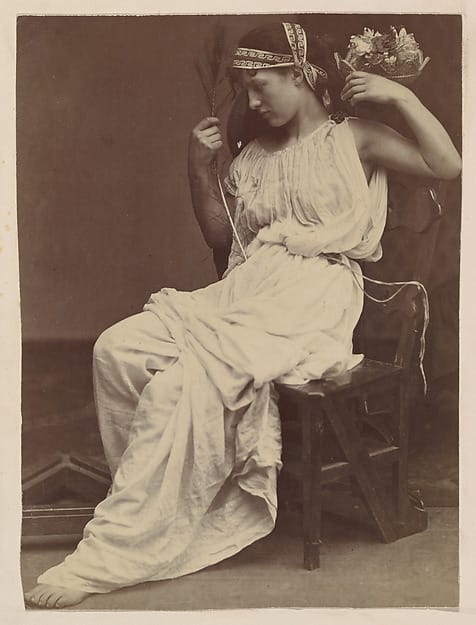
Flora Contemplating Vanity
Oscar Gustav Rejlander, Flora Contemplating Vanity, 1860. The Metropolitan Museum of Art, Acquired by exchange, 1958. Source: Flora Contemplating Vanity at The Metropolitan Museum of Art
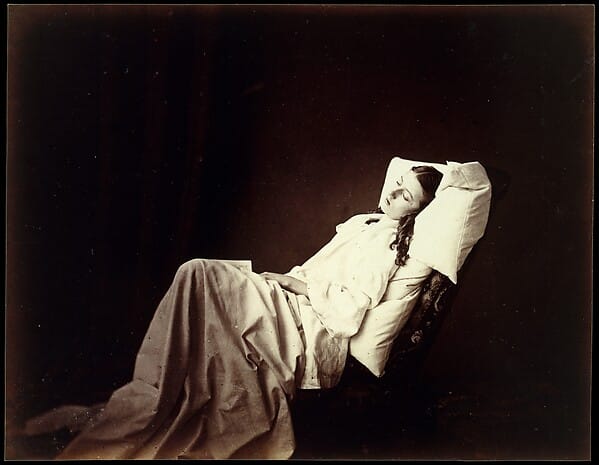
"She Never Told Her Love"
Henry Peach Robinson, "She Never Told Her Love", 1857. The Metropolitan Museum of Art, Gilman Collection, Purchase, Jennifer and Joseph Duke Gift, 2005. Source: "She Never Told Her Love" at The Metropolitan Museum of Art
Made by an AI model
An image gpt-image-2 made from this style’s choices, then checked against them by a vision model. Not a photograph, and not part of the style’s history. All generated images
-
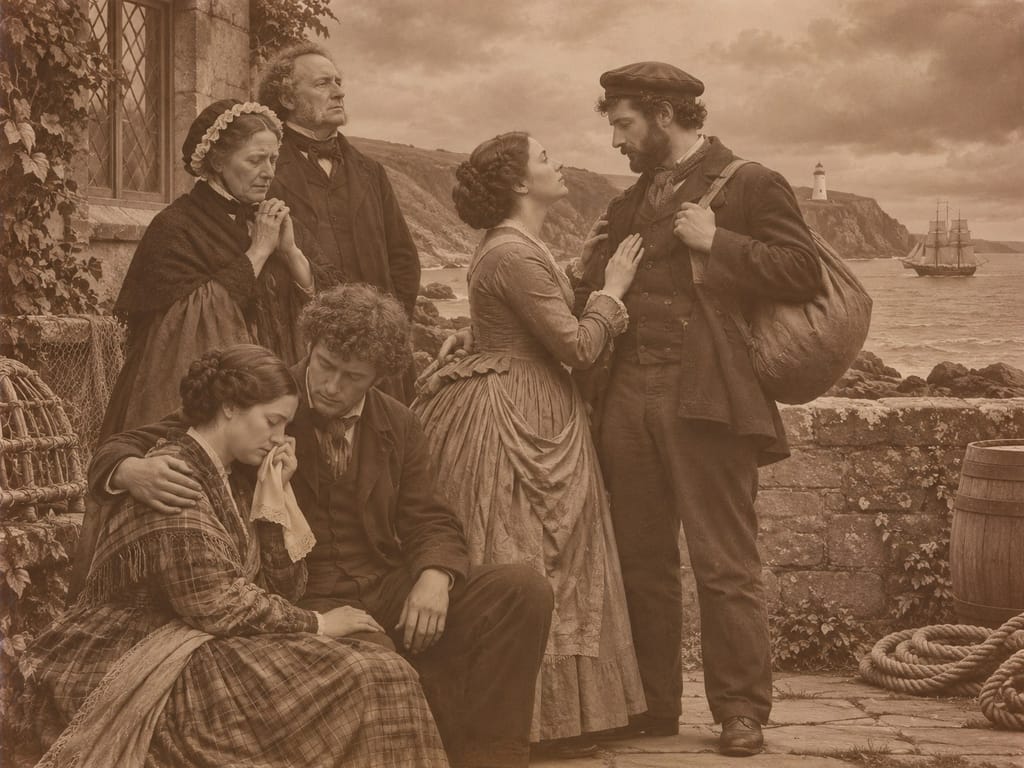
Six people in nineteenth-century clothing gather beside a stone coastal cottage in a sepia-toned scene resembling a sorrowful farewell. A standing woman touches a bearded man's chest as he carries a large shoulder bag, while a seated man comforts another woman; a sailing ship and lighthouse appear beyond the stone wall. What the check saw. The photograph-like image uses a carefully staged ensemble, soft light and sepia toning to evoke a sentimental Victorian farewell tableau.
With other styles
The opposite: Pictorialism. Pictorialism, its successor, softens focus and works platinum and gum prints by hand; keep the combination print sharp and join the pieces without a trace, then compare it with a soft, single-negative version of the same scene.
Pairs with Staged tableau photography. Both direct costumed or cast figures in one planned scene; borrow the tableau's single-picture wall scale but keep the Victorian moral story, sketch and albumen warmth, instead of the cinematic uncertainty.
The opposite: Surrealist photography. Surrealist montage cuts parts together to unsettle; the Victorian composite hides its joins to make one believable, edifying scene.
Pairs with Calotype and paper-negative photography. The calotype is the older paper print the early composites grew from; borrow its warm brown paper tones and a plain table, chair and book, but replace one-take sitters with several planned negatives.
The opposite: Carte-de-visite studio portraits. The carte puts one sitter in a stock studio; swap it for a costumed group acting a story in layered planes and print it large.
Sources
- https://en.wikipedia.org/wiki/Combination_printing
- https://en.wikipedia.org/wiki/Oscar_Rejlander
- https://en.wikipedia.org/wiki/Henry_Peach_Robinson
- https://en.wikipedia.org/wiki/Gustave_Le_Gray
- https://www.getty.edu/art/collection/person/103KC3
- https://www.metmuseum.org/art/collection/search/283124
- https://www.metmuseum.org/art/collection/search/283090