Styles / Documentary & reportage
African safari wildlife photography
- Key: the sun, about 45° to the camera’s left, high, hard.
Key high: about 30–45° above eye level, angled down. Open shadows: bright surroundings (walls, ground, sky) fill them; no reflector needed.
Schematic, not to scale: worked out from the style’s choices. No set-up of this style has been rendered yet.
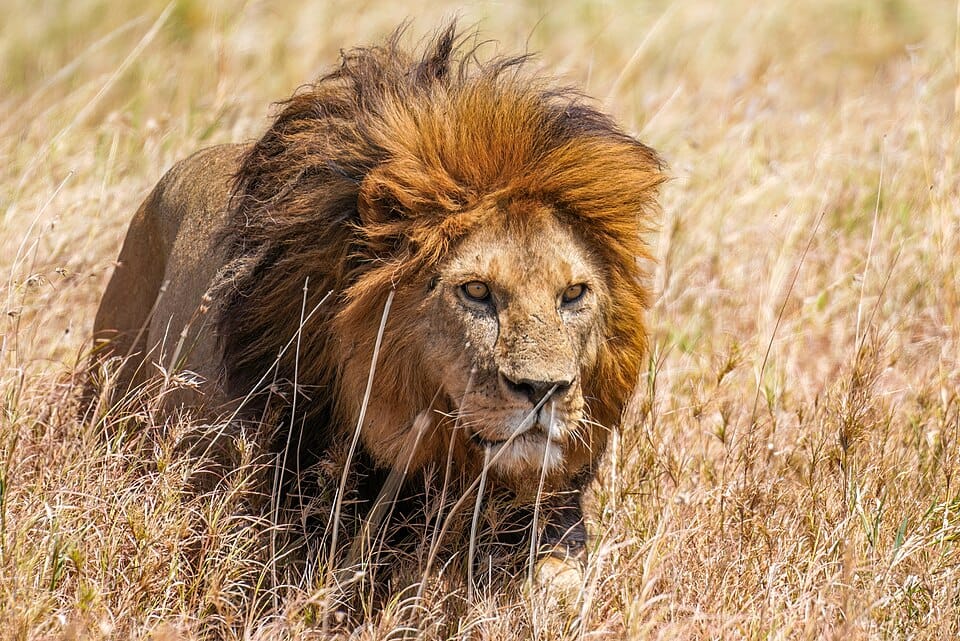
Male Lion prowling in the Serengeti National Park
Giles Laurent, CC BY-SA 4.0, via Wikimedia Commons. Source: Male Lion prowling in the Serengeti National Park at Wikimedia Commons

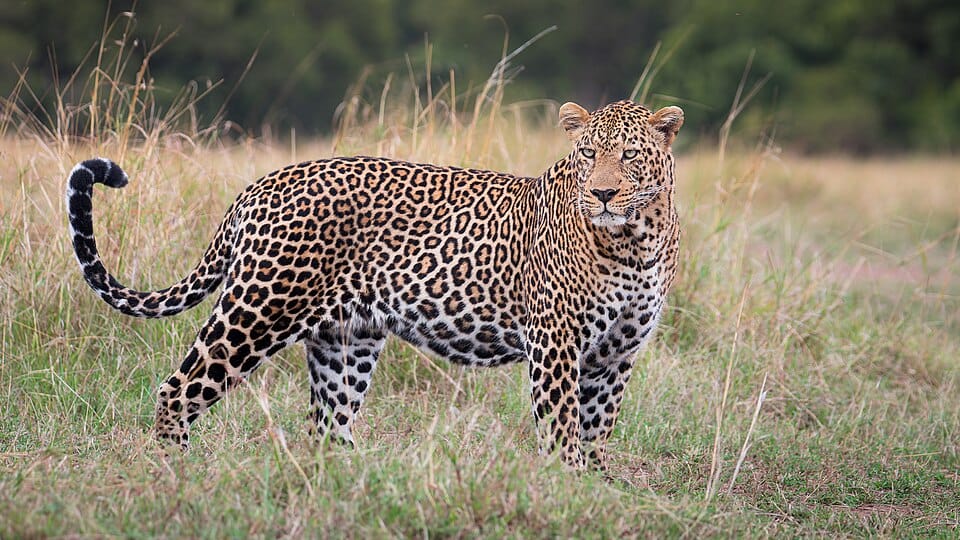
Male leopard - Mara
Sumeet Moghe, CC BY-SA 4.0, via Wikimedia Commons. Source: Male leopard - Mara at Wikimedia Commons

Free animals of the African savanna, photographed by a person with a long lens, usually from a vehicle or hide. The telephoto isolates one animal against a melted background, light is low and warm early or late in the day, the eye is sharp with a catchlight, and a fast shutter freezes a look, stride or yawn. Colour is natural and the animal is left as found.
Built mostly on one system: Telephoto colour. What systems are.
Shoot sheet for your kit A prompt for an image model The photographs
How the look is made
- Work from the vehicle or hide at the animal's own pace: wait for it to settle and never make it move for the picture.
- Use the longest lens you have and open the aperture so the animal separates from grass and bush as a clean, soft background.
- Place the focus point on the nearer eye and keep it sharp; wait for a catchlight and a turn of the head toward you.
- Shoot in the first and last hours of daylight, with the sun low behind or beside you, and expose for the animal rather than the sky.
- Choose a fast shutter (1/500 s or faster for moving animals, 1/250 s for resting ones) and raise ISO before you accept blur; leave the grass and dust in the frame as found.
- Frame with room for the animal to look or walk into, from its eye level or a little above, and crop only to remove clutter.
Shoot sheet for your kit
Fill in your camera, lenses and lights, and the sheet says which light plays each part, what to work around and where to start on your camera. Without a kit it starts on a full-frame camera.
Light
Key: the sun, about 45° to the camera’s left, high, hard.
- Key high: about 30–45° above eye level, angled down.
- Open shadows: bright surroundings (walls, ground, sky) fill them; no reflector needed.
- Shadow depth
- Shadows kept light and full of detail by a reflector, a fill light, bounce or bright surroundings (a low lighting ratio, up to about 3:1: the shadow side at most a stop and a half darker).
- Highlights
- Bright, clearly shaped reflections of the light in the eyes (a window, a ring, a softbox), made a feature of the portrait.
How the style is lit
- Low sun in the first and last hours of daylight, from behind or beside the photographer so the animal's coat and eye are lit and the background is in shade.
- Backlit grass and dust at sunrise or sunset, with the animal rim-lit or in silhouette against a warm sky.
This plan is worked out from the style’s choices, so it is drawn as a schematic. One way to get the light, not a record of how any photograph was lit.
Lens and settings
Start at
On a full-frame camera: the same depth of field and exposure as the style’s own numbers, in the same light. Then meter and adjust.
- Then
- 200–600 mm · f/5.6–f/8 · 1/1000–1/250 s · ISO 100–2500 on full frame, inferred from the gear and the look. Inferred from the recorded settings of four openly licensed Commons photographs (f/5.6 to f/8, 1/250 to 1/500 s, ISO 100 to 2500; lens lengths from 55 mm for the wide sunset sub-look, through 226 mm, to 400 mm and 560 mm for the telephoto frames) and from the long zoom lenses such work uses; no source states a typical setting. Zoom telephotos are slow at the long end, so ISO rises in shade. Environmental frames at sunset go wider and slower.
- White balance
- Daylight or auto: leave the low-sun gold and the warm grass warm, keep shade and the sky after sunset cool, and do not correct either to neutral.
- Focal length
- A long lens stacks distant planes close together.
- Focus
- One plane sharp, the rest melting into blur and bokeh.
- Angle
- The camera at the height of a standing person or of the subject.
- Distance
- Standing well back; people are small.
- Balance
- The subject placed off-centre, balanced against open space.
- Crop & fill
- The edges cut into the subject: heads, limbs or objects run out of frame.
- Instant
- Movement stopped dead by a fast shutter or flash. Gesture and geometry peak together in one instant.
Direct
Nobody in the picture.
- Without a pose
- No people at all, or people so small or far off that their pose does not read (hands alone are Hands alone).
- The moment
- People photographed as they are, unaware or unconcerned.
Style the set
Nothing is styled. The grass, dust, vehicles and tracks stay as found; clean only the frame, by moving the vehicle or waiting for a stalk of grass to bend away from the eye.
- How much is styled
- Nothing dressed, made up, moved or added for the picture.
Finish
- Colour
- An overall yellow, orange or red cast.
- Digital & other
- A modern digital camera: clean, detailed, neutral.
- Post-production
- Nothing changed beyond exposure and development.
- Shown as
- Each picture stands on its own.
- Shown in
- Pictures made for magazine pages and spreads.
Stay away from unseen camera, deep focus, direct on-camera flash, soft studio light, composite & montage, heavy retouching, directed scene & tableau and constructed set & miniature.
Before you shoot it
Photographs of animals can expose them: do not publish the exact location or GPS data of rhinos, elephants or other poached species, and do not bait, crowd or flush animals for a picture. Safari tourism sits in a colonial history of big-game hunting, and people living near the parks (Maasai and other communities) are sometimes photographed as scenery; take no photographs of local people without consent, and credit and pay guides and communities. Several named living photographers (for example Nick Brandt, the Jouberts) have recognisable styles: use their work as exemplars only, never in an image prompt.
A prompt for an image model
A ready prompt that describes this look to an image model: where the lights stand, the lens, the framing and the colour. It starts on the style’s own choices; change any of them and the prompt and the notes follow.
The prompt
Notes on this prompt
- How the style uses it: shoot in the first and last hours of daylight, with the sun low behind or beside you, and expose for the animal rather than the sky. Image models put the light in the wrong place more often than anything else, so the prompt says where each light stands: which side of the picture, and how high. Keep to one light pattern per prompt, or the model splits the difference.
- Image models read “shallow depth of field” better than an f-number; the camera settings in the prompt are a guide to the look, not an order.
- Say what the crop cuts: the top of the head, the hands at the edge. A model left to itself centres everything with room to spare.
The model makes a new picture, not a photograph of anything that happened. Label it as AI-generated, and don’t pass it off as the style’s history or as a real person.
Photographs that define it
From open collections, shown whole with their credits. Later photographs are linked, not shown, while they are in copyright.
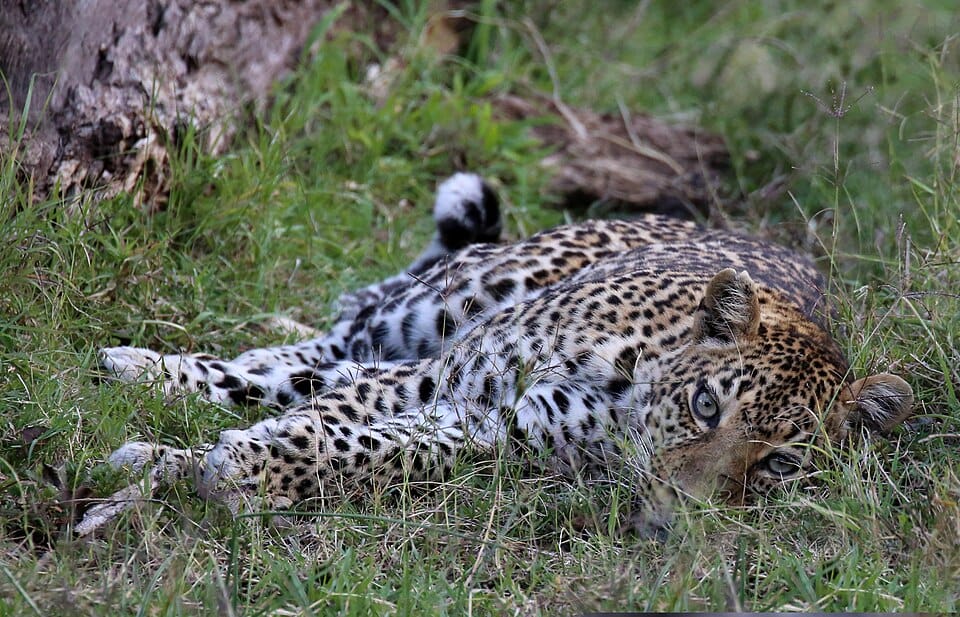
Leopard, Masai Mara
flowcomm, CC BY 2.0, via Wikimedia Commons. Source: Leopard, Masai Mara at Wikimedia Commons

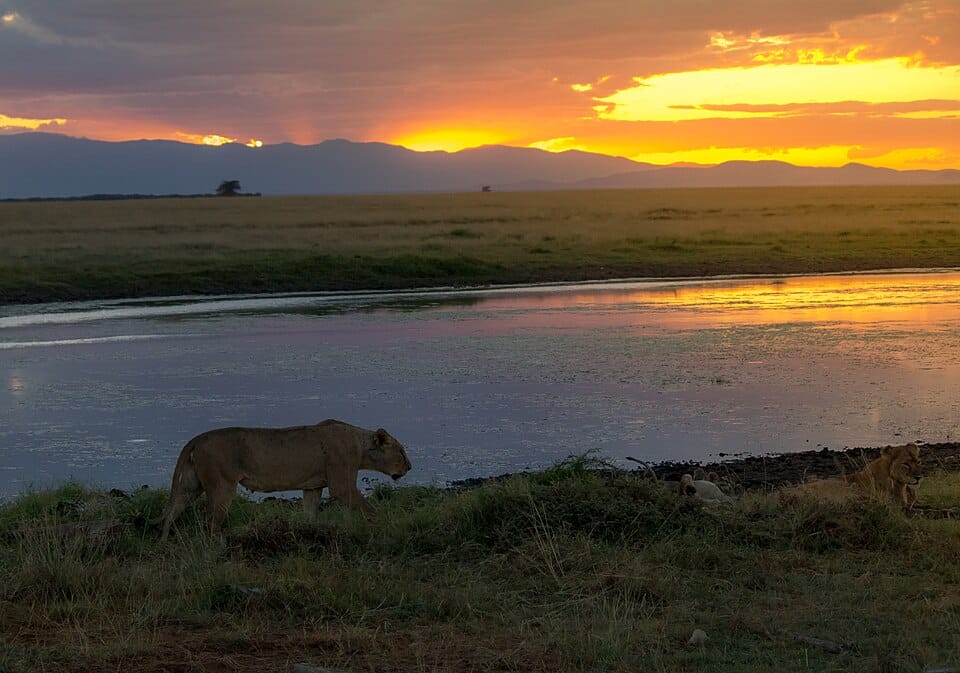
African Sunset, Amboseli National Park
Ray in Manila, CC BY 2.0, via Wikimedia Commons. Source: African Sunset, Amboseli National Park at Wikimedia Commons

Made by an AI model
An image gpt-image-2 made from this style’s choices, then checked against them by a vision model. Not a photograph, and not part of the style’s history. All generated images
-
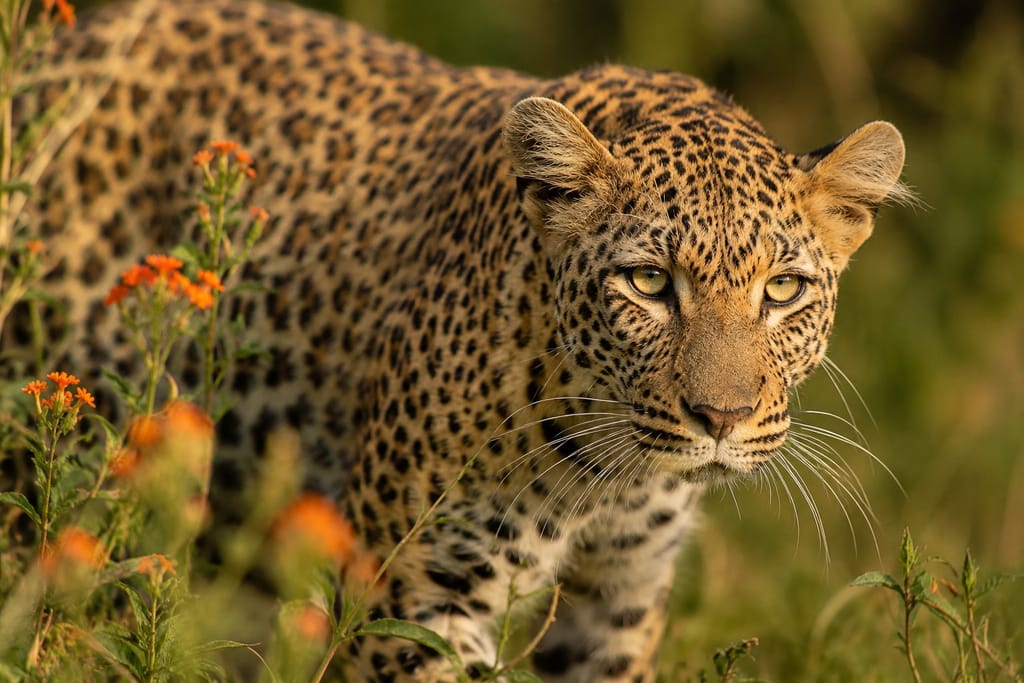
A leopard looks directly toward the camera amid green vegetation and small orange flowers. Its face and whiskers are sharply detailed against a softly blurred background, with its spotted body extending beyond the left edge. What the check saw. This tightly cropped wildlife image uses warm light and shallow depth of field to emphasize the leopard's eyes and spotted face.
With other styles
The opposite: Camera-trap wildlife photography. Same animals, opposite method: put an operator behind a telephoto at the eye line to choose the moment, where the trap sits wide and low and lets the animal choose.
Pairs with Straight photography. Keep the finish plain and honest (sharp eye, true colour, no composites) and the animal left as found.
The opposite: Underwater photography. Both photograph wild animals in their own element, but the swimmer works close and wide with strobes where the safari photographer stays far off with a long lens and natural light.
Sources
- Wildlife photography, Wikipedia: https://en.wikipedia.org/wiki/Wildlife_photography (National Geographic's first wildlife photographs by George Shiras III, July 1906; hides and long lenses as standard equipment; lists Nick Brandt, Beverly and Dereck Joubert, Marsel van Oosten, David Yarrow and Thomas Mangelsen with no detail of their work). Fetched.
- Safari, Wikipedia: https://en.wikipedia.org/wiki/Safari (safari journeys traced to the 19th century; William Cornwallis Harris's 1836 expedition; photographic safari mentioned only in a caption). Fetched.
- Nick Brandt, Wikipedia: https://en.wikipedia.org/wiki/Nick_Brandt (East African trilogy 2005, 2009, 2013; Pentax 67II medium format, two fixed lenses, black-and-white film, no telephoto or zoom; Big Life Foundation, 2010). Fetched.
- Beverly Joubert, Wikipedia: https://en.wikipedia.org/wiki/Beverly_Joubert (born 1957; National Geographic explorer-at-large; stills photography; long work in Botswana). Fetched.
- Wikimedia Commons file pages and EXIF data for the four specimens (Giles Laurent, flowcomm, Sumeet Moghe, Ray in Manila): licences and settings read from the file pages and the Commons API.
- Research boundary: no source checked codifies a 'safari look'; the conventions here (vehicle viewpoint, golden hour, tight telephoto portraits, shallow focus) are inferred from the open specimens and from the gear, and the entry says so. Marsel van Oosten, David Yarrow and Thomas Mangelsen are not used as exemplars because their work was not checked.