Styles / Digital & social
Arab Spring citizen protest photography
- Key: a lamp, sign or screen, about 30° to the camera’s left, hard.
Schematic, not to scale: worked out from the style’s choices. No set-up of this style has been rendered yet.
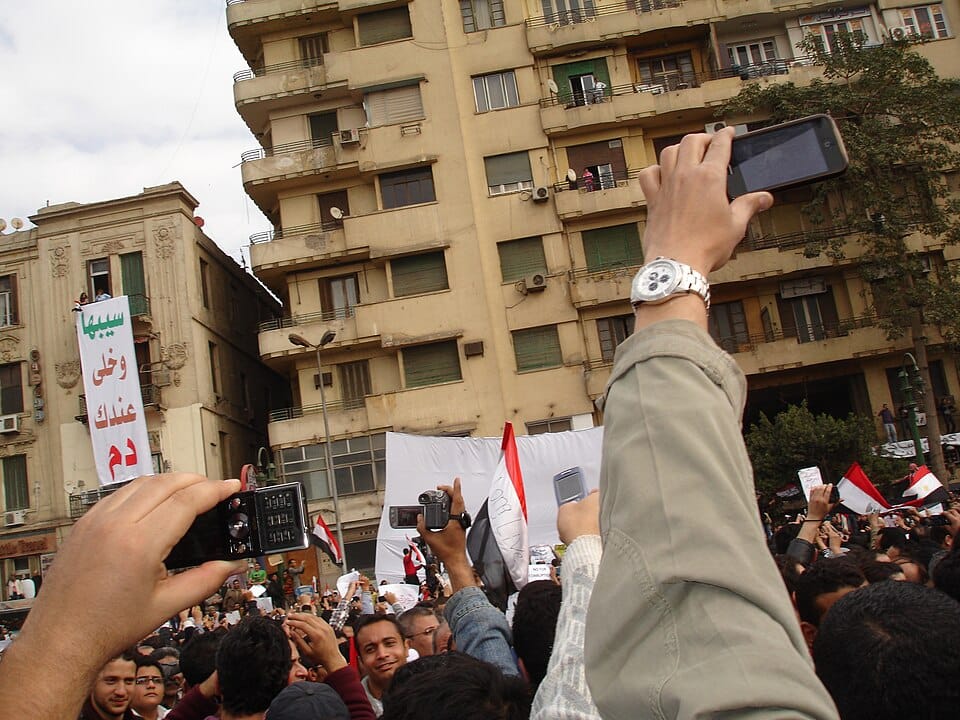
Protesters at Al Tahrir million man protest (6)
Kodak Agfa, CC BY-SA 2.0, via Wikimedia Commons. Source: Protesters at Al Tahrir million man protest (6) at Wikimedia Commons

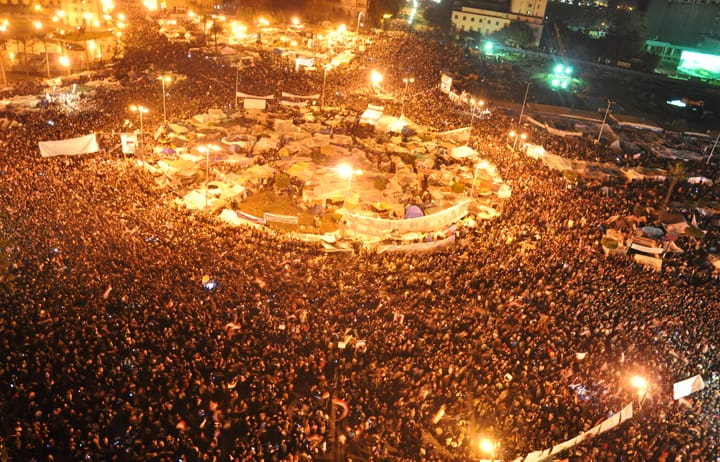
Over 2 million protesting in Tahrir Square after Mubarak's speech
Jonathan Rashad, CC BY 2.0, via Wikimedia Commons. Source: Over 2 million protesting in Tahrir Square after Mubarak's speech at Wikimedia Commons

Pictures made by the people inside a protest, on phones and pocket cameras, and posted at once to feeds. Dense crowds seen from balconies and bridges, flag-waving marches, night squares lit by street lamps, arms holding up phones, tear-gas smoke and street clashes: shot at arm's length or from above, unposed, sometimes blurred or blown out, with the risk of being there showing in every frame.
Built on three systems: Machine eye, Event reportage and Bright selfie. What systems are.
Shoot sheet for your kit A prompt for an image model The photographs
How the look is made
- Shoot as a participant, not a spectator: stay inside the crowd or on the building above it, and let your own risk set the distance.
- Get above the crowd when you can, from a balcony, bridge or roof, so the whole square, its tents and its banners read as one mass of people.
- Raise the phone at arm's length or over heads and take the frame as it comes; do not wait to compose, and accept tilt, a hand or a head cutting in.
- Use the night lamps and flags as they are, with no flash and no extra light; let the lit square go orange and the faces and sky clip.
- Keep the file unedited and keep the compression, noise and blur; post it immediately and caption it with place, date and time so it works as testimony.
- Frame the act of witnessing too, with raised phones in view, and protect the people in the picture: avoid identifiable faces of those who could be prosecuted and strip location data before posting.
Shoot sheet for your kit
Fill in your camera, lenses and lights, and the sheet says which light plays each part, what to work around and where to start on your camera. Without a kit it starts on a full-frame camera.
Light
Key: a lamp, sign or screen, about 30° to the camera’s left, hard.
- Shadow depth
- Dark shadows that still hold some detail (a high lighting ratio, about 4:1 to 8:1: the shadow side two to three stops darker).
- Highlights
- The brightest parts burn out to pure white with no detail, on purpose or because the light was too strong.
How the style is lit
- Daylight in a square or street, hard noon sun or a flat grey sky, with crowd shade and bright flags; exposure left to the phone's auto mode.
- Night square lit by street lamps and sodium floodlights, with warm orange pools, crushed black gaps and clipped lamps; no flash, hands held steady or braced on a rail.
- Smoke, tear gas and fire at night in clashes, the picture lit by flames and street lights, often blurred by movement.
This plan is worked out from the style’s choices, so it is drawn as a schematic. One way to get the light, not a record of how any photograph was lit.
Lens and settings
Start at
On a full-frame camera: the same depth of field and exposure as the style’s own numbers, in the same light. Then meter and adjust.
- The style’s f/3.1 on a phone gives about the depth of field of f/16 on full frame.
- Then
- 26–35 mm · f/2.8–f/3.5 · 1/2000–1/20 s · ISO 50–1600 on a phone, inferred from the gear and the look. Inferred from the small-sensor fixed-lens phones and compacts of 2010-2012 in auto mode; not documented for any one photograph here. Bright days give fast shutters; night lamps give slow shutters (about 1/15 s or slower) with blur and high ISO.
- White balance
- Auto white balance on the sensor: daylight scenes come out near neutral, while sodium and tungsten street lamps stay orange against cool shaded sky and screens; no correction applied.
- Focal length
- A wide view; near things loom and lines stretch towards the edges.
- Focus
- Everything sharp from the nearest stone to the horizon.
- Angle
- Looking down on the subject.
- The photographer
- The picture shows what the viewer’s own eyes would see. The camera held at arm’s length, often turned on oneself.
- Crop & fill
- Detail runs to every edge with no single centre. The subject shown small within its setting, which explains it.
- Depth
- Separate events in the foreground, middle ground and background.
- Instant
- A casual, unplanned instant, taken quickly.
- Duration
- Moving things smeared across the frame.
Direct
Nobody is posed. People march, chant, sit on kerbs and monuments, climb lamp posts, lift flags and signs, and hold up their own phones; faces turn to the speaker, the sky or the line of police, and a few look into the lens when the photographer is close. Do not direct anyone: take the crowd as it moves.
- Head & gaze
- Attention on what the hands are doing or on a thing (working, reading, eating, playing), not on the camera.
- Arms & hands
- Arms stretched out, pointing or waving, or hands caught mid-gesture while talking. Signs made at the camera: the V sign, heart hands, finger hearts, a thumbs-up, pointing at the lens.
- Several people
- Bodies close together, overlapping and leaning in: friends, a band, a family on a sofa.
- The moment
- People photographed as they are, unaware or unconcerned. Ordinary photographs by and for ordinary people, or images that look like them.
Style the set
Nothing is styled. People wear ordinary clothes for a winter day in Cairo or Tunis, and the only arranged things are what protesters bring: flags painted on cheeks and in hands, hand-lettered banners and signs, tents, blankets and scrawled walls. Leave the square's debris and improvised barricades in.
- How much is styled
- Nothing dressed, made up, moved or added for the picture.
Finish
- Colour
- Strong, dense colours.
- Digital & other
- A phone camera and its processing: deep focus, bright shadows, synthetic blur.
- Texture
- The flaws of digital capture and sharing.
- Shown in
- Pictures made for a scrolling feed.
Stay away from formal posed portrait, deadpan, hdr & tone-mapped, heavy retouching, composite & montage, filter & preset look, soft studio light, theatrical & acted, fully art-directed, sell & persuade, glamour & aspiration, shallow depth of field and hyper-detailed.
Before you shoot it
These photographs show real people, many of whom were arrested, injured, killed or later prosecuted for taking part; faces, locations and metadata in citizen images have been used by security services to identify protesters, so never publish identifiable faces or exact positions of people who may still be at risk. The movement is a living political memory for Egyptians, Tunisians and others, and its martyrs' families have claims on the pictures: credit makers by name where they wish it, and use the licences each file carries. The images were also reused by governments, parties and news channels for their own ends and some images from the period are misdated or misplaced, so caption exactly.
A prompt for an image model
No prompt for this style
Behind its pictures: real protesters, many arrested, injured or killed, a living political memory.
Caution forbids any fake protest, clash or casualty or anything that looks like a witness photograph.
These photographs show real people, many of whom were arrested, injured, killed or later prosecuted for taking part; faces, locations and metadata in citizen images have been used by security services to identify protesters, so never publish identifiable faces or exact positions of people who may still be at risk. The images were also reused by governments, parties and news channels for their own ends and some images from the period are misdated or misplaced, so caption exactly. Never generate a fake protest, clash, casualty or tear-gas scene, never make an image look like a real news or witness photograph of an event, and never glamorise the violence.
Work with photographers of this tradition, or take only its light and lens (the shoot sheet above) without its people, places or rituals.
Photographs that define it
From open collections, shown whole with their credits. Later photographs are linked, not shown, while they are in copyright.
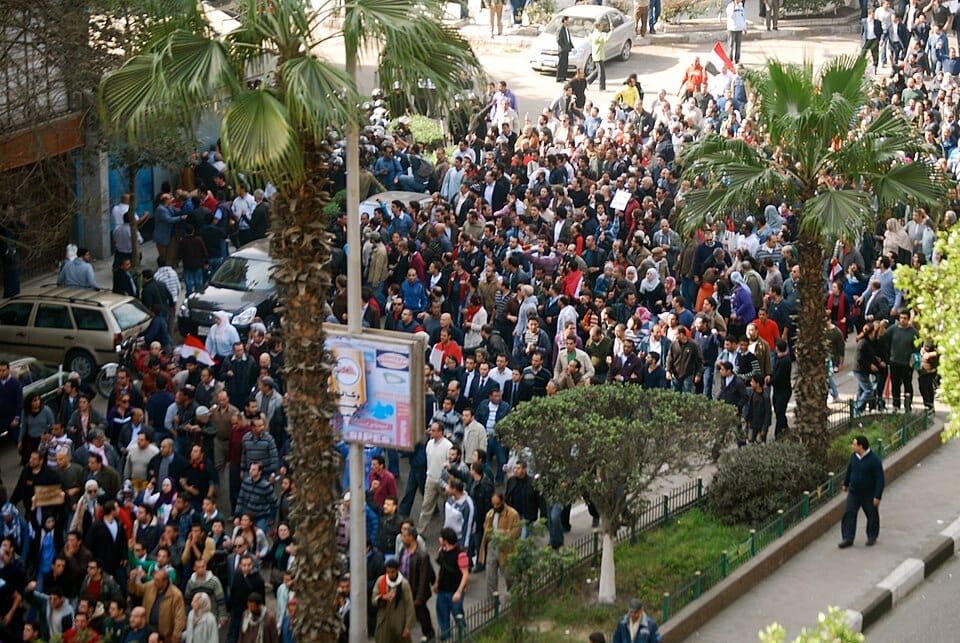
Crowd of protesters in Cairo during the 2011 Egyptian Revolution (7)
Mariam Soliman, CC BY-SA 2.0, via Wikimedia Commons. Source: Crowd of protesters in Cairo during the 2011 Egyptian Revolution (7) at Wikimedia Commons

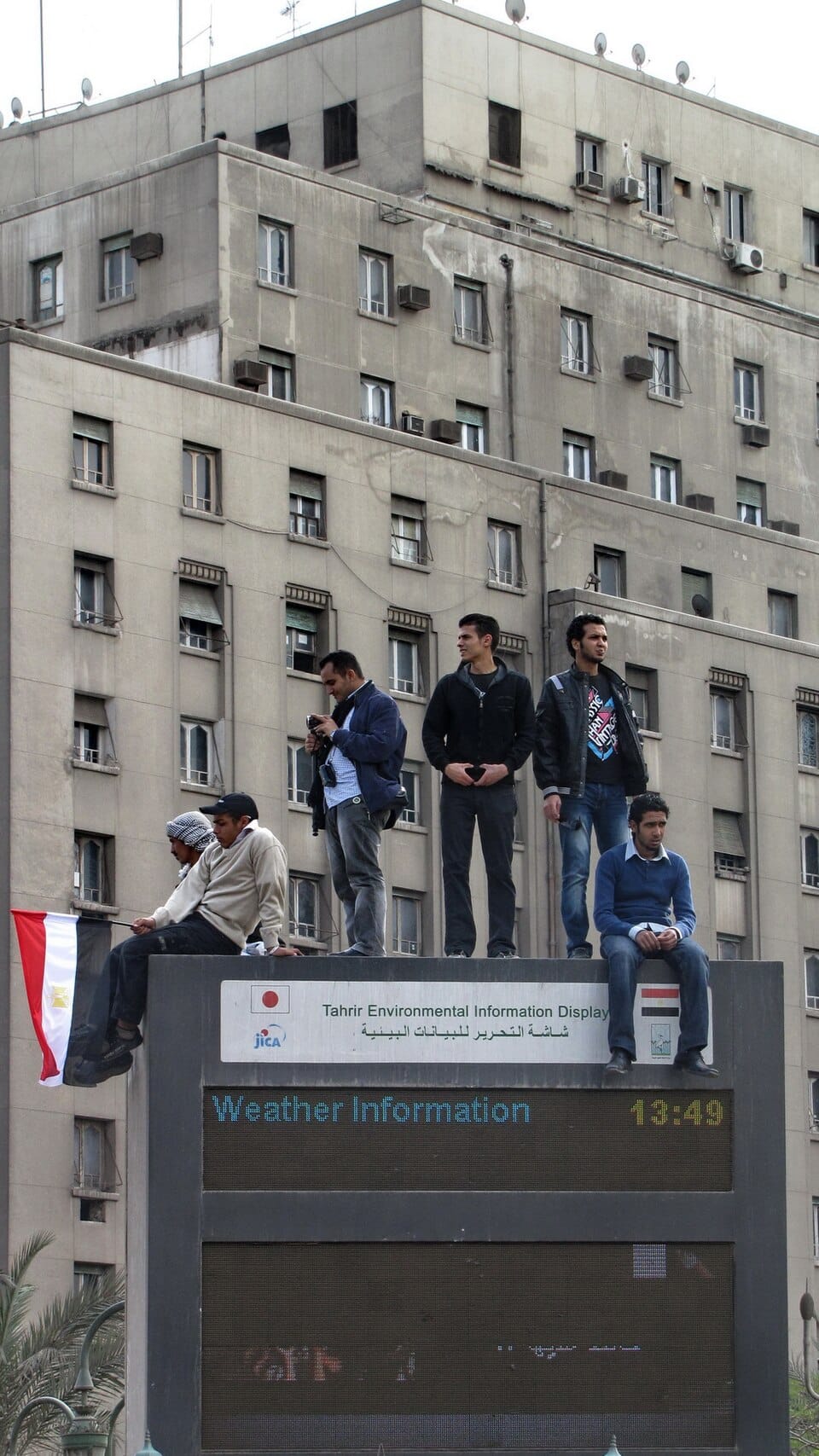
Protesters above Tahrir display
Sherif9282, CC BY-SA 3.0, via Wikimedia Commons. Source: Protesters above Tahrir display at Wikimedia Commons

With other styles
The opposite: Computational smartphone look (deep-focus HDR). Use this look for raw, unprocessed risky capture rather than the clarified, balanced HDR finish of the same hardware.
The opposite: Combat photojournalism. Choose this when the photographer is a participant posting at once to a feed; choose combat photojournalism for accredited, edited, grainy black-and-white wire and magazine work.
Pairs with Diaristic snapshot photography. Borrow its arm's-length, unposed intimacy for the people around you in the square, but keep the crowd and the event in view.
The opposite: Paparazzi photography. Both are candid and risky, but here the subject is a collective cause rather than a person hunted for a picture.
The opposite: South African struggle photography (Afrapix). Another witness practice of protest under oppression, but made largely by press and documentary photographers for newspapers and agencies; choose this look for participants on phones and compacts posting at once to feeds.
The opposite: Everyday Africa. Nearest by trait overlap (candid, as-found, environmental, vernacular), but Everyday Africa is a curated phone series of ordinary life; here the subject is a mass protest event and the maker is a participant at risk.
Sources
- https://en.wikipedia.org/wiki/Egyptian_revolution_of_2011
- https://en.wikipedia.org/wiki/Tunisian_revolution
- https://en.wikipedia.org/wiki/Citizen_journalism
- https://www.mosireen.com/?page_id=2
- https://commons.wikimedia.org/wiki/File:Tahrir_Square_-_February_10,_2011.png
- https://commons.wikimedia.org/wiki/File:Crowd_of_protesters_in_Cairo_during_the_2011_Egyptian_Revolution_(7).jpg