Styles / Fashion & commercial
Automotive rolling-shot photography
- Key: the open sky, all around and above, soft.
Schematic, not to scale: worked out from the style’s choices. No set-up of this style has been rendered yet.
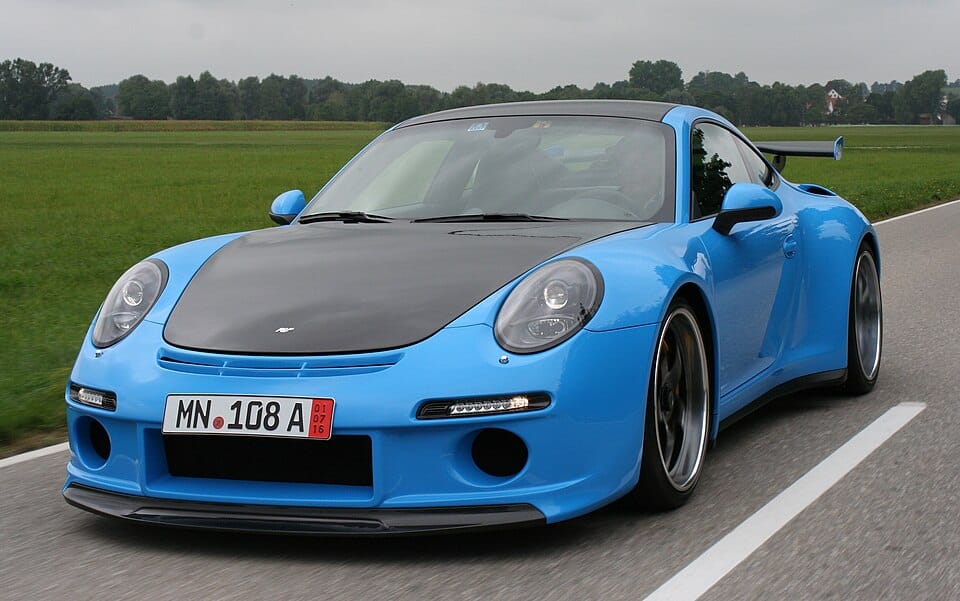
Ruf RTR Widebody Rolling
The Car Spy (Flickr 25632349@N04), Ruf RTR Widebody Rolling, 2015, CC BY 2.0, via Wikimedia Commons. Source: Ruf RTR Widebody Rolling at Wikimedia Commons

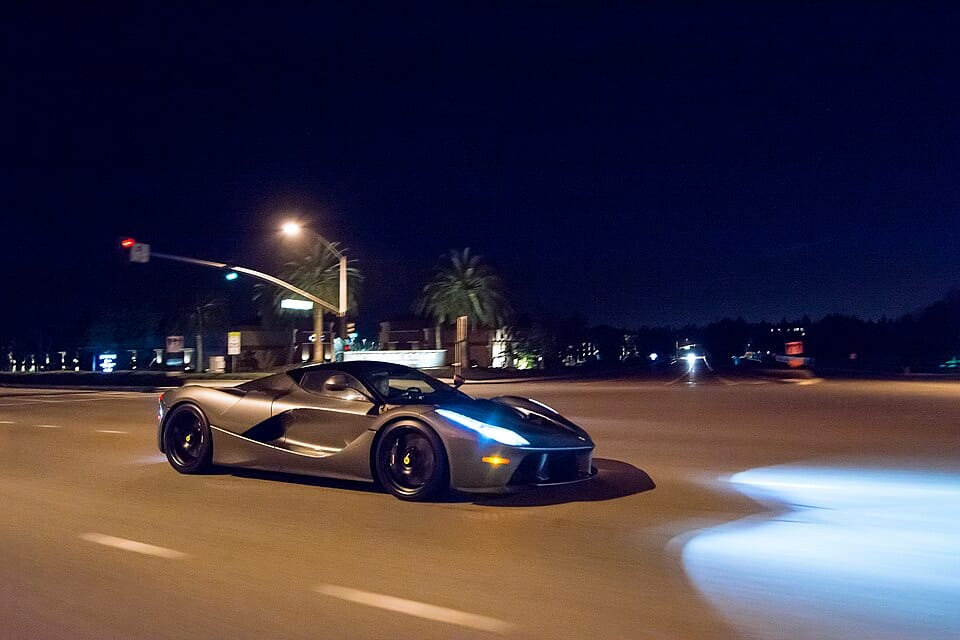
LaFerrari Rolling Shot
Axion23 (Flickr 22526198@N07), LaFerrari Rolling Shot, 2015, CC BY 2.0, via Wikimedia Commons. Source: LaFerrari Rolling Shot at Wikimedia Commons

A car shown at speed yet sharp: the camera travels with it from a second vehicle, or pans with it from the verge, at about 1/15 to 1/60 s, so the road, verge and wheel spokes streak while the body stays crisp. The car is shot low and wide in clean paint, on a chosen road in daylight or at night, its gloss carrying sky and highlights.
Built mostly on one system: Clean packshot. What systems are.
Shoot sheet for your kit A prompt for an image model The photographs
How the look is made
- Pick a smooth, empty road with a clear background, and brief a driver to hold a constant legal speed; for a rolling shot, shoot from a second car on a private road, track or divided highway, belted in and never leaning out.
- Set the shutter speed first, about 1/30 to 1/60 s for a rolling shot at road speed and 1/20 to 1/60 s for a panning shot, and shorten it only if the blur is too strong; shoot bursts, since many frames will blur the car too.
- Keep the car sharp and the ground blurred: pivot from the hips and follow the car through the whole exposure when panning, or match speed and steady the lens when rolling, using continuous autofocus.
- Go low and close with a wide lens (about 28 mm in 35 mm equivalent, or wider) so the car looms and the road streaks toward the camera, or step back with a 70-200 mm zoom from the verge when you want the car compressed against its backdrop.
- Shoot when the light flatters the paint: low sun from the side or behind, or dusk and night with the car's lamps lit; check the reflections in the body and wheels, and use a polariser if the road glare overwhelms the colour.
- Check the frames for sharpness of the body and wheels, and tidy distractions such as signs in post if needed; the sources checked do not document retouching or rig removal, so treat that as optional.
Shoot sheet for your kit
Fill in your camera, lenses and lights, and the sheet says which light plays each part, what to work around and where to start on your camera. Without a kit it starts on a full-frame camera.
Light
Key: the open sky, all around and above, soft.
- Highlights
- Small, bright glints where the light reflects off wet, oily or polished surfaces: glistening food, dewy skin, the sparkle of jewellery or chrome.
How the style is lit
- Low sun from the side or behind in the last hour of daylight, the body's gloss picking up sky and sun glints, expose for the paint and let the road fall darker.
- Overcast or open-shade daylight on a country road, with a circular polariser to cut road and glass glare and keep the colour dense.
- Dusk or night with street lamps and the car's headlamps and tail lamps lit, a high ISO and 1/40 s or so, or an off-camera flash balanced to the ambient light.
This plan is worked out from the style’s choices, so it is drawn as a schematic. One way to get the light, not a record of how any photograph was lit.
Lens and settings
Start at
On a full-frame camera: the same depth of field and exposure as the style’s own numbers, in the same light. Then meter and adjust.
- The style’s f/6.3 on APS-C gives about the depth of field of f/9.6 on full frame.
- Then
- 21–185 mm · f/2.8–f/14 · 1/400–1/15 s · ISO 100–5000 on APS-C, documented. A how-to guide gives 1/30 to 1/60 s for rolling shots at road speed (range 1/8 to 1/250 s; example 1/45 s, ISO 100, 28 mm on a Canon 40D) and says the panning shutter is about 1 divided by the speed in mph; its two panning examples (1/20 s at 100 mm f/2.8 ISO 200, 1/30 s at 115 mm f/2.8 ISO 400, Canon 20D) are given without car speeds, so the rule is not shown applied to them. The guide's focal lengths are for a 1.6x crop-sensor body and are converted to 35 mm equivalents (28 mm becomes about 45 mm, 100 to 115 mm about 160 to 185 mm); the lower bound comes from a 14 mm APS-C lens (about 21 mm) in a specimen. The checked specimens run from 1/15 s (panning, f/5, ISO 400) to 1/40 s (a night rolling shot at f/2.8, ISO 5000) and 1/400 s (an overcast rolling shot at f/14, ISO 400, which blurs only the road mildly); the widest aperture, highest ISO and 1/400 s end of these ranges come from those specimens and are lower-blur or night variants, not the guide's core recipe.
- White balance
- Daylight or auto balance so the paint reads true; let sunset stay warm on the body and the sky cool, and leave street lamps warm at night.
- Focal length
- A wide view; near things loom and lines stretch towards the edges.
- Angle
- Looking up: the subject towers.
- Distance
- Whole figures and their immediate surroundings.
- Crop & fill
- The subject shown small within its setting, which explains it.
- Duration
- Moving things smeared across the frame. The camera follows a moving subject; the background streaks.
Direct
Nobody in the picture.
- Without a pose
- No people at all, or people so small or far off that their pose does not read (hands alone are Hands alone).
Style the set
A clean, polished, well-presented car, often a tuned car or supercar, washed and detailed with wheels straight, moving on a chosen road. Nothing is added to the scene; the road, verge and sky are picked, not built.
- Food & things
- Everything clean, new and flawless: no dust, creases, fingerprints or wear.
Finish
- Digital & other
- A modern digital camera: clean, detailed, neutral.
- Texture
- Smooth tones with no visible grain.
- Shown as
- Each picture stands on its own.
- Shown in
- Pictures made for magazine pages and spreads.
Stay away from soft focus & diffusion, visible grain, faded & matte, soft monochrome, candid & unobserved, real, lived-in place, perfectly imperfect, soft studio light, deliberate stillness, melancholy and testimony & advocacy.
Before you shoot it
Rolling shots are dangerous: shoot only on closed roads, tracks or divided highways with a constant legal speed, seat belts on and nobody leaning out, never while overtaking, and follow local law. Number plates and drivers can identify real owners, so blur or remove plates and faces when publishing images of private cars. Speed and street-racing imagery can glamorise reckless driving; keep it away from public-road stunts.
A prompt for an image model
A ready prompt that describes this look to an image model: where the lights stand, the lens, the framing and the colour. It starts on the style’s own choices; change any of them and the prompt and the notes follow.
The prompt
Notes on this prompt
- How the style uses it: shoot when the light flatters the paint: low sun from the side or behind, or dusk and night with the car's lamps lit; check the reflections in the body and wheels, and use a polariser if the road glare overwhelms the colour. Image models put the light in the wrong place more often than anything else, so the prompt says where each light stands: which side of the picture, and how high. Keep to one light pattern per prompt, or the model splits the difference.
- Blur needs a cause: say what moves, and that the exposure is long enough to smear it.
- Give the camera height in plain words: from knee height looking up, from a stepladder looking down, straight down onto the table.
The model makes a new picture, not a photograph of anything that happened. Label it as AI-generated, and don’t pass it off as the style’s history or as a real person.
Photographs that define it
From open collections, shown whole with their credits. Later photographs are linked, not shown, while they are in copyright.
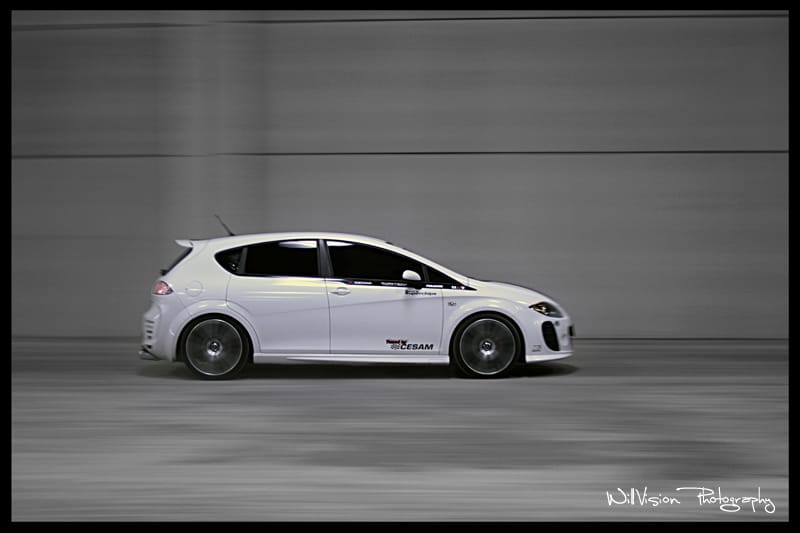
Tuning - Seat Leon by Cesam - Panning shot
WillVision (Flickr 92048075@N00), Tuning - Seat Leon by Cesam - Panning shot, 2009, CC BY 2.0, via Wikimedia Commons. Source: Tuning - Seat Leon by Cesam - Panning shot at Wikimedia Commons

With other styles
The opposite: E-commerce packshot on white. Both sell a clean object, but the packshot freezes it still on white under soft light; here the object is in motion, on location, with blur and hard reflections.
Pairs with Surf-magazine action photography. Both follow a fast subject with a long lens and bursts to keep it sharp against moving surroundings; the overlap is in the chase technique, while here the subject is a machine and the blur is a deliberate slow shutter.
The opposite: Contemporary ICM landscape abstraction. Both blur on purpose, but here the subject stays sharp and recognisable while only the ground moves; do not let the whole frame dissolve.
Pairs with Light painting photography. For night work, keep the long exposure and let lamp trails and lit surfaces glow, but keep the car sharp rather than drawn in light.
Sources
- John Jovic, panning and rolling (tracking) shots guide, Photo Cornucopia: https://www.photocornucopia.com/1042.html (rolling shots 1/30 to 1/60 s with a range 1/8 to 1/250 s, example 1/45 s ISO 100 28 mm on a Canon 40D; panning shutter about 1 divided by speed in mph, 70-200 mm lens, examples 1/20 s 100 mm f/2.8 ISO 200 and 1/30 s 115 mm f/2.8 ISO 400 on a Canon 20D; safety advice; the page does not give the idiom's history)
- Panning (camera), Wikipedia: https://en.wikipedia.org/wiki/Panning_(camera) (panning keeps the subject in the same place in the frame while the background blurs; F1 car 1/250 s, DTM Mercedes 1/80 s, Porsche 996 GT3 RSR 1/125 s as examples)
- Ruf RTR Widebody Rolling, The Car Spy, Wikimedia Commons (CC BY 2.0): https://commons.wikimedia.org/wiki/File:Ruf_RTR_Widebody_Rolling.jpg (EXIF: Canon EOS 350D, 39 mm, f/14, 1/400 s, ISO 400; taken 3 September 2015)
- LaFerrari Rolling Shot, Axion23, Wikimedia Commons (CC BY 2.0): https://commons.wikimedia.org/wiki/File:LaFerrari_Rolling_Shot_(16494006385).jpg (EXIF: Nikon D7100, 14 mm, f/2.8, 1/40 s, ISO 5000; 9 February 2015)
- Tuning - Seat Leon by Cesam - Panning shot, WillVision, Wikimedia Commons (CC BY 2.0): https://commons.wikimedia.org/wiki/File:Tuning_-_Seat_Leon_by_Cesam_-_Panning_shot_-_Flickr_-_WillVision_Photography.jpg (EXIF: Canon EOS 400D, 34 mm, f/5, 1/15 s, ISO 400; 3 March 2009)
- Origin note: no fetched source dates the idiom or names its originators; the c. 2000 start is an approximate, unsourced estimate from the digital-era guide and specimens, and no parent or influence is claimed.