Styles / Pictorialist
Contemporary ICM landscape abstraction
- Key: the open sky, all around and above, soft.
Schematic, not to scale: worked out from the style’s choices. No set-up of this style has been rendered yet.
The photographs that define it are still in copyright, so they are linked below rather than shown.
Move the camera during a slow exposure to turn woodland, water and low hills into streaks, veils and overlapping colour fields. A trunk, ridge or horizon may remain legible, but texture and geographic description give way to gesture. Contemporary digital practice includes soft monochrome, quiet earth tones and saturated water abstractions; optional in-camera double exposures add another layer. The blur begins in capture, not with a soft-focus lens or a software blur filter.
Built mostly on one system: Graphic abstraction. What systems are.
Shoot sheet for your kit A prompt for an image model The photographs
How the look is made
- Choose a real patch of woodland, water or land for its broad shapes and colour relationships rather than its landmark status; leave people out.
- Move the camera deliberately while the shutter is open: sweep with trunks or a shoreline, or change direction to build new slopes and gestures from an ordinary scene.
- Vary pauses within the exposure so that some forms register more firmly than others; permit a few legible, receding landform layers while suppressing fine texture, and edit repeated attempts for a clear rhythm rather than keeping indiscriminate blur.
- Keep bright sky from dominating the exposure: work in subdued daylight, exclude it from the crop, or look down into water and reflections.
- Build the abstraction in capture, then adjust colour, contrast and local tone to suit the series; disclose additional exposures rather than calling every layered image a single capture.
Shoot sheet for your kit
Fill in your camera, lenses and lights, and the sheet says which light plays each part, what to work around and where to start on your camera. Without a kit it starts on a full-frame camera.
Light
Key: the open sky, all around and above, soft.
- Highlights
- Even the brightest parts (clouds, white cloth, snow) keep texture and detail.
How the style is lit
- Use subdued outdoor daylight under cloud or late in the day over an existing woodland or low hillside; keep the sky-to-land contrast modest while the moving camera redistributes the scene's light.
- Look down into a pond or swamp in available daylight, excluding bright sky; let cool reflected sky contrast with warmer leaves and debris, without adding coloured lamps.
This plan is worked out from the style’s choices, so it is drawn as a schematic. One way to get the light, not a record of how any photograph was lit.
Lens and settings
Start at
On a full-frame camera: the same depth of field and exposure as the style’s own numbers, in the same light. Then meter and adjust.
- 1 s: on a tripod.
- Then
- 35–70 mm · f/8–f/16 · 1/4–5 s · ISO 100–200 on full frame, inferred from the gear and the look. Documented landscape methods span about 0.25 s for a quick woodland sweep to 0.5–5 s for longer gestures; focal length, full-frame format, aperture and ISO remain inferred starting choices, not specimen metadata. Motion amplitude and pauses matter more than optical softness; no existing specimen's individual exposure was confirmed.
- White balance
- For the colour variant, start with a consistent daylight balance, then adjust deliberately in RAW for the series; neither neutral colour nor one warm or cool cast defines the style.
- Angle
- The camera at the height of a standing person or of the subject.
- Distance
- Whole figures and their immediate surroundings.
- Balance
- Tilted lines and oblique movement drive the picture.
- Crop & fill
- Detail runs to every edge with no single centre.
- Depth
- Depth collapsed into pattern and flat shapes. A strong horizon splits the frame into bands.
- Duration
- Moving things smeared across the frame. Seconds or more: water turns to mist, lights become trails.
Direct
Nobody in the picture.
- Without a pose
- No people at all, or people so small or far off that their pose does not read (hands alone are Hands alone).
Style the set
Leave land, vegetation and debris as found. Select the viewpoint and crop instead of moving natural materials or building a set; palette comes from the scene and disclosed colour work, not dressed props.
- How much is styled
- Nothing dressed, made up, moved or added for the picture.
Finish
- Colour
- The colour of ordinary things treated as the point of the picture. Colour held back towards grey.
- Digital & other
- A modern digital camera: clean, detailed, neutral.
- Texture
- Smooth tones with no visible grain.
- Shown as
- Pictures made and shown as a set. Each picture stands on its own.
Stay away from frozen instant, panning, hyper-detailed, soft focus & diffusion, gum & pigment processes, objective & scientific and direct on-camera flash.
Before you shoot it
This is a shared capture approach, not permission to copy a living photographer's compositions, series or colour treatment. Credit the named makers and obtain permission before reproducing their protected photographs; the specimens remain link-only. This entry excludes the people and market photographs that appear alongside landscape work in some ICM teaching sources. Respect land access and ecological restrictions and leave natural materials undisturbed.
A prompt for an image model
A ready prompt that describes this look to an image model: where the lights stand, the lens, the framing and the colour. It starts on the style’s own choices; change any of them and the prompt and the notes follow.
The prompt
Notes on this prompt
- Image models put the light in the wrong place more often than anything else, so the prompt says where each light stands: which side of the picture, and how high. Keep to one light pattern per prompt, or the model splits the difference.
- Blur needs a cause: say what moves, and that the exposure is long enough to smear it.
The model makes a new picture, not a photograph of anything that happened. Label it as AI-generated, and don’t pass it off as the style’s history or as a real person.
Where to see it
From open collections, shown whole with their credits. Later photographs are linked, not shown, while they are in copyright.
In copyright, so linked
- When all the world is green I — Image 1 , Christopher J Osborne, published 28 November 2022; capture date not confirmed. Christopher J Osborne, artist's website.
- Mountains from Molehills 01 , Chris Dale, published 11 July 2017; capture date not confirmed. Chris Dale Photography, artist's website.
- Untitled water abstraction (Question-2-2 illustration in the ICM case-study interview) , Janet Powick, published 10 January 2023; capture date not confirmed. Pics of Asia, interview with Janet Powick.
Made by an AI model
An image gpt-image-2 made from this style’s choices, then checked against them by a vision model. Not a photograph, and not part of the style’s history. All generated images
-
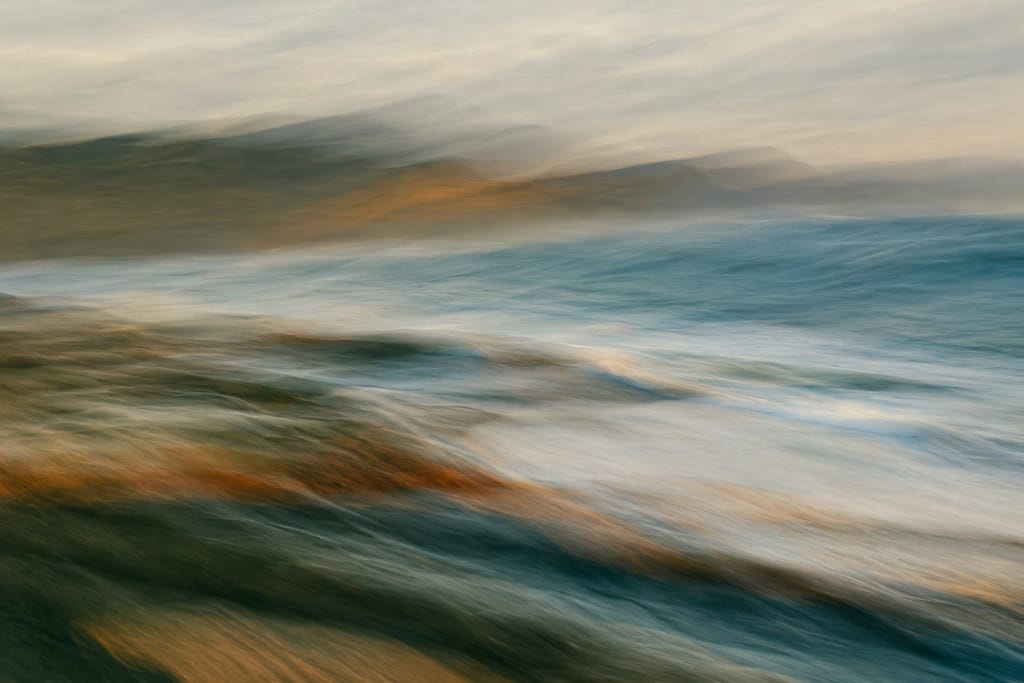
A blurred coastal landscape shows blue sea and white surf washing over dark rocks with ochre patches. Low hills stretch beneath a pale cloudy sky, with diagonal streaks giving the scene a painterly appearance. What the check saw. Sweeping blur and restrained blue, green and ochre tones turn the coastal scene into a lyrical study of movement and colour.
With other styles
The opposite: Pictorialism. Keep atmosphere and simplified masses, but make the softness with camera motion rather than a diffused lens or hand-worked pigment print.
Pairs with Subjektive Fotografie. Share its willingness to turn a scene into graphic form, but choose daylight land and colour fields rather than treating negative printing and hard monochrome as requirements.
The opposite: Milky Way nightscape photography. Use duration to dissolve the whole terrestrial scene instead of stabilising a wide view to preserve pinpoint stars above a legible foreground.
The opposite: New Topographics. An ordinary nearby landscape can supply either approach: choose expressive camera movement instead of level, sharp, descriptive neutrality.
Sources
- Gary Holpin, Simplicity in landscape photography: simplicity using silhouettes & Intentional Camera Motion: https://www.garyholpin.co.uk/post/simplicity-using-silhouettes-and-icm (first-person landscape method: a 1/4–1/2-second starting range, upward woodland sweep and ND filtration when needed; demonstrates that whole-second exposures and subdued light are not universal requirements).
- Kay Hathway, first-person author biography, On Landscape: https://www.onlandscape.co.uk/author/kayhathway/ (Sydney-based photographer describing Australian landscape work, intentional camera movement, multiple exposures and a preference for softer monochrome and black-and-white work; supports an occasional monochrome variant, not metadata for an unexamined specimen).
- ICM Photography Magazine, June 2020 inaugural issue: https://www.icmphotomag.com/icmphotomag-june-2020 (publisher's issue page and founder navigation; establishes the community milestone, not an invention date).
- Janet Powick, first-person interview in Pics of Asia, ICM Intentional camera movement case study - Part 2, published 10 January 2023: https://www.picsofasia.com/photography-blog/icm-intentional-camera-movement-case-study-part-2 (HTML datePublished checked; Australian water studies, filters and colour experimentation; all photographs explicitly her property).
- Christopher J Osborne, When all the world is green I, published 28 November 2022: https://www.cjo.info/galleries/when-all-the-world-is-green/i/ (author identifies Edinburgh woodland, intentional camera movement plus double exposure, 0.5–5 s and ND filters; image 1 downloaded and viewed).
- Chris Dale, Mountains from Molehills, published 11 July 2017: https://chrismdale.co.uk/mountains-from-molehills/ (WordPress record https://chrismdale.co.uk/wp-json/wp/v2/posts/480 confirms publication date; first-person account of local single-exposure ICM and post-production; finished image 01 downloaded and viewed).
- Chris Dale, project gallery: https://chrismdale.co.uk/mountains/ (Nottinghamshire subject matter, single exposures and explicit copyright notice).
- Taxonomic qualifications: branch pictorialist denotes a formal family resemblance, not documented historical affiliation. No fixed trait exactly covers moving a camera across a stationary landscape: time.motion-blur is the nearest visible descriptor; time.panning is avoided because its definition requires following a moving subject. optics.normal is only an occasional practical choice, not the cause of blur. staging.candid is used weakly for an unarranged encounter with an existing scene; the vocabulary defines it around people, and styling.as-found carries the firmer evidence. No lamp layout, f-number, focal length, ISO or optical defocus can be inferred from a smear alone. Publication years are explicitly distinguished from unconfirmed capture dates in the specimens.