Styles / Pictorialist
Bhedwar-era Indian studio tableau pictorialism
- Key: a window, from the camera’s left, at the side, soft.
Schematic, not to scale: worked out from the style’s choices. No set-up of this style has been rendered yet.
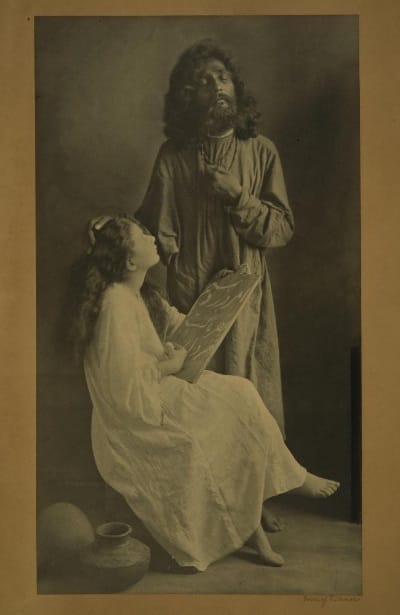
Force of Silence
Shapoor N. Bhedwar, Force of Silence, 1891. Asian Art Museum, San Francisco; Public Domain Mark via Wikimedia Commons. Source: Force of Silence at Asian Art Museum, San Francisco (Collection of William K. Ehrenfeld, M.D., 2005.64.144)

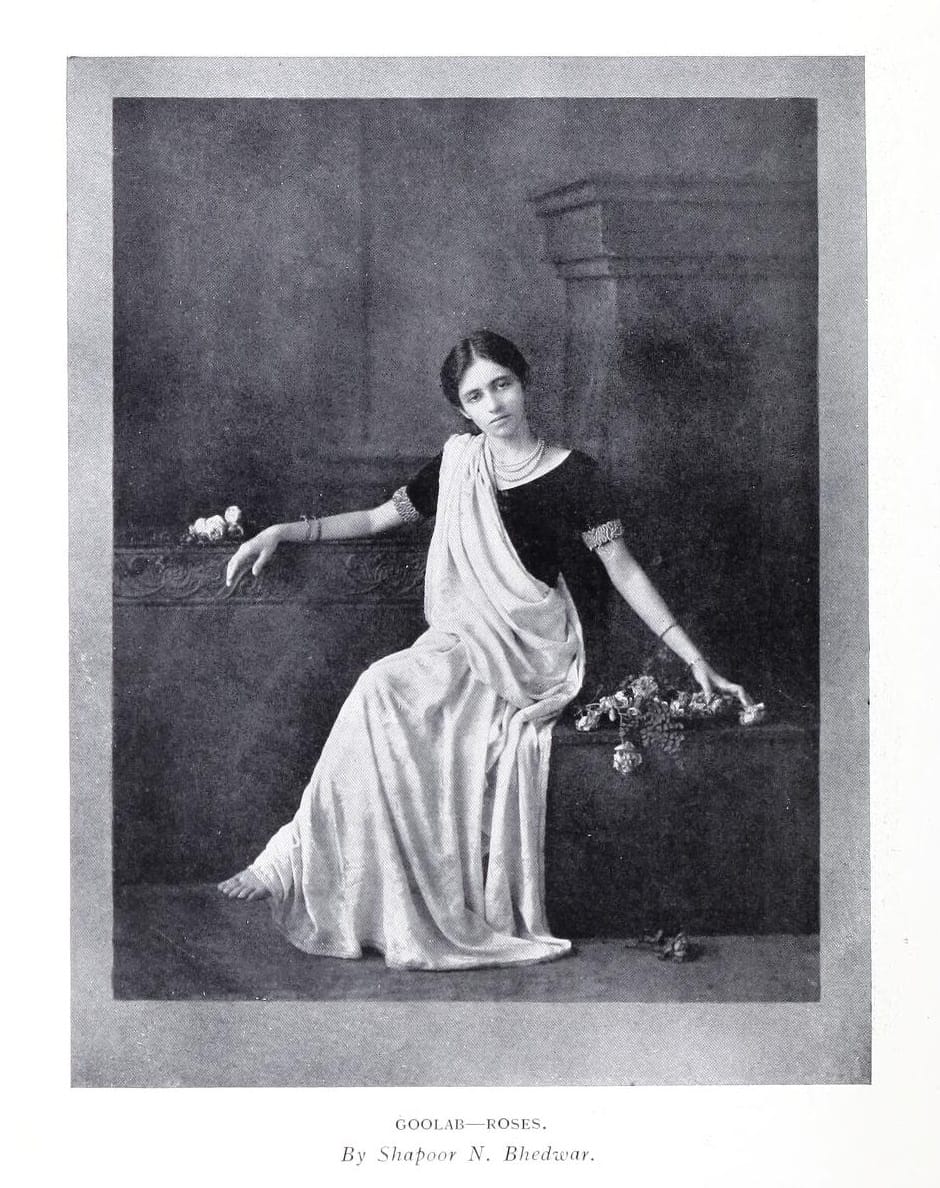
Goolab - Roses
Shapoor N. Bhedwar, Goolab - Roses, c. 1904, plate in Photograms of the Year 1904; public domain via Wikimedia Commons. Source: Goolab - Roses at Photograms of the Year 1904 (Internet Archive scan)
Staged studio pictorialism from Bhedwar's Bombay: sitters in saris, shawls and headdresses posed against draped or dark backdrops, lit softly from one side and printed in warm, soft-edged monochrome as single exhibition prints with a lyrical, literary or religious title, in a wide border. The later club salons (1930s-60s) are not documented here by specimens.
Built mostly on one system: Pictorial print. What systems are.
Shoot sheet for your kit A prompt for an image model The photographs Its portrait light in the lab
How the look is made
- Direct your sitters like a painter's models: choose a story, poem or sacred theme, dress them in saris, shawls, garlands or headdresses, and hold them still in one gesture.
- Build the set in the studio: drape a dark cloth or a plain wall behind them and add a few chosen props such as a water jar, roses or a carved ledge, so the background recedes into shadow.
- Light from one soft side, in window or daylight-studio light, and let the face and drapery model out of a dark ground; keep edges gentle and the shadows deep but not empty.
- Direct the gaze: lift the eyes to another figure, or turn the head slightly off the lens into an absorbed look, and keep hands graceful and slow; lowered eyes are only a possible later-club option.
- Print for the salon wall: tone the print warm, keep it soft and low in contrast, mount it with a wide border, and give the single picture a poetic title and a signature.
Shoot sheet for your kit
Fill in your camera, lenses and lights, and the sheet says which light plays each part, what to work around and where to start on your camera. Without a kit it starts on a full-frame camera.
Light
Key: a window, from the camera’s left, at the side, soft.
- Shadow edges
- Shadows that fade gradually from light to dark, cast by a large or diffused light: a window, a softbox, a cloudy sky.
- Shadow depth
- Dark shadows that still hold some detail (a high lighting ratio, about 4:1 to 8:1: the shadow side two to three stops darker).
- Shape & form
- Light turning gradually into shade across faces and objects, so their volume shows.
How the style is lit
- Daylight studio or a single window, soft, from one side and slightly above, with the background left in shadow.
- The same light bounced from a white cloth or board on the shadow side, just enough to keep drapery and faces open.
- For a night or religious scene, a single low lamp-like source with the rest of the set printed down dark.
This plan is worked out from the style’s choices, so it is drawn as a schematic. One way to get the light, not a record of how any photograph was lit.
Lens and settings
Start at
On a full-frame camera: the same depth of field and exposure as the style’s own numbers, in the same light. Then meter and adjust.
- The style’s f/13 on Whole plate gives about the depth of field of f/2.1 on full frame.
- Then
- 45–75 mm · f/8–f/22 · 1/4–4 s · ISO 6–100 on Whole plate, inferred from the gear and the look. No exposures are recorded for the specimens and Bhedwar's camera is not documented. The numbers are inferred from a still sitter in daylight-studio light on slow plate or paper, with f-numbers for a whole-plate (6.5 x 8.5 in) camera; roll-film and enlarger work of the 1930s onward would use faster film and shorter times.
- Focal length
- Roughly the eye’s own perspective; no visible distortion.
- Focus
- A soft glow around highlights; edges never quite sharp.
- Angle
- The camera at the height of a standing person or of the subject.
- Distance
- Whole figures and their immediate surroundings.
- Balance
- The subject in the middle, the frame balanced around it.
- Duration
- An unmoving scene, exposed slowly and carefully.
Direct
Pose one to three sitters as a tableau: seated loosely on a ledge or low step, the body turned three-quarter, gaze lifted to another figure or turned slightly off the lens, hands slow and graceful, a flower or garland held; keep still for the long exposure and let the gesture tell the story.
- Body position
- Slouched, sprawled, cross-legged or perched on a step, an armrest or the floor.
- Turn to the camera
- The body, the head or both turned about 45° from the lens, so one side is nearer the camera and the far ear is hidden.
- Head & gaze
- Attention on what the hands are doing or on a thing (working, reading, eating, playing), not on the camera. Face and eyes raised towards the light or the sky: hope, devotion, longing.
- Arms & hands
- Fingers placed on purpose: relaxed and separated, shown edge-on, wrists softly bent, as in ballet, fashion and glamour.
- Line & energy
- Rigid and motionless, sometimes braced against a head rest or gripping a chair: held for a long exposure or a solemn occasion.
- The set-up
- A scene staged and directed like a film still or a painting. Sets, models and miniatures built to be photographed.
Style the set
Dress sitters in saris, shawls, veils, jewellery and headdresses chosen for the story, with no visible make-up; set roses, water jars, leopard skins, carved stone or hanging lamps against a draped or darkened backdrop, arranged like a painting.
- Clothes
- The wearers’ own festive, religious or wedding clothes: saris and lehengas, boubous, robes, kimono. Period dress, fancy dress, stage costume or someone else’s clothes, worn to play a part rather than as one’s own.
- Set & props
- A painted, cloth, paper or seamless backdrop behind the subject. Props chosen and placed for colour, texture and story: linen, ceramics, cutlery, flowers, scattered ingredients.
- How much is styled
- Clothes, hair, make-up, props and set all chosen and placed by a team to one idea.
Finish
- Monochrome
- A monochrome image tinted sepia, brown, selenium purple or cyanotype blue. Low contrast and gentle greys.
- Colour
- An overall yellow, orange or red cast.
- Texture
- The film edge, rebate or frame left in the picture.
- Shown as
- Each picture stands on its own.
- Shown in
- Large prints on the wall, like paintings.
Stay away from straight print, direct on-camera flash, saturated colour, hyper-detailed, candid & unobserved, testimony & advocacy, snapshot and tilted angle.
Before you shoot it
The sitters are real people, mostly unnamed, probably family or hired models, and the tableaux are staged in Orientalist and religious costume for a colonial-era international salon audience; The Feast of Roses series draws on Thomas Moore's Lalla Rookh, an Orientalist source text. Do not dress people in Indian, Parsi or Zoroastrian clothes as decoration, and treat religious subjects (Bhedwar's Zoroastrian series shows a naver ceremony, a sacred rite not to be reproduced as a style example) as sacred, not as props. Do not use the soft, warm look to prettify poverty or to present staged people as a record of village or street life.
A prompt for an image model
No prompt for this style
Behind its pictures: Zoroastrian and other religious subjects are sacred and dress is not costume.
Its caution asks to commission living photographers instead of imitating.
Do not use the soft, warm look to prettify poverty or to present staged people as a record of village or street life.
Work with photographers of this tradition, or take only its light and lens (the shoot sheet above) without its people, places or rituals.
Photographs that define it
From open collections, shown whole with their credits. Later photographs are linked, not shown, while they are in copyright.
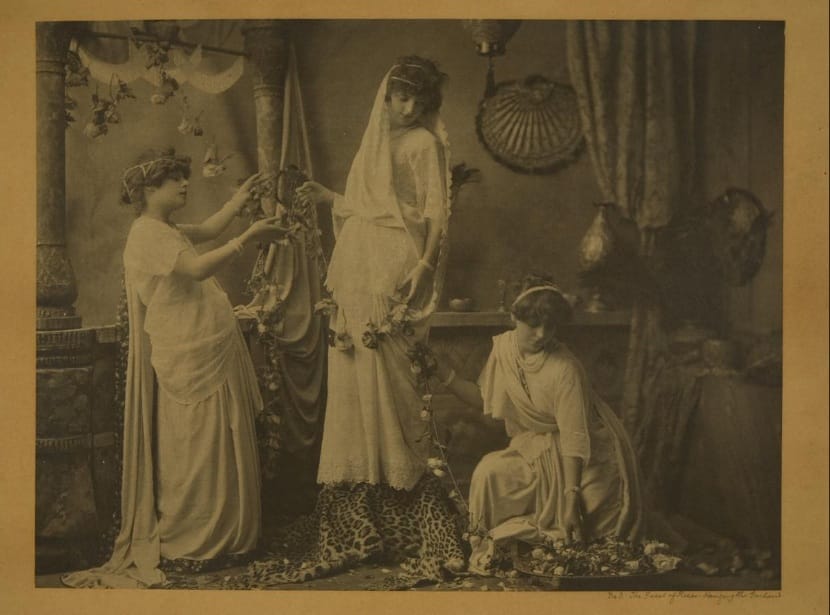
The Feast of Roses: Hanging the Garland
Shapoor N. Bhedwar, Hanging the Garland (The Feast of Roses), 1891. Asian Art Museum, San Francisco; Public Domain Mark via Wikimedia Commons. Source: The Feast of Roses: Hanging the Garland at Asian Art Museum, San Francisco (Collection of William K. Ehrenfeld, M.D., 2005.64.143)

With other styles
Pairs with Pictorialism. Keep the parent's soft, toned, hand-finished salon print, but change the cast: Indian dress, a literary or sacred title and a posed studio tableau instead of misty landscape.
Pairs with Victorian combination printing. Both stage allegorical scenes with costumed models; Bhedwar trained under Ralph W. Robinson, whose father combination-printed, but each Bhedwar picture is a single exposure with a soft platinum finish.
The opposite: Chinese salon photography. The Chinese salon built landscapes with empty paper and backlit haze; here the figure fills a dark, draped studio set and is lit from the side, so choose by whether the brief wants air or a staged figure.
The opposite: Straight photography. Straight photography forbids the posing, props and soft finish; print one sitter both ways to decide whether the picture should be found or composed.
Sources
- Photographic Society of India, About PSI: https://photographicsocietyofindia.com/about-psi/ (started in 1937 in Bombay by three friends to promote photography as an art form; salons and competitions)
- Alkazi Foundation, Camera in the Tropics: https://alkazifoundation.org/photography-and-the-magazine-in-india-4/ (Photographic Society of Bombay 1854, Bombay Amateur Photographic Society 1886, Camera Pictorialists of Bombay 1932 with frequent salons, Photographic Society of India 1937 and its magazine Click in the 1950s; J. N. Unwalla; Club of Gujarat Pictorialists founded 1938 by Ravishankar Raval, Niharika named for an exhibition; Camera in the Tropics from January 1940; covers of a woman with lowered gaze, head draped, in subtle greys)
- Photo-web, Shapoor Bhedwar: https://www.photo-web.com.au/shapoorbhedwar/about/index.html (1858-1916; Parsi, Bombay; London from 1889 under Ralph W. Robinson; staged tableaux; platinum printing; The Feast of Roses; Force of Silence 1891; Zoroastrian Series; works in the National Gallery of Australia and the Asian Art Museum)
- Rath India, Images Recast: Pictorialism and Beyond: https://www.rathindia.org/2020/08/19/images-recast-pictorialism-and-beyond/ (Bhedwar as Parsi cricketer, inventor and pictorialist who set religious motifs against the secular)
- Asian Art Museum, Force of Silence, 1891, 2005.64.144, via Wikimedia Commons: https://commons.wikimedia.org/wiki/File:Force_of_Silence_by_Shapoor_N._Bhedwar.jpg (Public Domain Mark)
- Sam Tata, Wikipedia: https://en.wikipedia.org/wiki/Sam_Tata (a 1947 Bombay show arranged with help from Jehangir N. Unwalla)