Styles / Staged & conceptual
Botanical radiographic still life
- Key: a softbox, about 25° to the camera’s left, high, soft.
- Fill: a softbox, about 25° to the camera’s right, high, soft.
Key high: about 30–45° above eye level, angled down. Shadowless: big sources close in on both sides (or a light tent, or a white cove) so nothing casts a shadow.
Schematic, not to scale: worked out from the style’s choices. No set-up of this style has been rendered yet.
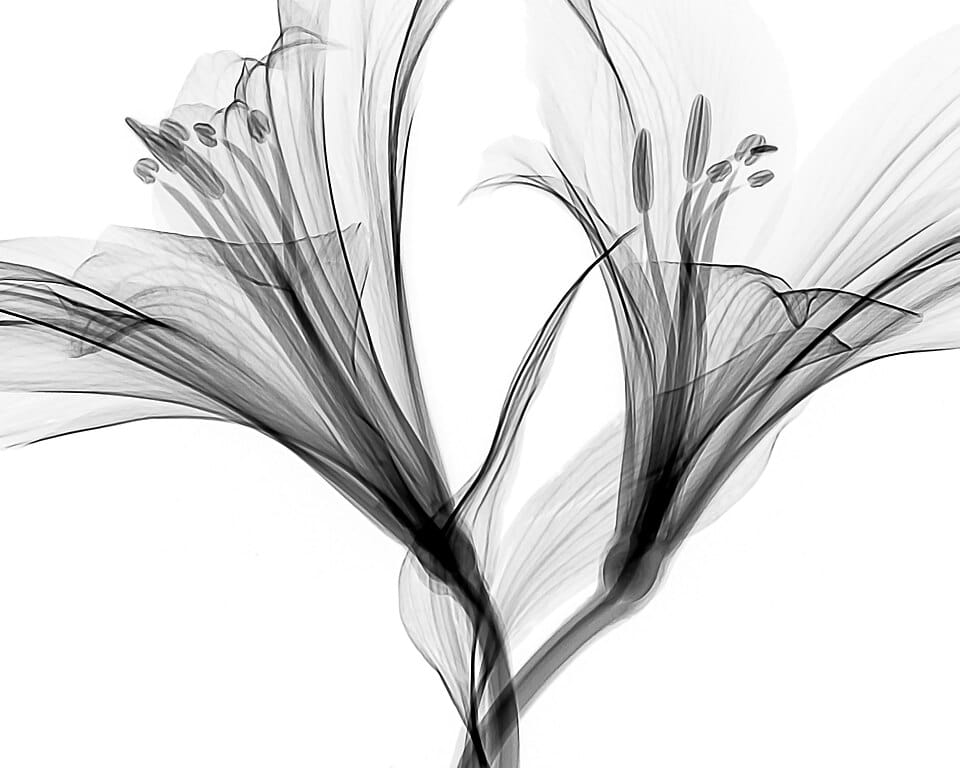
Twin flower Xray (macro X-ray of a flower)
Cadop, Twin flower Xray, 2019, CC0, via Wikimedia Commons. Source: Twin flower Xray (macro X-ray of a flower) at Wikimedia Commons

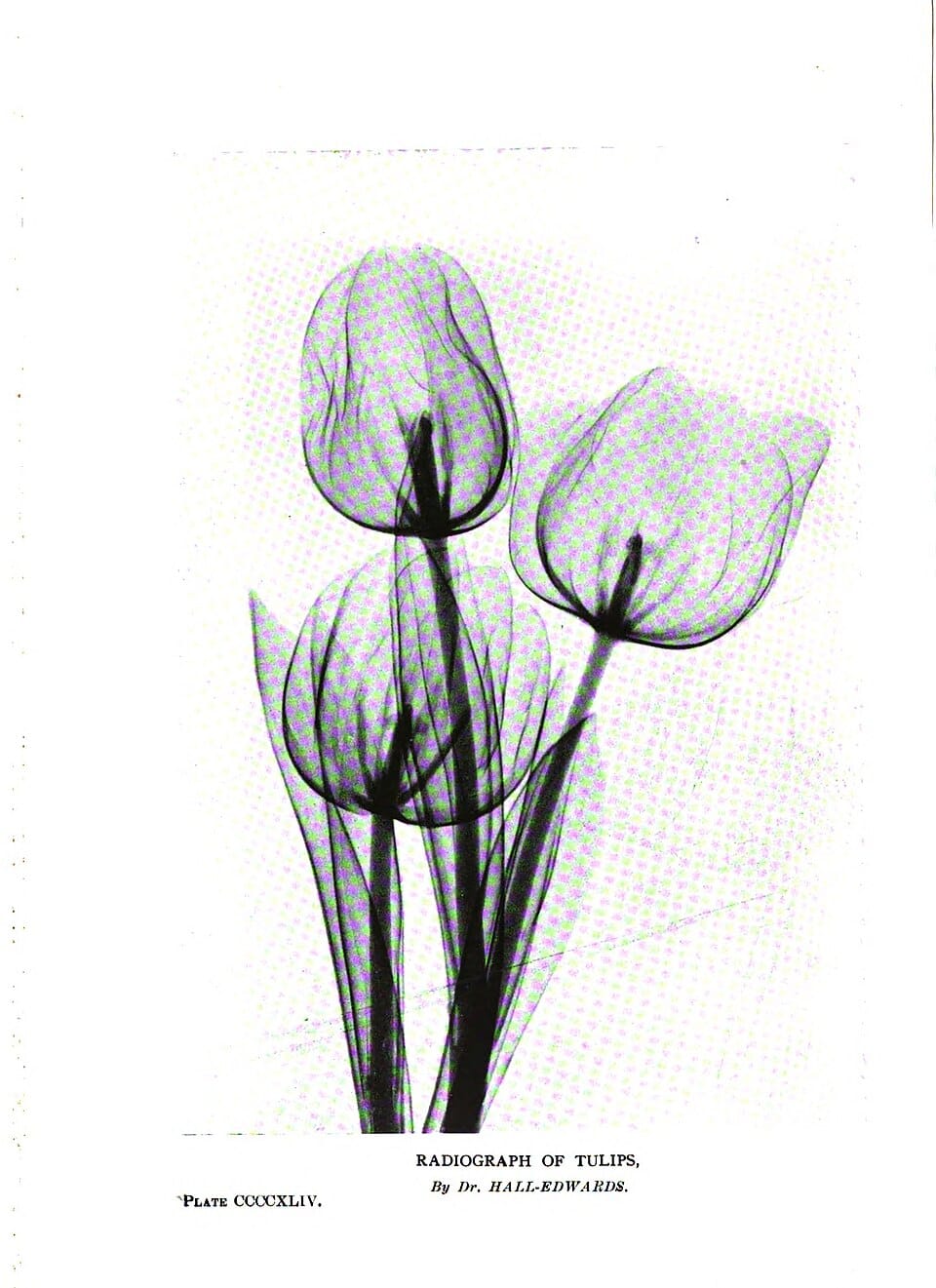
Radiograph of Tulips
Dr. John Francis Hall-Edwards, Radiograph of Tulips, plate CCCCXLIV, Archives of the Roentgen Ray, 1915; public domain via Wikimedia Commons. Source: Radiograph of Tulips at Wikimedia Commons

Cut flowers laid on X-ray film and exposed to radiation in a qualified facility, so the picture shows what passes through the bloom rather than its coloured surface. Petals become veils of grey, stamens and stems dense dark lines, and everything is equally sharp and shadowless on a clean pale or dark ground. Usually a single stem or a small bunch, centred, shown as a framed print.
Built mostly on one system: Cameraless still life. What systems are.
Shoot sheet for your kit A prompt for an image model The photographs
How the look is made
- Choose flowers and buds whose structure rewards transmission: thin petals over dense stems, stamens and seed heads, with some overlap but no mass that blocks the beam.
- Lay each stem flat on the film plane and separate the parts by hand so every petal and stamen reads; do not photograph the plant from above with a lens.
- Fill the frame with one stem or one tight cluster, centred, with a clean empty ground around it; let the white or black field carry no room, table or horizon.
- Expose so petals stay as pale translucent layers and the stems and ovaries as dark, with no clipped petals; check the first plate and repeat the arrangement rather than fixing it later.
- Keep the finish plain and exact: no retouched petals, no added shadows. If you tone, tint or hand-colour a print, say so and keep the colour pale and sparing.
- Produce and view the work only through a radiology department, a lab or a licensed X-ray facility with trained staff; never improvise ionising radiation.
Shoot sheet for your kit
Fill in your camera, lenses and lights, and the sheet says which light plays each part, what to work around and where to start on your camera. Without a kit it starts on a full-frame camera.
Light
Key: a softbox, about 25° to the camera’s left, high, soft.
Fill: a softbox, about 25° to the camera’s right, high, soft.
- Key high: about 30–45° above eye level, angled down.
- Shadowless: big sources close in on both sides (or a light tent, or a white cove) so nothing casts a shadow.
- Shadow edges
- Light from all around, so almost no shadows form even under the chin or behind objects: a white cove, a light tent, a large ring light, fog over snow.
- Shadow depth
- Shadows kept light and full of detail by a reflector, a fill light, bounce or bright surroundings (a low lighting ratio, up to about 3:1: the shadow side at most a stop and a half darker).
- Shape & form
- Light from the camera’s own position (an on-camera flash, a ring light, a frontal softbox) fills every hollow, so faces and objects look flat, with little shape.
How the style is lit
- No visible light: a collimated X-ray source above the flat stem and the film beneath, run by a trained operator in a shielded room, so the picture is a transmission record with no cast shadow.
- For a lit presentation, a plain white or black wall behind a framed print with even gallery light and no glare.
This plan is worked out from the style’s choices, so it is drawn as a schematic. One way to get the light, not a record of how any photograph was lit.
Lens and settings
Start at
On a full-frame camera: the same depth of field and exposure as the style’s own numbers, in the same light. Then meter and adjust.
- The style’s f/8 on 8 × 10 in gives about the depth of field of f/1.1 on full frame.
- Your lens opens to f/1.4; for the style’s shallow focus get closer, use your longest focal length and keep the background far away.
- 1/8 s: on a tripod.
- Then
- 0.5–30 s on 8 × 10 in, inferred from the gear and the look. No source states exposure or film size for flower radiographs, so both are inferred: 8 × 10 in is a sheet-film stand-in for large X-ray film, and the range is a placeholder for a few seconds of low-energy X-rays on thin petals, longer for thick stems or overexposed plates (Turvey names overexposure and multiple exposure as methods). There is no camera, lens, aperture or ISO, so depth of field does not apply; set exposure in a licensed facility from test plates. Process.cameraless is used here for film exposed without a camera, though the vocabulary description names photograms and chemigrams (a note for the vocabulary owner).
- Crop & fill
- A small subject in a large empty field.
- Depth
- Depth collapsed into pattern and flat shapes.
- Duration
- An unmoving scene, exposed slowly and carefully.
Direct
Nobody in the picture.
- Without a pose
- No people at all, or people so small or far off that their pose does not read (hands alone are Hands alone).
- The set-up
- A scene staged and directed like a film still or a painting.
Style the set
Flowers are cut fresh, trimmed and laid out singly or in a short bunch with deliberate overlaps and gaps. Nothing else is placed on the film; the white or black ground stays empty. Buds, open heads and a few leaves give variety of density.
- Food & things
- Objects set in rows, grids or neat patterns, squared up and evenly spaced (knolling).
- Look of the styling
- Few, simple elements on clean surfaces, with space around them.
Finish
- Monochrome
- Rich blacks, clean whites and every grey between.
- Digital & other
- Photograms and chemigrams: images made on light-sensitive material without a camera.
- Texture
- Smooth tones with no visible grain.
- Post-production
- Nothing changed beyond exposure and development.
Stay away from shallow depth of field, golden hour, cast shadows as shapes, direct on-camera flash, visible grain, tilted angle and composite & montage.
Before you shoot it
Never attempt to make X-rays yourself: ionising radiation is hazardous, and flower radiography belongs in a licensed facility with trained staff and shielding. Source plants lawfully and prefer cultivated flowers. The specimen set is limited to a 2019 CC0 amateur image and a 1915 precursor plate; no Richards or Turvey work is licensed here, so gallery-scale, photobook, series and hand-coloured weights are low and rest on their published practice, not on a specimen.
A prompt for an image model
No prompt for this style
Behind its pictures: caution asks to license and credit a living artist and an estate rather than generate a substitute for their recognisable work.
Credit them, license their work rather than generating a substitute for a recognisable print, and do not present a generated image as a real radiograph or scientific evidence. Never attempt to make X-rays yourself: ionising radiation is hazardous, and flower radiography belongs in a licensed facility with trained staff and shielding. Source plants lawfully and prefer cultivated flowers. The specimen set is limited to a 2019 CC0 amateur image and a 1915 precursor plate.
Work with photographers of this tradition, or take only its light and lens (the shoot sheet above) without its people, places or rituals.
Where to see it
From open collections, shown whole with their credits. Later photographs are linked, not shown, while they are in copyright.
With other styles
The opposite: Botanical cyanotype photograms. Both set a plant flat on a plane without a lens, but a cyanotype is a blue contact silhouette of the outside in sunlight whereas a radiograph shows interior structure through the petals in grey.
The opposite: Natural-object scanography. Both are lensless flower arrangements on a plane, but a scanner records reflected surface colour with fading depth and a radiograph records transmission, so petals stay see-through and equally sharp.
The opposite: UV-induced visible-fluorescence botanicals. Both reveal what the eye cannot see in a flower, but UV fluorescence is a lit camera picture of glowing surfaces in the dark and a radiograph is a cameraless picture of internal density.
The opposite: Chemigram abstraction. Both are cameraless and lensless, but a chemigram is painted chemistry on the surface of light-sensitive paper in colour and gesture, whereas a radiograph is a grey transmission record of a real flower's interior.
Sources
- https://flowerxrays.com/bio — Richards born 1917, University of Michigan dental professor, died 2008; flower radiography as an avocation over more than forty years; no start year, technique or exhibition list stated
- https://flowerxrays.com/ — Richards' Radiographs home page; copyright 2023, all rights reserved
- https://en.wikipedia.org/wiki/Albert_G._Richards — The Secret Garden: 100 Floral Radiographs, Almar Co., Ann Arbor, 1990; Museum of Jurassic Technology holds a collection
- https://www.x-rayartist.com/about — Turvey: born 1971, X-ray experiments 1996-97, term Xogram, overexposure, multiple exposure, hand colouring; coined Xogram for his x-ray images; Hidden Garden shown 2021; DACS-licensed
- https://commons.wikimedia.org/wiki/File:Radiograph_of_Tulips.jpg — Hall-Edwards plate, Archives of the Roentgen Ray vol. XIX, 1915, public domain
- Settings: the format is an inferred sheet-film stand-in; no source states a film size for flower radiographs.