Styles / Modernist
Chicago Institute of Design experimental photography
- Key: the sun, about 45° to the camera’s left, high, hard.
Key high: about 30–45° above eye level, angled down. No reflector or fill: let the shadows fall to black.
Schematic, not to scale: worked out from the style’s choices. No set-up of this style has been rendered yet.
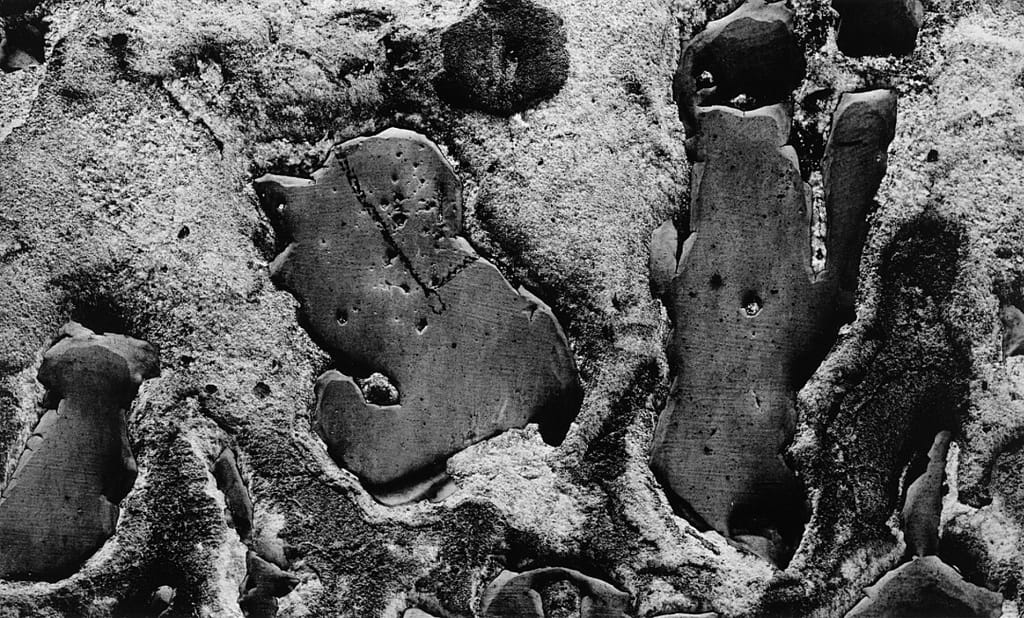
Untitled (two 'footprints')
Aaron Siskind, Untitled, 1948, gelatin silver print, LACMA, anonymous gift (M.84.163). Public domain by the museum's mark only (not a proven public domain) on Wikimedia Commons; LACMA is 'unaware of any current copyright restrictions', and Siskind's estate may hold the copyright. Source: Untitled (two 'footprints') at Los Angeles County Museum of Art, M.84.163 (via Wikimedia Commons)

Formal experiments made from the ordinary surroundings of Chicago: a peeling wall or patch of rock cut tight and flattened until it reads as abstract painting, a street or a wife's figure pushed toward extreme black and white, one frame printed twice or a whole walk laid out as a grid of strips. Students began with light studies and photograms, then each followed a personal project, usually as a series. Sharp small-camera or view-camera negatives, hard light and heavy darkroom control; the picture is an investigation of how photography sees.
Built mostly on one system: Graphic abstraction. What systems are.
Shoot sheet for your kit A prompt for an image model The photographs
How the look is made
- Walk the same ordinary ground every day, and make a series of it, not a single picture: a wall, a street, a doorway, a person.
- Go close and square-on to a surface, cut away the edges and the horizon, and let texture and shadow shapes fill the frame like a flat painting.
- Push the print to its extremes: print the shadows to solid black and drop the middle greys where the form needs it (inferred from the prints, not sourced).
- Test the medium itself: double-expose the negative, print one frame several times, or lay strips and frames in a grid, and let the transformation be the subject.
- Start from light: modulate it on paper in a photogram or on objects in a box, then bring that attention to hard sun and cast shadows in the street.
- Keep what you make personal and unposed; take people as they walk past and show how you pursued the idea, not what you witnessed.
Shoot sheet for your kit
Fill in your camera, lenses and lights, and the sheet says which light plays each part, what to work around and where to start on your camera. Without a kit it starts on a full-frame camera.
Light
Key: the sun, about 45° to the camera’s left, high, hard.
- Key high: about 30–45° above eye level, angled down.
- No reflector or fill: let the shadows fall to black.
- Shadow edges
- Shadows with crisp outlines, cast by a small or distant light: direct sun, a bare flash, a spotlight.
- Shadow depth
- Shadows with no fill at all that fall to pure black with no detail, so parts of the subject disappear.
- Shape & form
- Shadows thrown away from what casts them (a figure’s long shadow, railings on a wall) that become shapes of their own in the composition.
How the style is lit
- Hard direct sun at a low angle, raking across a wall, pavement or rock so that every pit and crack throws a black shadow.
- A sheet of paper or a box of objects lit by one lamp, to modulate light as a photogram or light volume.
- Window light falling on a figure at home, exposed for the highlights so the room drops to black.
This plan is worked out from the style’s choices, so it is drawn as a schematic. One way to get the light, not a record of how any photograph was lit.
Lens and settings
Start at
On a full-frame camera: the same depth of field and exposure as the style’s own numbers, in the same light. Then meter and adjust.
- Then
- 35–50 mm · f/8–f/22 · 1/250–1/59 s · ISO 50–400 on full frame, inferred from the gear and the look. Inferred from the school's gear: normal lenses on 35 mm and roll-film cameras for street series, larger formats for wall and rock studies. Hard sun with slow black-and-white film gives roughly f/8-f/22 at 1/60-1/250 s. Callahan used double and triple exposures and large and small formats; the sources do not give settings.
- Focal length
- Roughly the eye’s own perspective; no visible distortion.
- Focus
- Everything sharp from the nearest stone to the horizon.
- Distance
- Within arm’s reach: faces, hands and details fill the frame.
- Balance
- The subject faces the lens; planes run parallel to the picture.
- Crop & fill
- The edges cut into the subject: heads, limbs or objects run out of frame. Detail runs to every edge with no single centre.
- Depth
- Depth collapsed into pattern and flat shapes.
- Duration
- An unmoving scene, exposed slowly and carefully.
- Many times
- Several exposures laid over each other in one frame.
Direct
Mostly nobody poses. In the street, people pass the camera or are caught from behind, shadowed or cut off by the frame, and in the Loop and portal series they become repeated figures in a pattern. At home, a sitter, often a spouse, stands or sits still in a window or a landscape, face neutral or turned away, as a form in the light.
- The moment
- People photographed as they are, unaware or unconcerned.
Style the set
Nothing is dressed or set up: walls, doors, grass, rock, shop windows, reflections and street signs are taken as found, and people wear their own everyday clothes without make-up. The only arrangement is the photographer's own: laid-out photograms, objects placed in a light box, and frames or strips arranged into a sequence or grid.
- How much is styled
- Nothing dressed, made up, moved or added for the picture.
Finish
- Monochrome
- A black-and-white scale pushed towards pure black and pure white, with few middle greys.
- Post-production
- Areas lightened and darkened by hand in printing. Several photographs combined into one picture.
- Shown as
- Pictures made and shown as a set.
Stay away from soft focus & diffusion, gum & pigment processes, heavy retouching, formal posed portrait, glamour & aspiration, sell & persuade and state persuasion & propaganda.
Before you shoot it
People in these Chicago street, portal and family pictures are real, and many were photographed without asking: Barbara Crane's People of the North Portal shows visitors leaving a museum, and Callahan's long study of his wife is a private portrait. When you work in this way, get consent for faces you will publish, and ask a sitter before a series about them is shown. The school's alumni include living photographers; use the approach, never their names, in prompts. Siskind's and Callahan's estates hold the copyright in their photographs, so do not reproduce the images beyond the licences given. The specimens for this style are limited: only one openly viewable image, a pre-school Siskind, and none shows a multiple exposure, series or grid.
A prompt for an image model
A ready prompt that describes this look to an image model: where the lights stand, the lens, the framing and the colour. It starts on the style’s own choices; change any of them and the prompt and the notes follow.
The prompt
Notes on this prompt
- How the style uses it: go close and square-on to a surface, cut away the edges and the horizon, and let texture and shadow shapes fill the frame like a flat painting. Image models put the light in the wrong place more often than anything else, so the prompt says where each light stands: which side of the picture, and how high. Keep to one light pattern per prompt, or the model splits the difference.
- Black and white: colour words in the subject (a red dress, green leaves) can pull the model back to colour, so leave them out.
- Say what the crop cuts: the top of the head, the hands at the edge. A model left to itself centres everything with room to spare.
The model makes a new picture, not a photograph of anything that happened. Label it as AI-generated, and don’t pass it off as the style’s history or as a real person.
Where to see it
From open collections, shown whole with their credits. Later photographs are linked, not shown, while they are in copyright.
With other styles
Pairs with New Vision. Take the camera-as-eye diagonals and photograms for light studies, then drop the steep angles and stay flat-on to a surface.
Pairs with Straight photography. Borrow the sharp, full-range silver print, then break the single-picture rule with doubled frames and series.
The opposite: New Topographics. Same ordinary ground but opposite stance: deadpan far frontal views against close, flattened, dark-printed formal experiments.
Pairs with Appropriation and rephotography. Both treat the print or frame as material to be repeated and re-framed; Josephson's pictures within pictures lead on to it.
Pairs with Pinhole photography. Another way of testing the camera's own seeing, with light as the subject.
Sources
- Photographers of the New Bauhaus, Museum of Contemporary Photography: https://www.mocp.org/resources/photographers-of-the-new-bauhaus/ (founded 1937 by Moholy-Nagy as the New Bauhaus, later the Institute of Design; photograms for all students; personal projects after the Foundations Course; Lerner's light box; Callahan joined 1945, head 1949-1961; Siskind joined 1951, left 1971; Metzker's 1959 thesis My Camera and I in the Loop; Josephson's thesis Exploration of the Multiple Image; Crane's grids and People of the North Portal 1970-71)
- When Aaron Met Harry: Chicago Photography 1946-1971, Museum of Contemporary Photography: https://www.mocp.org/exhibition/when-aaron-met-harry-chicago-photography-1946-1971/ (1946 to 1971; curated by Denise Miller with Stephen Daiter; Siskind's abstract expressionist urban walls, Lerner's Light Volume, Chicago, 1937)
- New Bauhaus, Wikipedia: https://en.wikipedia.org/wiki/New_Bauhaus (1937 founding, 1938 closure, 1939 reopening, 1944 renaming, 1949 merger with IIT)
- Harry Callahan, Wikipedia: https://en.wikipedia.org/wiki/Harry_Callahan_(photographer) (1912-1999; taught at the Institute of Design from 1946 at Moholy-Nagy's invitation; double and triple exposures; Eleanor his subject 1947-1960; left for RISD in 1961; the MoCP page gives 1945 and Wikipedia 1946/1947 for his arrival)
- Aaron Siskind, Wikipedia: https://en.wikipedia.org/wiki/Aaron_Siskind (1903-1991; close-ups of walls and graffiti reduced to flat surfaces; friends with Kline, Rothko and de Kooning)
- Ray K. Metzker, Wikipedia: https://en.wikipedia.org/wiki/Ray_K._Metzker (1931-2014; master's degree from the Institute of Design in 1959, studied with Callahan and Siskind; Composites)
- Ray Metzker, My Camera and I in the Loop, 1959, Institute of Design records, IIT Galvin Library: https://findingaids.library.iit.edu/repositories/2/archival_objects/3237 (thesis portfolio, Box 136)
- Kenneth Josephson, Wikipedia: https://en.wikipedia.org/wiki/Kenneth_Josephson (master's degree from the Institute of Design, 1960; Siskind and Callahan influences; New York State, 1970)
- Nathan Lerner, Wikipedia: https://en.wikipedia.org/wiki/Nathan_Lerner (1913-1997; enrolled under Moholy-Nagy; light box technique)
- Untitled (Aaron Siskind, 1948), LACMA M.84.163, Wikimedia Commons: https://commons.wikimedia.org/wiki/File:Untitled_LACMA_M.84.163.jpg (gelatin silver print; LACMA's public-domain mark on Commons, which says only that LACMA is unaware of copyright restrictions; Siskind's estate may hold copyright)