Styles / Staged & conceptual
Pinhole photography
- Key: the open sky, all around and above, soft.
Schematic, not to scale: worked out from the style’s choices. No set-up of this style has been rendered yet.
The photographs that define it are still in copyright, so they are linked below rather than shown.
Pictures made with a tiny hole instead of a lens: everything from near to far is equally, softly sharp, corners fade into vignettes and wide views bend at the edges. Exposures last seconds to hours, so anything that moves dissolves and still things hold; solarigraphs run for months, draw the sun's arcs across the paper and come out in the paper's own shifted colours. Pinhole is a style as well as a tool: the hole sets an optical idiom that governs subject, time and finish.
Built on two systems: Pictorial print and Rough and unseen. What systems are.
How the look is made
- Replace the lens with a small hole and accept what it gives: soft, even sharpness from near to far with no focusing.
- Choose still subjects (stones, rooms, buildings, fields, trees) and let anything that moves blur away or vanish.
- Put something close to the camera as well as something far: the hole holds both, and a wide angle stretches the foreground.
- Fix the camera on a firm support and time the exposure by test, adding extra time past about one second for film (reciprocity failure).
- Leave the vignette, the unevenness and the paper or film's own colour alone (solargraphs come out in cyan, orange and violet); they are the picture's signature.
- For long records, leave the camera in place for months and let the sun's daily arcs build on the paper.
Shoot sheet for your kit
Fill in your camera, lenses and lights, and the sheet says which light plays each part, what to work around and where to start on your camera. Without a kit it starts on a full-frame camera.
Light
Key: the open sky, all around and above, soft.
- Shadow edges
- Shadows that fade gradually from light to dark, cast by a large or diffused light: a window, a softbox, a cloudy sky.
How the style is lit
- Open daylight in the long exposure, bright sun or flat overcast; the hole is so small that dim light needs minutes, so subjects are chosen for still, even light.
- A darkened room with a single hole in the window blind or a tent-camera, projecting the outdoor view onto the room's walls and recorded for hours.
This plan is worked out from the style’s choices, so it is drawn as a schematic. One way to get the light, not a record of how any photograph was lit.
Lens and settings
Start at
On a full-frame camera: the same depth of field and exposure as the style’s own numbers, in the same light. Then meter and adjust.
- The style’s f/181 on 6 × 9 cm gives about the depth of field of f/78 on full frame.
- Stop down as far as the lens goes, focus a third of the way into the scene, and check the corners.
- Keep the long time for the movement: an ND filter of about 8 stops cuts the light enough.
- 1 min: on a tripod.
- Then
- 18–35 mm · f/128–f/256 · 1 s–1 h · ISO 3–400 on 6 × 9 cm, inferred from the gear and the look. A pinhole's f-number is the distance to the film divided by the hole's diameter: a 50 mm camera with a 0.26 mm hole is about f/193. Film exposures run from seconds to hours and need extra time past about 1 second (30 seconds for paper) because of reciprocity failure; paper used as the negative has an ISO of only a few. Distances, hole sizes and times vary widely, and solarigraphs expose for months. The equivalents here are estimates. Format 6x9 stands in for roll film; specimens use a 6x17 roll-film pinhole body and film-canister cameras; sheet film and paper are also used.
- Focus
- Everything sharp from the nearest stone to the horizon. A soft glow around highlights; edges never quite sharp.
- Rendering
- A crude or absent lens: soft, distorted, unpredictable.
- Angle
- The camera at the height of a standing person or of the subject.
- Duration
- Seconds or more: water turns to mist, lights become trails. An unmoving scene, exposed slowly and carefully.
Direct
Mostly nobody is posed: the subjects are stones, rooms, fields and streets. Where people appear they hold still for seconds or minutes, or pass through as ghosts and blurs that the long exposure partly erases.
- Without a pose
- No people at all, or people so small or far off that their pose does not read (hands alone are Hands alone).
Style the set
Nothing is styled. Places, buildings, interiors and landscapes are photographed as found; in room-sized camera work the furniture and room are left as they are and the projected view does the arranging.
- How much is styled
- Nothing dressed, made up, moved or added for the picture.
Finish
- Shown as
- Each picture stands on its own.
Stay away from shallow depth of field, corrected perspective, hyper-detailed, direct on-camera flash, snapshot, frozen instant, fast, full-body movement and candid & unobserved.
Before you shoot it
Pinhole pictures usually show places, not people, but long exposures can capture identifiable passers-by as ghosts and street scenes of private homes and windows; avoid showing identifiable strangers or private interiors without consent.
A prompt for an image model
A ready prompt that describes this look to an image model: where the lights stand, the lens, the framing and the colour. It starts on the style’s own choices; change any of them and the prompt and the notes follow.
The prompt
Notes on this prompt
- How the style uses it: for long records, leave the camera in place for months and let the sun's daily arcs build on the paper. Image models put the light in the wrong place more often than anything else, so the prompt says where each light stands: which side of the picture, and how high. Keep to one light pattern per prompt, or the model splits the difference.
- Soft focus is a glow round the highlights, not a blurred picture. If it comes back blurred, ask for sharp detail under the glow.
- Blur needs a cause: say what moves, and that the exposure is long enough to smear it.
The model makes a new picture, not a photograph of anything that happened. Label it as AI-generated, and don’t pass it off as the style’s history or as a real person.
Made by an AI model
An image gpt-image-2 made from this style’s choices, then checked against them by a vision model. Not a photograph, and not part of the style’s history. All generated images
-
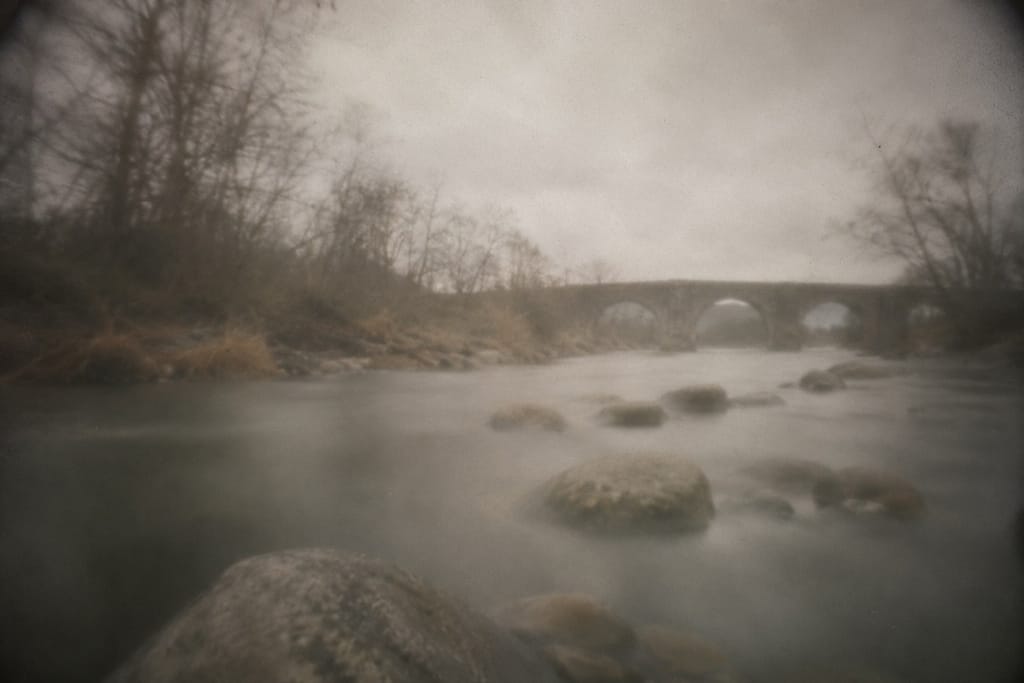
A shallow river flows around large foreground rocks toward a stone bridge with several arches. Leafless trees line the banks beneath a pale, overcast sky, and the image is soft, muted and darkened at the corners. What the check saw. Soft pinhole-like rendering, silky long-exposure water, visible grain and dark corners give this landscape an aged, contemplative photographic appearance.
With other styles
Pairs with Pictorialism. Take the soft tone and lyrical mood, but get the softness from the hole rather than from a soft-focus lens or hand work.
The opposite: Lomographic lo-fi snapshot aesthetic. Both vignette and soften, but a toy camera has a poor lens and snaps in an instant; a pinhole has none and waits.
Pairs with Light painting photography. Both depend on a locked-down camera and an exposure measured in minutes or hours; use the long time to draw or to let light move.
The opposite: Straight photography. Straight photography wins its sharp detail from a lens stopped down; a pinhole gives deep focus without any of that detail.
