Styles / Digital & social
Chongqing cyberpunk night photography
- Key: a lamp, sign or screen, about 30° to the camera’s left, hard.
- Ambient light: a lamp, sign or screen, from behind, to the camera’s right, high, soft.
No reflector or fill: let the shadows fall to black. Leave the lamps’ own colour in: do not correct sodium orange, tungsten amber or fluorescent green.
Schematic, not to scale: worked out from the style’s choices. No set-up of this style has been rendered yet.
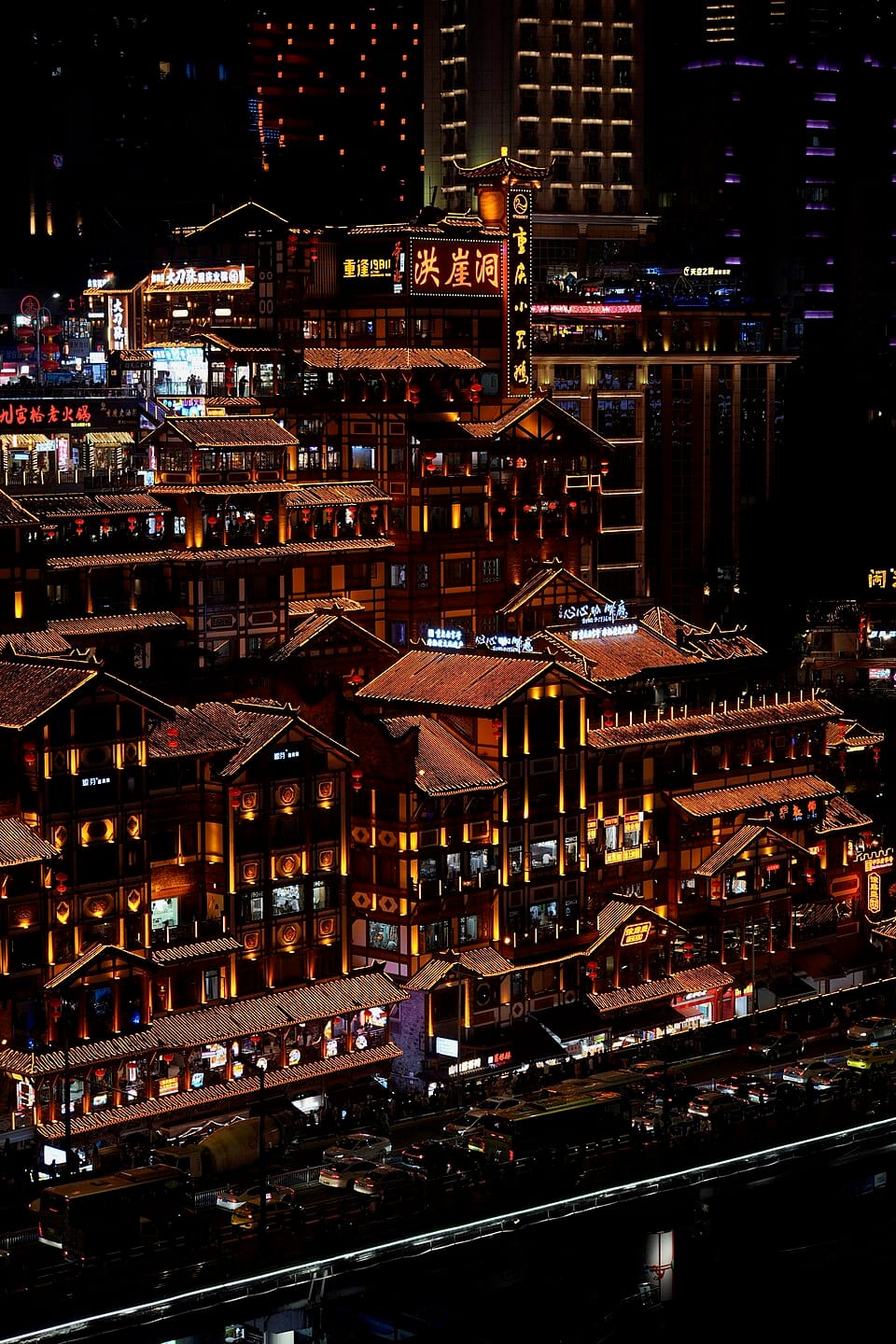
Hongyadong night lights, Chongqing
Lianguanlun, CC BY 4.0, via Wikimedia Commons. Source: Hongyadong night lights, Chongqing at Wikimedia Commons

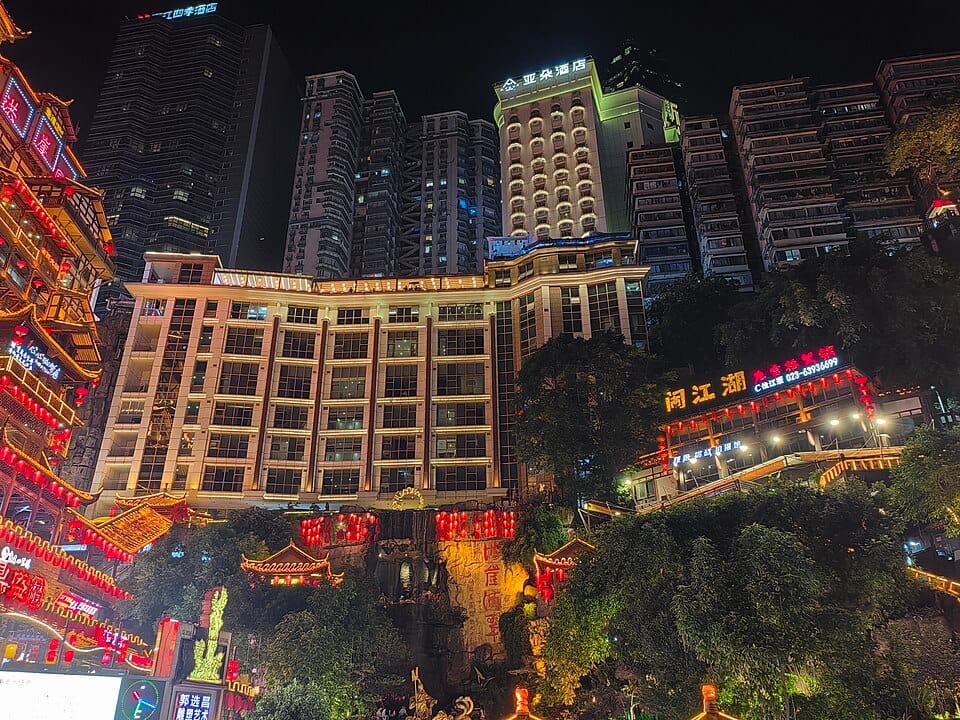
Hongyadong, 21 May 2025
Yumeto, CC BY-SA 4.0, via Wikimedia Commons. Source: Hongyadong, 21 May 2025 at Wikimedia Commons

Night pictures of Chongqing's stacked cliff-side towers, lit stilted houses, bridges and monorail, shot as a 'cyberpunk' city: dense neon and lamp light, coloured reflections where the ground or river is wet, high viewpoints and lenses from wide to telephoto. Made on phones and mirrorless cameras with clean digital files and a saturated grade, often vertical for the feed, at a short list of famous viewpoints.
Built mostly on one system: Cinematic colour. What systems are.
Shoot sheet for your kit A prompt for an image model The photographs
How the look is made
- Go to the known viewpoints (Hongyadong from across the Jialing River or Qiansimen Bridge, Liziba's monorail platform) and arrive before dusk to shoot from blue hour into full dark.
- Climb for a high viewpoint. Shoot wide (16-35 mm) so towers, lit tiers and bridges stack in layers, or compress the Hongyadong cliff-face from Qiansimen Bridge with a 70-200 mm telephoto (roamandridge: 135 mm, f/8, ISO 100, 4 s on a tripod).
- Often frame vertically for the phone feed when the subject is tall, and keep the verticals straight.
- Hold the exposure down so neon signs and lit eaves keep their colour; let the sky and unlit towers fall to near black.
- Shoot when the ground is wet, or add a few seconds on a tripod, so ground, river and traffic trails carry coloured reflections.
- Grade for saturated warm gold and red against cool blue and magenta, and keep the file clean, with no film grain or halation.
Shoot sheet for your kit
Fill in your camera, lenses and lights, and the sheet says which light plays each part, what to work around and where to start on your camera. Without a kit it starts on a full-frame camera.
Light
Key: a lamp, sign or screen, about 30° to the camera’s left, hard.
Ambient light: a lamp, sign or screen, from behind, to the camera’s right, high, soft.
- No reflector or fill: let the shadows fall to black.
- Leave the lamps’ own colour in: do not correct sodium orange, tungsten amber or fluorescent green.
- Shadow depth
- Dark shadows that still hold some detail (a high lighting ratio, about 4:1 to 8:1: the shadow side two to three stops darker). Shadows with no fill at all that fall to pure black with no detail, so parts of the subject disappear.
- Highlights
- Even the brightest parts (clouds, white cloth, snow) keep texture and detail.
How the style is lit
- Existing night light only: lit facades, neon signs, lamp strings and traffic, with no added light.
- Blue-hour start 20 to 40 minutes after sunset, then full dark, with the exposure held down to protect the neon.
- Wet pavement or river as a mirror for coloured reflections, when available.
This plan is worked out from the style’s choices, so it is drawn as a schematic. One way to get the light, not a record of how any photograph was lit.
Lens and settings
Start at
On a full-frame camera: the same depth of field and exposure as the style’s own numbers, in the same light. Then meter and adjust.
- 1/8 s: on a tripod.
- Then
- 14–200 mm · f/2–f/11 · 1/250–5 s · ISO 100–3200 on full frame, inferred from the gear and the look. A current photo-spot guide advises 1/4 s to several seconds on a tripod at ISO 100-400 for trails, 0.5-5 s for traffic, a 16-35 mm equivalent wide lens and holding exposure down to save neon highlights; phones use night mode with exposure dragged down. The handheld range and f-numbers are inferred, not documented. A 70-200 mm telephoto is also used for the Hongyadong stack (roamandridge).
- White balance
- Auto or daylight white balance, then graded: lamp-lit timber, eaves and signs left warm gold and red, sky, river and LED facades left cool blue, teal or magenta so the split is exaggerated (inferred).
- Focal length
- A wide view; near things loom and lines stretch towards the edges. A long lens stacks distant planes close together.
- Focus
- Everything sharp from the nearest stone to the horizon.
- Angle
- Looking down on the subject.
- Distance
- Standing well back; people are small.
- Crop & fill
- The subject shown small within its setting, which explains it.
- Depth
- Separate events in the foreground, middle ground and background.
- Duration
- Seconds or more: water turns to mist, lights become trails.
Direct
Mostly no one poses: the subject is the city, and passers-by and viewing-platform crowds are small, dark shapes. Where a person appears, they stand or walk with their back to the camera, or look at the view or into a phone, a small figure for scale.
- Without a pose
- No people at all, or people so small or far off that their pose does not read (hands alone are Hands alone).
- The moment
- Ordinary photographs by and for ordinary people, or images that look like them.
Style the set
Nothing is styled: facades, signs, lanterns, rails and traffic as found, lit by the city's own lighting schemes. The only choices are viewpoint, time, weather and the grade.
- Set & props
- A real place picked for its look as the setting for a shoot, not the subjects’ own: a street, a field, a palace, a hotel room.
- How much is styled
- Nothing dressed, made up, moved or added for the picture.
Finish
- Colour
- Strong, dense colours. Warm skin against teal shadows, as in film grading.
- Digital & other
- A modern digital camera: clean, detailed, neutral. A phone camera and its processing: deep focus, bright shadows, synthetic blur.
- Texture
- Smooth tones with no visible grain.
- Post-production
- A ready-made grade laid over the whole image. Shadows and highlights both opened up, with a processed look.
- Shown as
- Each picture stands on its own.
- Shown in
- Pictures made for a scrolling feed.
- Frame
- A tall frame made for phones and screens.
Stay away from halation & light leaks, visible grain, colour negative film, 35 mm film, overcast & flat daylight, golden hour, hard, direct sun, high-key, direct on-camera flash, pastel, black & white, full range, faded & matte, shallow depth of field, straight print and melancholy.
Before you shoot it
The pictures are made in public places that are crowded and lived in: viewing platforms, riverside walks and streets with residents' windows and shops. Do not make identifiable bystanders the subject without their agreement, take care with long tripod set-ups that block pedestrians on bridges and platforms, and do not photograph into private apartments, such as those on the Liziba block. The 'cyberpunk' label is a social-media branding of a living city, not how its residents describe it, and the dates of the look are uncertain. Hanfu sitters wear a living cultural dress, so ask their consent. Tripod set-ups on viewing platforms may need permission, and drone rules apply.
A prompt for an image model
A ready prompt that describes this look to an image model: where the lights stand, the lens, the framing and the colour. It starts on the style’s own choices; change any of them and the prompt and the notes follow.
The prompt
Notes on this prompt
- How the style uses it: climb for a high viewpoint. Shoot wide so towers, lit tiers and bridges stack in layers. Image models put the light in the wrong place more often than anything else, so the prompt says where each light stands: which side of the picture, and how high. Keep to one light pattern per prompt, or the model splits the difference.
- Blur needs a cause: say what moves, and that the exposure is long enough to smear it.
- Give the camera height in plain words: from knee height looking up, from a stepladder looking down, straight down onto the table.
The model makes a new picture, not a photograph of anything that happened. Label it as AI-generated, and don’t pass it off as the style’s history or as a real person.
Photographs that define it
From open collections, shown whole with their credits. Later photographs are linked, not shown, while they are in copyright.
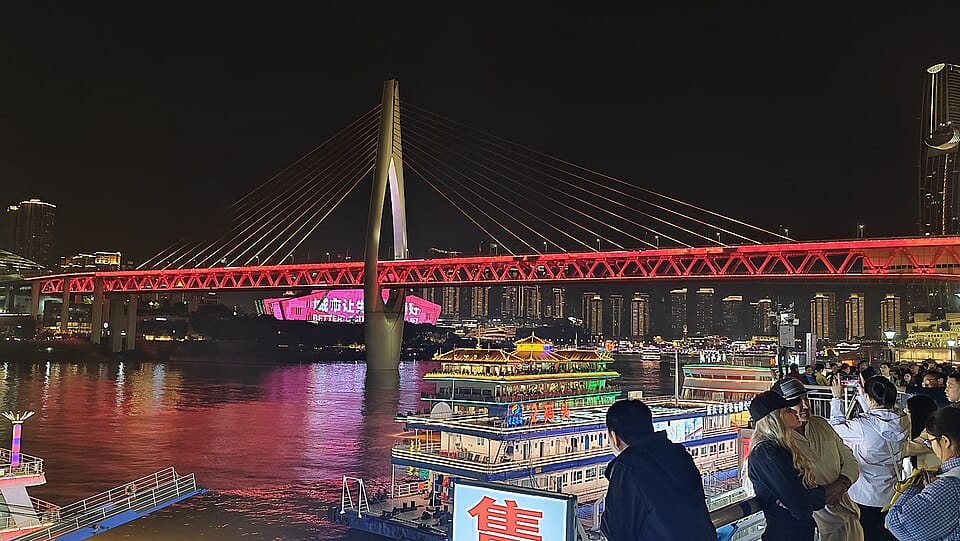
Qiansimen Bridge at night, seen from Hongyadong
DvTor8303, CC0, via Wikimedia Commons. Source: Qiansimen Bridge at night, seen from Hongyadong at Wikimedia Commons

With other styles
The opposite: Tungsten cine-stock night look (CineStill halation). Take its neon-and-wet-street subject but drop the halation glow and grain: shoot clean digital so the lit signs stay crisp.
Pairs with Teal-and-orange cinematic look. Push the grade towards teal shadows and orange lamp light to heighten the cyberpunk split.
Pairs with Computational smartphone look (deep-focus HDR). Use night mode and HDR to hold neon and shadows together on a phone, then drag exposure down to protect the signs.
Pairs with Light painting photography. Add a few seconds of exposure on a tripod so traffic and monorail trails draw lines through the neon.
Pairs with Hanfu photography. A figure in costume against the lit stilted houses gives the scene a human scale. Hanfu is a living cultural dress practice, so the sitter must consent.
The opposite: Tropical influencer travel photography. Swap the figure-first posed travel portrait for a figureless, vertical city view at night.