Styles / Digital & social
Instagram baddie glamour
- Key: a ring light round the lens, from the camera, soft.
- Reflector: a white card or reflector, about 55° to the camera’s right, soft.
Schematic, not to scale: worked out from the style’s choices. No set-up of this style has been rendered yet.
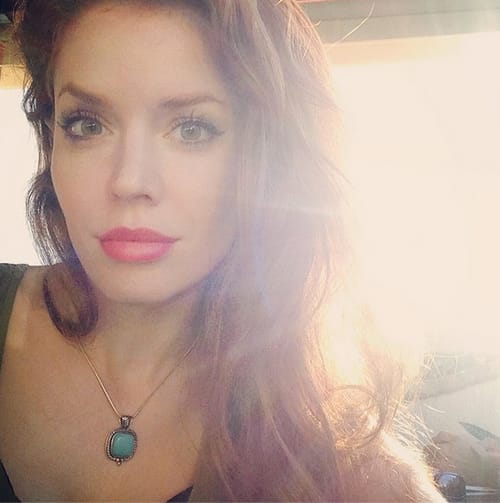
Marlo Meekins (selfie)
Marlo Meekins (per the file description; uploaded by User:Jamesharveyjames), 2014. Licence stated as CC BY-SA 4.0 on Wikimedia Commons but unverified: a third-party uploader may not have the right to relicense an Instagram selfie. Named, identifiable private person; used only as a pose example. Source: Marlo Meekins (selfie) at Wikimedia Commons

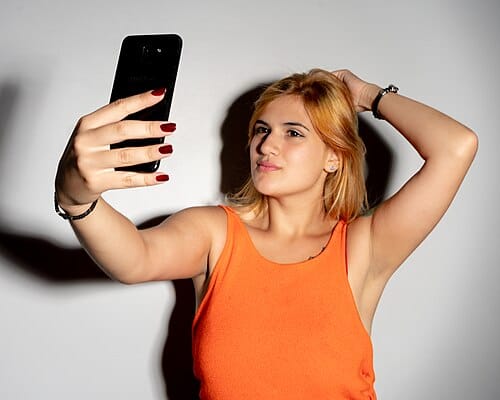
Angie
Rodrigo Paredes, Angie, 2020. CC BY 2.0, via Wikimedia Commons. The sitter is named and identifiable; used only as a pose example. Source: Angie at Wikimedia Commons / Flickr

Posed, edited glamour pictures of adult women made for a social feed, on a phone held at arm's length, in a mirror or by a friend: full-coverage contour, strong highlighter, groomed brows, winged liner and lashes, body-con or coordinated sets, a hip pushed out, a smouldering or blank look to the lens. Warm, bronzed skin and glossy highlights; apps smooth the skin and reshape face and waist; the result is a tall frame in a carousel.
Built mostly on one system: Gloss and curve. What systems are.
Shoot sheet for your kit A prompt for an image model The photographs
How the look is made
- Shoot yourself or an adult sitter on a phone at arm's length, in a mirror, or with a friend as photographer, and frame tall for the feed. The mirror selfie, phone held in front of the body, is a core format.
- Build the face first: full-coverage base, contour, a bright highlighter on cheekbones, nose and brow bone, groomed brows, winged liner and lashes, so the face reads sculpted even in a small thumbnail.
- Angle the body to shape it: hip pushed out, shoulders turned, chin down and eyes up to the lens, a smouldering or blank face rather than a smile (typical, not exclusive: many posts smile); for the full-length shot step back and hold the camera at about chest height.
- Light from the front and a little above with a ring light, a window or golden-hour sun, so catchlights are round, shadows stay open and the highlighter glints.
- Grade warm and bronzed, then smooth skin and tidy the body only as far as the sitter chooses; keep edits believable and never reshape a body into proportions it could not have.
- Post as a carousel of near-identical frames, with the location (hotel room, car seat, rooftop, bathroom mirror) chosen to match the outfit.
Shoot sheet for your kit
Fill in your camera, lenses and lights, and the sheet says which light plays each part, what to work around and where to start on your camera. Without a kit it starts on a full-frame camera.
Light
Key: a ring light round the lens, from the camera, soft.
Reflector: a white card or reflector, about 55° to the camera’s right, soft.
- Shadow edges
- Shadows that fade gradually from light to dark, cast by a large or diffused light: a window, a softbox, a cloudy sky.
- Shadow depth
- Shadows kept light and full of detail by a reflector, a fill light, bounce or bright surroundings (a low lighting ratio, up to about 3:1: the shadow side at most a stop and a half darker).
- Highlights
- Small, bright glints where the light reflects off wet, oily or polished surfaces: glistening food, dewy skin, the sparkle of jewellery or chrome. Bright, clearly shaped reflections of the light in the eyes (a window, a ring, a softbox), made a feature of the portrait.
How the style is lit
- A ring light at the phone, or held just above it, giving round catchlights and an even, glowing face; the room behind falls darker.
- Window light or golden-hour sun from the front or side, the face turned to it, with the highlighter and a glossy lip catching the glint.
- For night and mirror shots, warm room lamps or a phone's own flash, accepting the harder, shinier skin.
This plan is worked out from the style’s choices, so it is drawn as a schematic. One way to get the light, not a record of how any photograph was lit.
Lens and settings
Start at
On a full-frame camera: the same depth of field and exposure as the style’s own numbers, in the same light. Then meter and adjust.
- The style’s f/2.1 on a phone gives about the depth of field of f/10 on full frame.
- Then
- 24–32 mm · f/1.8–f/2.4 · 1/125–1/30 s · ISO 50–800 on a phone, inferred from the gear and the look. Worked out from phone cameras (front cameras about 24-32 mm equivalent at f/1.8-2.4; main cameras about 26 mm) used at arm's length or in a mirror, indoors under room light or a ring light; portrait mode adds software blur. No source states typical numbers, and ranges vary by phone.
- White balance
- Phone auto white balance, then a warm grade: skin kept golden and bronzed, a ring light or window left neutral-to-warm and room lamps allowed to stay amber, cool tones pulled down (inferred).
- Focal length
- A wide view; near things loom and lines stretch towards the edges.
- The photographer
- The camera held at arm’s length, often turned on oneself.
- Depth
- The scene doubled, layered or split by its reflection in a mirror, a shop window, water or a polished surface.
- Instant
- A casual, unplanned instant, taken quickly.
Direct
Self-directed or directed by a friend: weight on one leg and a hip pushed out, shoulders turned and the waist angled to the lens, a look back over the shoulder, chin down and eyes up, a blank or smouldering expression with lips lightly parted or pouted; a hand in the hair or on the hip or face; in a mirror selfie the phone is held in front of the body. Take dozens of near-identical frames and choose one.
- Whole body
- MustAdults only, and every picture non-explicit.Safety and consent. The entry's caution: the look is made by and of real, mostly young women.
- MustSmooth the skin and tidy the body only as far as the sitter chooses; never reshape a body into proportions it could not have, and label edited or generated pictures as such.Safety and consent. Heavy reshaping produces bodies surgeons call anatomically impossible, and edited selfies are linked to the wish for surgery and to body dysmorphia.
- MustNever produce a likeness of a real influencer or celebrity, and never use the look, braids or a darker skin to imitate a race; credit where the aesthetic comes from.Safety and consent. Sources say Black American women popularised it; non-Black influencers who borrowed it were criticised as blackfishing.
- UsuallyTake dozens of near-identical frames, changing the angle a little each time, and choose one.Subject chooses. The posted picture is a selection, and the angle shapes the body as much as the pose does.
- UsuallyFor the full-length shot, step back and hold the camera at about chest height.Subject chooses.
- UsuallyWear an outfit of your own choosing for the place: a body-con dress, a crop top or a coordinated set, with bold accessories.Subject chooses.
- OptionalLean against something in the chosen place: a car, a counter or a wall.Subject chooses.
- Head and neck
- MustBuild the face before the first frame: full-coverage base, contour, highlighter on cheekbones, nose and brow bone, groomed brows, winged liner and lashes.Subject chooses. The face must read sculpted even in a small thumbnail.
- UsuallyDrop the chin and lift the eyes to the lens, and turn the face to the ring light or the window so the highlighter catches it.Subject chooses.
- OptionalTurn the body away and look back over the shoulder at the lens.Subject chooses.
- Face and eyes
- MustA smouldering or blank look straight into the lens, the lips lightly parted or pouted.Subject chooses. The 'Instagram face' was named for its blank expression.
- AvoidDo not default to a smile or a cute face; many posts do smile, but that is a different picture from this one.Subject chooses. The pastel, smiling beauty selfie is this style's foil.
- Hands
- UsuallyIn a mirror selfie, hold the phone in front of the body, so it shows as part of the picture.Comes with the activity. The mirror selfie, phone held in front of the body, is a core format of the style.
- OptionalPut the free hand in the hair, on the hip or at the face.Subject chooses.
- Torso and hips
- UsuallyTurn the shoulders and angle the waist to the lens rather than standing square to it.Subject chooses. Angling the body shapes it in camera before any app does.
- Legs
- UsuallyStand with the weight on one leg and the other knee relaxed, so the hip pushes out.Subject chooses.
Must: the look depends on it · Usually: what the style does most of the time · Optional: one possibility among others · Avoid: works against the look.
- The moment
- Ordinary photographs by and for ordinary people, or images that look like them.
Style the set
Full-coverage contour and highlighter, groomed brows, winged liner, lashes, matte or glossy nude lips, long nails and styled hair; body-con dresses, crop tops, coordinated sets, bold accessories; the place (hotel room, car, rooftop, gym or bathroom mirror) is picked or tidied to suit the outfit and kept uncluttered.
- Clothes
- Best clothes, jewellery and accessories put on for the studio or the occasion. Outfits the wearers put together to be seen, designer labels included: layering, sneakers, statement pieces.
- Hair & make-up
- Visible artifice: sculpted brows, strong lips, lashes, contouring and set or sculpted hair.
- Set & props
- A real place picked for its look as the setting for a shoot, not the subjects’ own: a street, a field, a palace, a hotel room.
Finish
- Colour
- An overall yellow, orange or red cast.
- Digital & other
- A phone camera and its processing: deep focus, bright shadows, synthetic blur.
- Post-production
- Perfected skin and surfaces. A ready-made grade laid over the whole image.
- Shown in
- Pictures made for a scrolling feed.
- Frame
- A tall frame made for phones and screens.
Stay away from pastel, cute & playful faces, smiling, playful, high-key, soft focus & diffusion, visible grain, candid & unobserved, faded & matte, straight print, natural face & hair and awkward & in-between.
Before you shoot it
These are real people (the two open specimens show identifiable private individuals, used only as pose examples), mostly young women, and the look has real costs. Heavy editing produces images surgeons call 'anatomically impossible to replicate' (HuffPost UK, 2021); a 2020 study found Facetune use increases the desire for cosmetic surgery, and a Boston University study of 2018 linked edited selfies to body dysmorphic disorder. The filtered face is criticised as a homogeneous, Eurocentric standard that lightens skin and narrows noses while borrowing features coded as 'ethnic'. Sources describe the baddie aesthetic as popularised in the 2010s by Black American women (Document Women, a blog-level source; Wiktionary gives no etymology for the slang), and the first user of the word is undocumented; non-Black influencers who adopted the look, braids or darker skin have been criticised as 'blackfishing': credit the source and do not use the look to imitate a race. Living people and brands (Kim Kardashian, Kylie Jenner, Molly-Mae Hague, Facetune) are credited here as documented exemplars only: never imitate them or name them in a prompt.
A prompt for an image model
A ready prompt that describes this look to an image model: where the lights stand, the lens, the framing and the colour. It starts on the style’s own choices; change any of them and the prompt and the notes follow.
The prompt
Notes on this prompt
- How the style uses it: light from the front and a little above with a ring light, a window or golden-hour sun, so catchlights are round, shadows stay open and the highlighter glints. Image models put the light in the wrong place more often than anything else, so the prompt says where each light stands: which side of the picture, and how high. Keep to one light pattern per prompt, or the model splits the difference.
- Describe an invented person by age, clothes and pose. Never name a real or famous person, and never write “looks like”.
- Heavy retouching: ask for smooth skin that keeps its pores, or the model makes it look like plastic.
The model makes a new picture, not a photograph of anything that happened. Label it as AI-generated, and don’t pass it off as the style’s history or as a real person.
Where to see it
From open collections, shown whole with their credits. Later photographs are linked, not shown, while they are in copyright.
With other styles
The opposite: Meitu beauty-app selfie. Both reshape the face with an app, but the beauty selfie is pastel, high-key, smiling and head-and-shoulders; keep this look warm, smouldering and full-figure, and do not let a pastel grade creep in.
Pairs with Glossy beauty retouch. Borrow the studio's controlled highlight on gloss and its dodge-and-burn contour, but keep the phone, the location and the whole figure that make this a feed picture.
The opposite: Tropical influencer travel photography. There the figure is small in a view, often back-turned; here the body and face fill the frame and the place is only a backdrop.
The opposite: Boudoir photography. Boudoir is a private hired session in soft studio light; this look is public, self-made and built for a feed, so keep the outfit dressed and the pose standing.
Pairs with Hollywood glamour portraiture. The studio star portrait carved the face with one hard light on a dark ground; use its single key light when a ring-lit phone portrait looks flat.
Sources
- Instagram face, Wikipedia: https://en.wikipedia.org/wiki/Instagram_face (beauty standard of filters and influencers; Jia Tolentino named it in The New Yorker in 2019 and called Kim Kardashian 'patient zero'; Kylie Jenner's 2015 lip-filler confession; catlike eyes, long lashes, small nose, high cheekbones, full lips, blank expression; Eurocentric filters that appropriate 'ethnic' features; read directly, does not describe how photographs are taken)
- Jia Tolentino, 'The Age of Instagram Face', The New Yorker, 12 December 2019: https://www.newyorker.com/culture/decade-in-review/the-age-of-instagram-face (date and title from Wikipedia; the page itself was not read)
- Selfish (book), Wikipedia: https://en.wikipedia.org/wiki/Selfish_(book) (Universe, a Rizzoli imprint, 5 May 2015, 448 pages, her selfies many previously posted; reviews by Kat Brown, Megan Garber and Jonathan Jones)
- Jesselyn Cook, HuffPost UK, 20 May 2021: https://huffingtonpost.co.uk/entry/facetune-selfies-surgeries-body-dysmorphia_n_60926a11e4b0b9042d989d48 (Facetune 2013, Facetune2 2016; Reshape tool; 1 to 1.5 million photos exported daily; 'anatomically impossible'; a 2020 study on surgery desire; Boston University 2018 on body dysmorphic disorder)
- L'Oreal Paris USA, 'Instagram baddie outfits and makeup', 9 October 2020: https://www.lorealparisusa.com/beauty-magazine/beauty-tips/beauty-looks/instagram-baddie-outfits-and-makeup (brand content: full-coverage foundation, bronzer, highlighter on cheekbones, nose tip and cupid's bow, defined brows, smoky eye, winged liner, matte mauve lips, coordinated sets; no origin of the term, no photographic advice)
- Erin Lindsay, image.ie, 16 April 2020: https://www.image.ie/editorial/molly-maes-instagram-tutorial-shows-much-effort-goes-typical-selfie-days-190758 (a 15-minute YouTube tutorial on lighting, props, angles and editing with Facetune; does not mention a ring light or poses)
- Dauda Opeyemi, 'Who's a Baddie, Anyway?', Document Women, 19 May 2023: https://www.documentwomen.com/whos-a-baddie-anyway ('the baddie aesthetic became popularized in the 2010s by African American women', on Twitter and Instagram; links it to #BlackGirlMagic; a blog-level source, does not discuss appropriation)
- Baddie, Wiktionary: https://en.wiktionary.org/wiki/baddie (slang sense: an attractive, confident woman, usually a social-media influencer; no etymology given for the slang sense)
- Blackfishing, Wikipedia: https://en.wikipedia.org/wiki/Blackfishing (white female influencers adopting a look associated with Black people; term popularised by Wanna Thompson in 2018; page does not mention Instagram baddies)
- Specimen note: the atlas has no open-licensed type specimen of this style; the two Commons pictures are context only