Styles / Vernacular & studio
Marubi studio photography (Shkodër)
- Key: the open sky, all around and above, soft.
Daylight studio: a skylight, a glasshouse or a courtyard, with a backdrop behind the sitter. Open shadows: bright surroundings (walls, ground, sky) fill them; no reflector needed.
Schematic, not to scale: worked out from the style’s choices. No set-up of this style has been rendered yet.
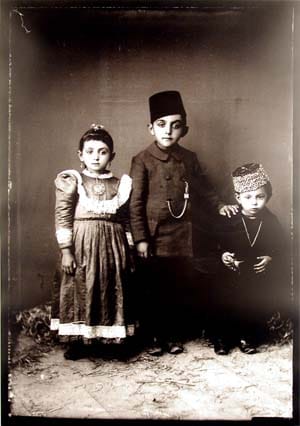
Children of Maliq Bushati
Kel Marubi (1870-1940), public domain, via Wikimedia Commons. Source: Children of Maliq Bushati at Wikimedia Commons (Marubi National Museum of Photography archive)

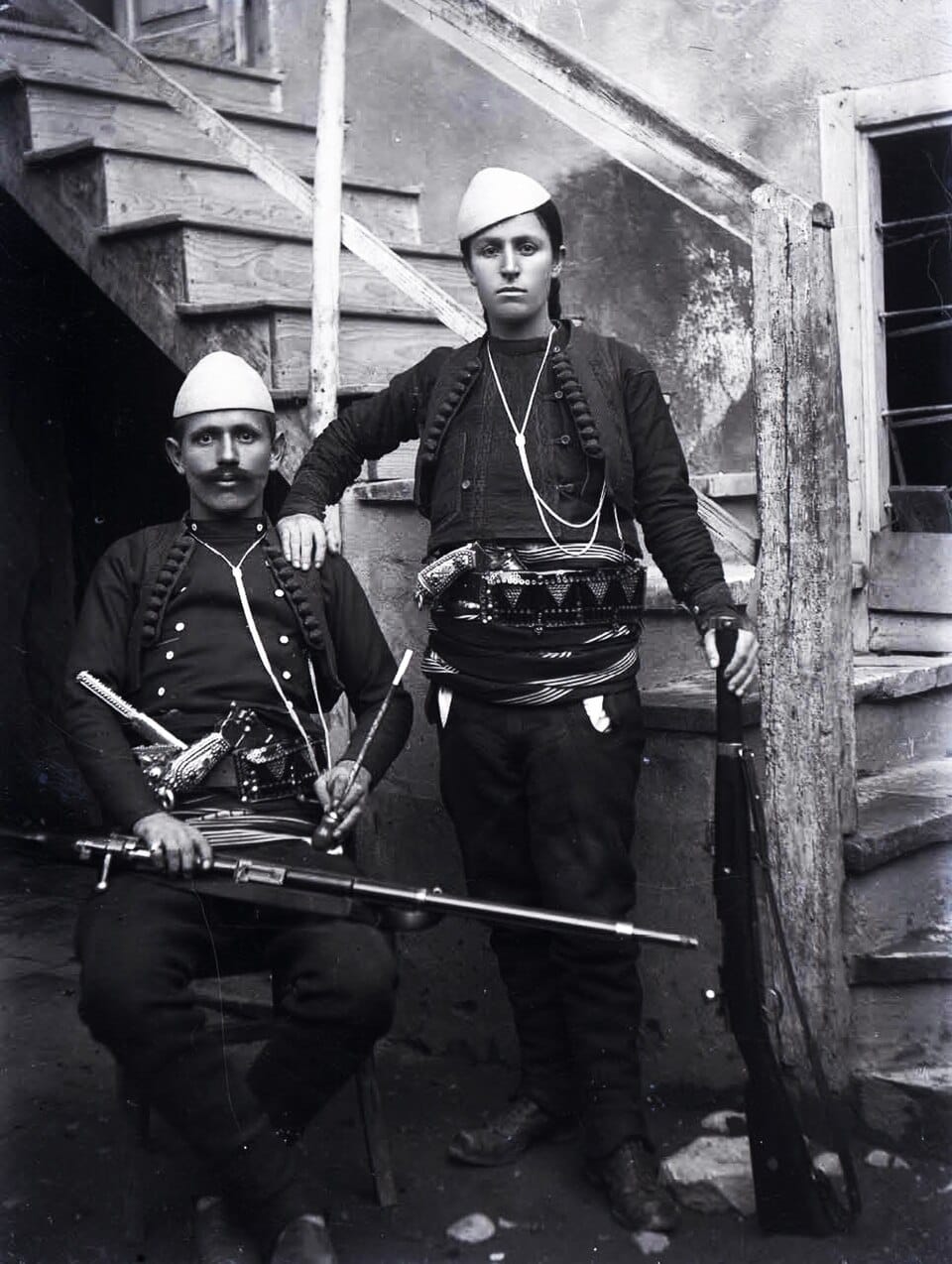
Azem Galica and Shote Galica
Kel Marubi (1870-1940), public domain, via Wikimedia Commons. Source: Azem Galica and Shote Galica at Wikimedia Commons (Marubi National Museum of Photography archive)

A century of portraits made in one provincial studio on glass plates: highland men with rifles and embroidered waistcoats, townswomen, children in their best clothes, political committees seated round a draped table. Sitters stand or sit still, square to the camera, in window light before a plain or painted backdrop, or against a stair or wall outdoors. The plates are large, sharp and grey-toned, and the same hand also records meetings, uprisings and a community's faces.
Built mostly on one system: Painted studio. What systems are.
Shoot sheet for your kit A prompt for an image model The photographs
How the look is made
- Put the camera at the sitter's eye level, a few metres back, and fill the plate with the whole figure or the whole group, centred.
- Light from a window or skylight (inferred), one broad soft source from the side or front, with no fill beyond the room; outdoors, use daylight and the wall or stair as found, and let shadows fall deep.
- Let sitters wear their own best dress, local costume, sashes, belts and weapons, and hold the objects that say who they are.
- Have them hold still for the long exposure, facing the lens with composed, unsmiling faces; arrange groups in two rows round a table.
- Use a plain or lightly painted backdrop, a draped table or chair indoors; for events and uprisings, move outside and use the wall, stair or yard as found.
- Make a glass-plate negative and keep it: the studio archive is the record, so make one clean frame per sitting and label it.
Shoot sheet for your kit
Fill in your camera, lenses and lights, and the sheet says which light plays each part, what to work around and where to start on your camera. Without a kit it starts on a full-frame camera.
Light
Key: the open sky, all around and above, soft.
- Daylight studio: a skylight, a glasshouse or a courtyard, with a backdrop behind the sitter.
- Open shadows: bright surroundings (walls, ground, sky) fill them; no reflector needed.
- Shadow edges
- Shadows that fade gradually from light to dark, cast by a large or diffused light: a window, a softbox, a cloudy sky.
- Shadow depth
- Shadows kept light and full of detail by a reflector, a fill light, bounce or bright surroundings (a low lighting ratio, up to about 3:1: the shadow side at most a stop and a half darker).
How the style is lit
- Glass-roofed or large-window daylight studio, a single broad soft source, walls and a pale cloth as the only fill.
- Outdoor open shade against a stair, wall or yard for events and field portraits.
This plan is worked out from the style’s choices, so it is drawn as a schematic. One way to get the light, not a record of how any photograph was lit.
Lens and settings
Start at
On a full-frame camera: the same depth of field and exposure as the style’s own numbers, in the same light. Then meter and adjust.
- The style’s f/11 on 13 × 18 cm gives about the depth of field of f/2.2 on full frame.
- Then
- 35–60 mm · f/8–f/16 · 0.5–4 s · ISO 1–25 on 13 × 18 cm, inferred from the gear and the look. Plate sizes and format are inferred (the cited Wikipedia and museum pages give none); lens, stops, times and plate speed are likewise inferred from collodion and early gelatin plates under daylight, which needed seconds, so sitters held still. Outdoor work was shorter.
- Focal length
- Roughly the eye’s own perspective; no visible distortion.
- Focus
- Everything sharp from the nearest stone to the horizon.
- Angle
- The camera at the height of a standing person or of the subject.
- Distance
- Whole figures and their immediate surroundings.
- Balance
- The subject in the middle, the frame balanced around it. The subject faces the lens; planes run parallel to the picture.
- Crop & fill
- The subject shown small within its setting, which explains it.
- Duration
- An unmoving scene, exposed slowly and carefully.
Direct
Seat or stand the sitter square or a little turned to the camera, still for the exposure: a man seated with a rifle across his knees and a companion standing with a hand on his shoulder; a committee in two rows, arms folded or hands on knees, round a draped table; children in a row by height, a hand on a sibling's shoulder. Faces are composed and unsmiling, eyes at the lens.
- Body position
- Upright, weight on both feet, shoulders level: the plain, even stance of a formal sitting or a line-up. On a chair or stool, back straight, hands and feet placed: the formal sitting.
- Turn to the camera
- Shoulders and hips face the lens straight on: direct, symmetrical, sometimes confrontational.
- Head & gaze
- Looking straight into the camera, so the subject meets the viewer’s eye.
- Arms & hands
- Hands busy with a prop or a tool: flowers, a phone, a cup, a cigarette, an instrument, one’s own work.
- Line & energy
- Rigid and motionless, sometimes braced against a head rest or gripping a chair: held for a long exposure or a solemn occasion.
- Expression
- Unsmiling, composed and blank: the face gives nothing away.
- Several people
- One or more seated in front and others standing behind, all facing the camera: from a seated-and-standing couple to a team in tiers.
- With the sitter
- The sitter arranged and still, facing the camera.
- The set-up
- A scene staged and directed like a film still or a painting.
Style the set
Sitters come in their own best clothes: northern highland dress with braided waistcoat, wide sash or belt, white felt cap, pistol, dagger or rifle; urban sitters in frock coat, fez, lace and jewellery; clerics in habit. The studio adds a plain or lightly painted backdrop, a table with a fringed cloth, a chair and a rug; outdoors the stair or wall is used as found.
- Clothes
- The wearers’ own festive, religious or wedding clothes: saris and lehengas, boubous, robes, kimono. Best clothes, jewellery and accessories put on for the studio or the occasion.
- Set & props
- Things shown to say who the sitter is or wants to be, their own or lent by the studio: a radio, a bicycle, a watch, books, tools. The stock furniture of a portrait studio, standing in for a setting: a posing chair, a column, a balustrade, a draped table, a potted palm. A painted, cloth, paper or seamless backdrop behind the subject.
Finish
- Monochrome
- Rich blacks, clean whites and every grey between.
- Film
- A view camera on a tripod: great detail, slow and deliberate.
- Post-production
- Nothing changed beyond exposure and development.
- Shown as
- Each picture stands on its own.
Stay away from candid & unobserved, snapshot, tilted angle, direct on-camera flash, laughing, hand-coloured and composite & montage.
Before you shoot it
The photographs show real, mostly named people, among them political leaders, fighters and children, many of whom (or whose descendants) are remembered in Albanian national history; treat them as historical records and never attach invented names, causes or events to a face. The archive was later altered and used for communist propaganda (the museum notes this), and some sitters were persecuted afterwards, so do not use the pictures to identify or implicate anyone. Highland dress, weapons and the Galica and Manastir pictures carry national meaning: do not present them as exotic costume or as a generic Balkan 'warrior' type.
A prompt for an image model
No prompt for this style
Behind its pictures: real, named sitters of national memory, some persecuted later, in an archive altered for propaganda.
Caution forbids images that pass as Marubi plates.
Treat them as historical records and never attach invented names, causes or events to a face. The archive was later altered and used for communist propaganda, and some sitters were persecuted afterwards, so do not use the pictures to identify or implicate anyone. credit the museum and the photographer when showing originals. named politicians appear too, so never recycle captions as identification in generated prompts.
Work with photographers of this tradition, or take only its light and lens (the shoot sheet above) without its people, places or rituals.
Where to see it
From open collections, shown whole with their credits. Later photographs are linked, not shown, while they are in copyright.
With other styles
Pairs with Carte-de-visite studio portraits. Shared practice, not a documented descent: the carte's upright, whole-figure plan and draped table, but on large plates and with regional dress and weapons rather than the stock urban set.
The opposite: Ethiopian imperial court and Addis Ababa studio photography. Also provincial studio portraiture of rank and dress, but here the clientele is Balkan highland and townspeople, one continuous family studio over three generations, and glass plates (later celluloid), with no court patron.
The opposite: Haitian studio portraiture. Both are community studio portraiture; Marubi is plain, unsmiling and archive-bound on glass plates, with highland dress and weapons as status, a different clientele and setting.
Pairs with Ottoman imperial studio photography (Pera). Shared practice only: both pose clients in their own rank and dress with formal stillness; no source ties Marubi to Ottoman court studios (Pietro was an Italian painter-photographer).
The opposite: Hollywood glamour portraiture. Hollywood sculpts one face with controlled lights and retouching; Marubi lights the whole figure with one window and lets dress and objects carry the sitter.
Sources
- https://en.wikipedia.org/wiki/Pietro_Marubi
- https://en.wikipedia.org/wiki/Kel_Marubi
- https://en.wikipedia.org/wiki/Geg%C3%AB_Marubi
- https://en.wikipedia.org/wiki/Marubi_National_Museum_of_Photography
- https://marubi.gov.al/about-us
- https://commons.wikimedia.org/wiki/File:Azem_Galica_and_Shota_Galica.jpg