Styles / Documentary & reportage
Mountaineering and Himalayan expedition photography
- Key: the sun, from the camera’s left, at the side, high, hard.
Key high: about 30–45° above eye level, angled down. Snow or frost brightens everything from below.
Schematic, not to scale: worked out from the style’s choices. No set-up of this style has been rendered yet.
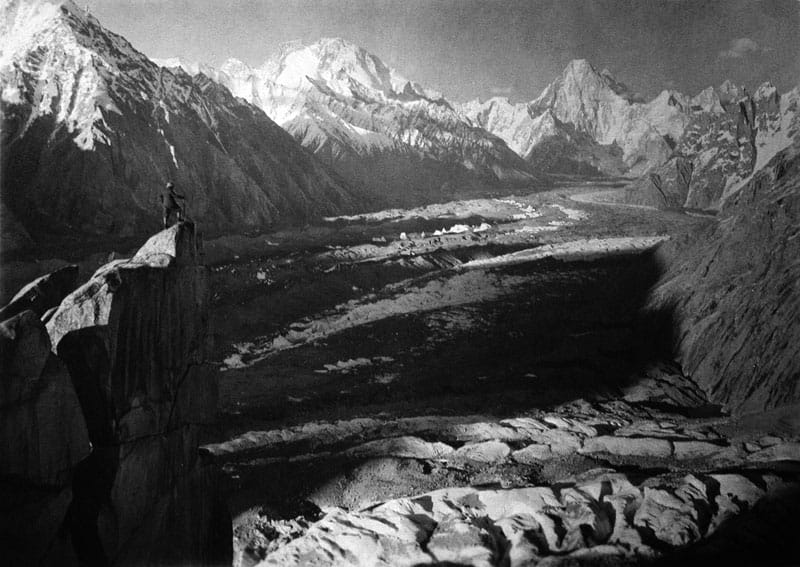
Baltoro from Urdokas
Vittorio Sella, 1909; public domain (Wikimedia Commons). Source: Baltoro from Urdokas at Wikimedia Commons

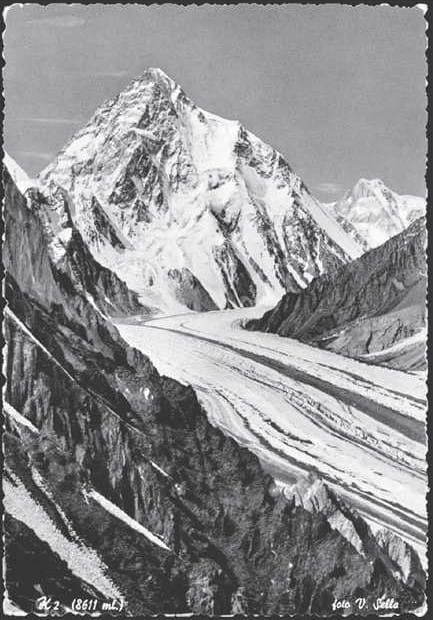
K2 (8611 m) from the Godwin-Austen glacier
Vittorio Sella, 1909; public domain (Wikimedia Commons). Source: K2 (8611 m) from the Godwin-Austen glacier at Wikimedia Commons

Peaks, ridges and glaciers photographed from above and afar on large glass plates, sharp from the moraine at your feet to the summit, in hard sun on snow. Rock goes black, snow burns white, the sky prints dark or empty. A climber or camp is a tiny scale mark on a rib of rock, or nobody is there. Unlike the polar expedition view, the aim is a summit and the way to it: ridge, rope and glacier from a high rock viewpoint, with no ships, huts or team portraits. Made on expedition for albums, lectures and club books.
Built mostly on one system: Deadpan document. What systems are.
Shoot sheet for your kit A prompt for an image model The photographs
How the look is made
- Climb for the viewpoint: carry the camera to a ridge, moraine or rock tower above the glacier so the whole range opens in receding layers.
- Set a large plate or sheet camera on a tripod, stop down and keep every plane sharp, from the boulders at your feet to the summit.
- Wait for sun that rakes the snow and rock; let the lit face burn near white, the shadow side go black, and the sky print dark or empty.
- Put a small figure, rope team or tent on a rib of rock for scale, back turned, and leave the rest of the frame to the mountain.
- Isolate one peak from the range by walking to a viewpoint where it stands clear, and keep the plate flat and unretouched.
- Print for the album and the lecture hall: a numbered plate for each peak, glacier and camp, in a sequence that follows the route.
Shoot sheet for your kit
Fill in your camera, lenses and lights, and the sheet says which light plays each part, what to work around and where to start on your camera. Without a kit it starts on a full-frame camera.
Light
Key: the sun, from the camera’s left, at the side, high, hard.
- Key high: about 30–45° above eye level, angled down.
- Snow or frost brightens everything from below.
- Shadow edges
- Shadows with crisp outlines, cast by a small or distant light: direct sun, a bare flash, a spotlight.
- Shadow depth
- Dark shadows that still hold some detail (a high lighting ratio, about 4:1 to 8:1: the shadow side two to three stops darker).
- Shape & form
- Shadows thrown away from what casts them (a figure’s long shadow, railings on a wall) that become shapes of their own in the composition.
- Highlights
- The brightest parts burn out to pure white with no detail, on purpose or because the light was too strong.
How the style is lit
- Hard high-altitude sun raking snow, ice and rock, with lit faces near white and shadow sides black, and no fill.
- Low sun at dawn or evening behind a peak, backlighting spindrift and cloud.
- Thin cloud, mist or overcast on glaciers for the quiet approach views, with long exposures on a tripod.
This plan is worked out from the style’s choices, so it is drawn as a schematic. One way to get the light, not a record of how any photograph was lit.
Lens and settings
Start at
On a full-frame camera: the same depth of field and exposure as the style’s own numbers, in the same light. Then meter and adjust.
- The style’s f/27 on Whole plate gives about the depth of field of f/4.3 on full frame.
- Then
- 24–70 mm · f/16–f/45 · 1/50–2 s · ISO 10–50 on Whole plate, inferred from the gear and the look. Worked out from the glass plates of roughly 30 x 40 cm or smaller, slow dry emulsions, tripod use, and the sharp-to-far, bright-snow results; no source consulted gives the settings for these photographs. F-numbers are for whole-plate, and larger plates needed smaller stops.
- Focus
- Everything sharp from the nearest stone to the horizon.
- Angle
- Looking down on the subject.
- Distance
- Standing well back; people are small.
- Crop & fill
- A small subject in a large empty field.
- Depth
- Separate events in the foreground, middle ground and background. A strong horizon splits the frame into bands.
- Duration
- An unmoving scene, exposed slowly and carefully.
Direct
People are scale marks and not sitters: one climber stands or sits small on an outcrop with his back to the camera, looking into the valley, or a rope team files across a slope, held still by the long exposure. Many views have nobody. Group pictures of the party at camp are plain and square-on, but they are not the heart of the style.
- Without a pose
- No people at all, or people so small or far off that their pose does not read (hands alone are Hands alone).
- With the sitter
- Neutral, unemotional and distant.
Style the set
Nothing is dressed or set: peaks, glaciers, moraine, camps and gear are photographed as found. Expedition members wear the wool, boots, rope and ice axes they climb in; a man on a rock or a row of tents is placed or allowed where he gives the scale.
- How much is styled
- Nothing dressed, made up, moved or added for the picture.
Finish
- Monochrome
- Rich blacks, clean whites and every grey between. A black-and-white scale pushed towards pure black and pure white, with few middle greys.
- Film
- A view camera on a tripod: great detail, slow and deliberate.
- Post-production
- Nothing changed beyond exposure and development.
- Shown as
- Pictures made and shown as a set.
- Shown in
- Prints for an album, a card or a frame at home.
Stay away from portrait, shallow depth of field, soft focus & diffusion, soft studio light, composite & montage, heavy retouching, filter & preset look, saturated colour, glamour & aspiration and sell & persuade.
Before you shoot it
These pictures served expeditions that were often national prestige projects, and they were made with the labour of local porters, guides and Sherpas, many of whom died and few of whom were named. The peaks and valleys are home to living communities, and some mountains are sacred. Do not use the style to glamorise risk and death on the mountain, and do not treat it as neutral record of a pristine land.
A prompt for an image model
A ready prompt that describes this look to an image model: where the lights stand, the lens, the framing and the colour. It starts on the style’s own choices; change any of them and the prompt and the notes follow.
The prompt
Notes on this prompt
- How the style uses it: wait for sun that rakes the snow and rock; let the lit face burn near white, the shadow side go black, and the sky print dark or empty. Image models put the light in the wrong place more often than anything else, so the prompt says where each light stands: which side of the picture, and how high. Keep to one light pattern per prompt, or the model splits the difference.
- Black and white: colour words in the subject (a red dress, green leaves) can pull the model back to colour, so leave them out.
- Give the camera height in plain words: from knee height looking up, from a stepladder looking down, straight down onto the table.
The model makes a new picture, not a photograph of anything that happened. Label it as AI-generated, and don’t pass it off as the style’s history or as a real person.
Photographs that define it
From open collections, shown whole with their credits. Later photographs are linked, not shown, while they are in copyright.
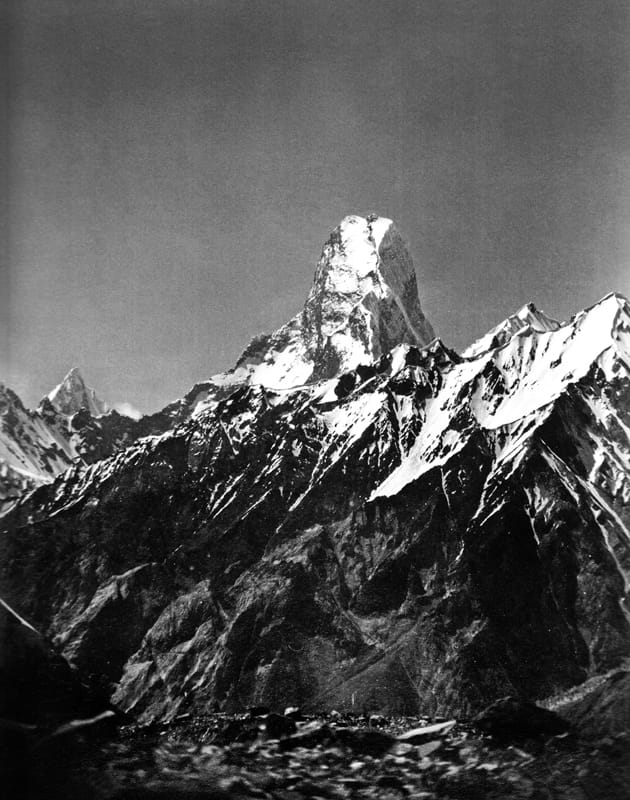
Muztagh Tower from above the Upper Baltoro glacier
Vittorio Sella, 1909; public domain (Wikimedia Commons). Source: Muztagh Tower from above the Upper Baltoro glacier at Wikimedia Commons

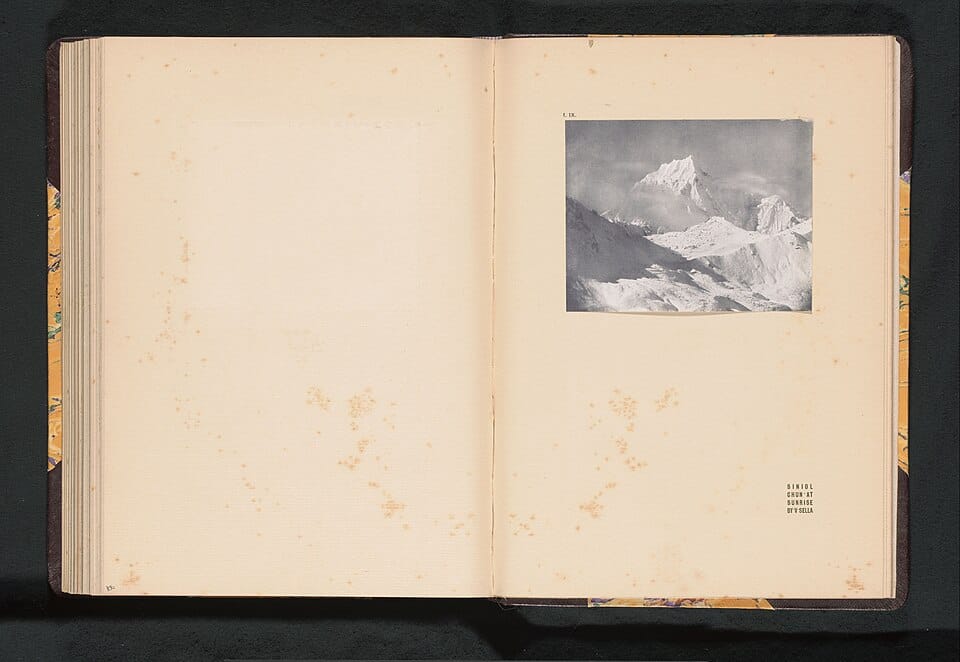
Siniolchun at sunrise (album page, Gezicht op de Siniolchu)
V. Sella; Rijksmuseum, RP-F-2001-7-1668-101, CC0 (via Wikimedia Commons). Source: Siniolchun at sunrise (album page, Gezicht op de Siniolchu) at Rijksmuseum
Made by an AI model
An image gpt-image-2 made from this style’s choices, then checked against them by a vision model. Not a photograph, and not part of the style’s history. All generated images
-
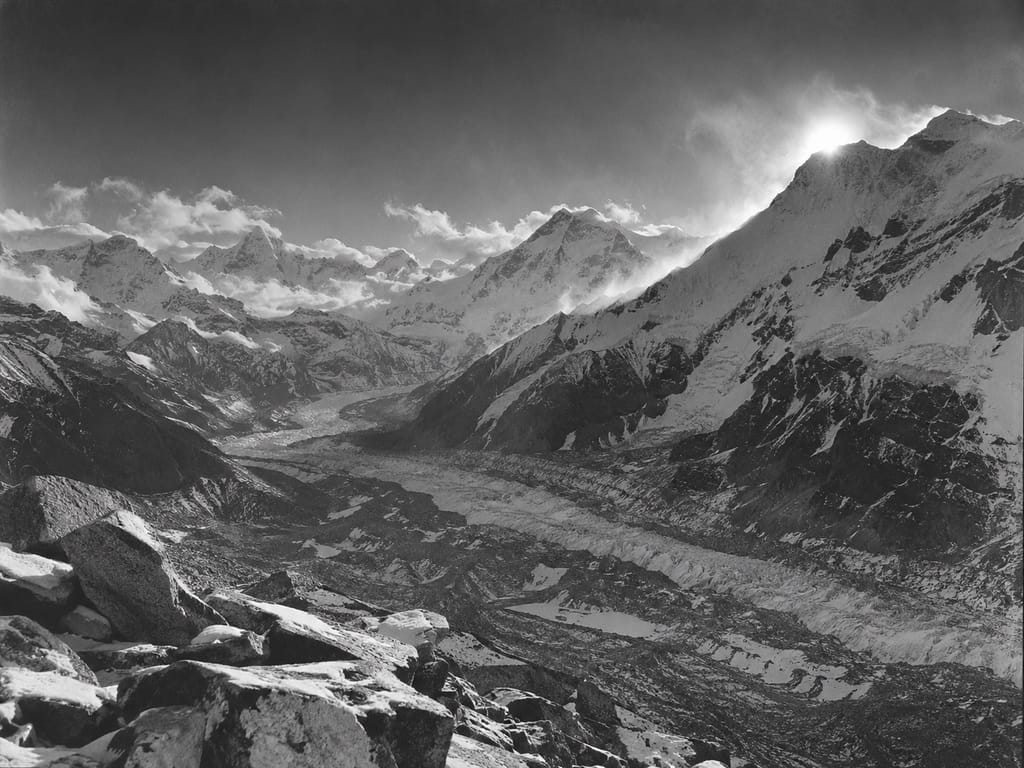
A black-and-white view across a rugged mountain valley shows a glacier winding between towering, snow-covered peaks, with large rocks in the foreground. Sunlight breaks over the ridge at upper right, illuminating clouds and blowing snow around the summits. What the check saw. Deep focus, a full monochrome tonal range, and strong backlighting emphasize the immense scale and rugged textures of the mountain landscape.
With other styles
Pairs with Heroic Age polar expedition photography. A sibling expedition idiom, not its parent (it dates from 1910 on, after Sella and Bisson): the same book of far, sharp views with a tiny figure for scale; take from it the blank white snow and cold light, then swap ships, huts and team portraits for ridge, rope and summit.
Pairs with Western survey photography. Its parent: both climb for a far, sharp view on big plates; keep the survey's layered depth, but shoot up at snow and rock and build the sequence around a route and a summit instead of a territory.
The opposite: Straight photography. Straight photography comes close to isolate form on glossy prints; the expedition view stays far, includes the whole range and records the climb.
The opposite: New Topographics. Level, deadpan views of altered land against high, dramatic views of untouched peaks; reverse each choice to see the contrast.
Sources
- Vittorio Sella, Wikipedia: https://en.wikipedia.org/wiki/Vittorio_Sella (born 28 August 1859, died 12 August 1943, Caucasus, Mount Saint Elias and Rwenzori expeditions, 1909 K2 and Karakoram with the Duke of the Abruzzi, 30 x 40 cm plates, modified pack saddles and rucksacks, Fondazione Sella in Biella)
- Luigi Amedeo, Duke of the Abruzzi, Wikipedia: https://en.wikipedia.org/wiki/Luigi_Amedeo,_Duke_of_the_Abruzzi (Mount Saint Elias 1897, Rwenzori 1906, K2 and Chogolisa 1909)
- John Noel, Wikipedia: https://en.wikipedia.org/wiki/John_Baptist_Lucius_Noel (official photographer and film-maker on the 1922 Everest expedition, The Epic of Everest 1924, born 1890, died 1989)
- 1924 British Mount Everest expedition, Wikipedia: https://en.wikipedia.org/wiki/1924_British_Mount_Everest_expedition (Noel as photographer and movie camera operator, photographic rights, 8 June 1924 sighting)
- Auguste-Rosalie Bisson, Wikipedia: https://en.wikipedia.org/wiki/Auguste-Rosalie_Bisson (summer 1861 Mont Blanc summit photographs, 25 porters)
- Wikimedia Commons, Photographs by Vittorio Sella (public domain): https://commons.wikimedia.org/wiki/Category:Historical_images_of_mountains_by_Vittorio_Sella
- Rijksmuseum, Gezicht op de Siniolchu, RP-F-2001-7-1668-101 (Siniolchun at sunrise by V. Sella, c. 1900-1905 is the album date of the autotype reproduction, not necessarily the exposure): http://hdl.handle.net/10934/RM0001.COLLECT.718612