Styles / Fashion & commercial
Outdoor and location pole dance photography
One of four ways to photograph pole dance: compare them side by side.
- Key: the sun, from behind, to the camera’s left, high, hard.
- Reflector: a white card or reflector, about 55° to the camera’s right, soft.
Key high: about 30–45° above eye level, angled down.
Schematic, not to scale: worked out from the style’s choices. No set-up of this style has been rendered yet.
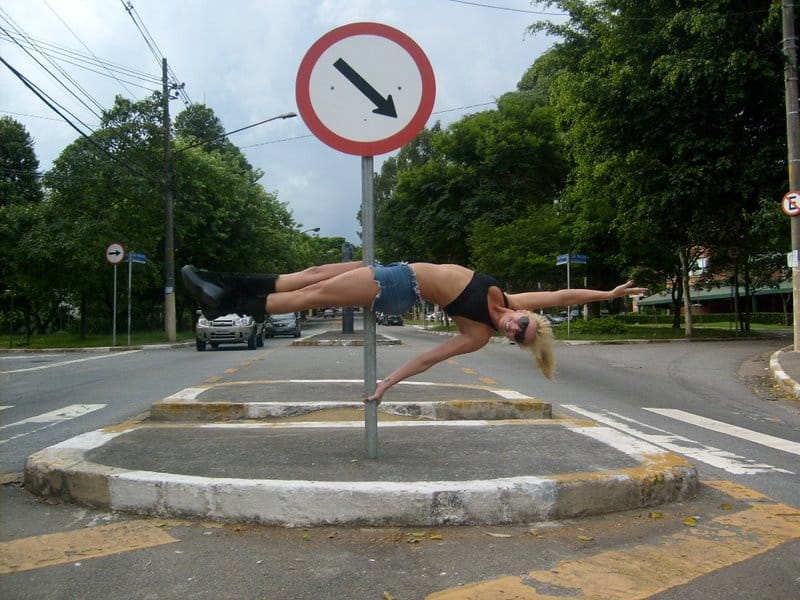
Pole dance street, realizado numa placa de trânsito (pole street on a traffic sign)
Elislike, Streetpoleplaca, 2009. Wikimedia Commons, CC BY-SA 3.0. Source: Pole dance street, realizado numa placa de trânsito (pole street on a traffic sign) at Wikimedia Commons

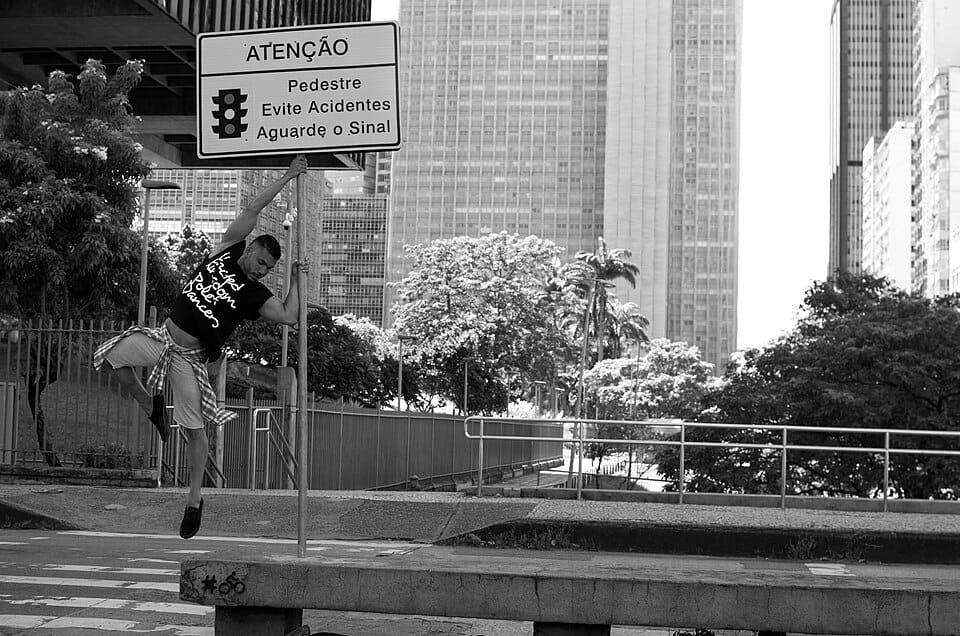
Aguarde o Sinal
Ellen Pederçane, Aguarde o Sinal, 2019. Wikimedia Commons, CC BY-SA 4.0. Source: Aguarde o Sinal at Wikimedia Commons (Wiki Loves Folklore 2025, Brazil)

A pole dancer photographed whole, mid-trick, on a portable stage pole or a found street pole, out in a real place: sea, rocks, dunes, a field, a rooftop, a city street. On a portable pole the camera stands back and often low, so body and pole stand against the sky and the horizon, and the place counts as much as the trick; on a street pole it stays at eye level among traffic and buildings. The light is the day's own: low sun behind the dancer with a reflector, hard sun, or overcast. Sessions are planned with the dancers and shown as sets.
Built mostly on one system: Body in flight. What systems are.
Shoot sheet for your kit A prompt for an image model The photographs
How the look is made
- Choose the place first and let it carry half the picture: a horizon, a skyline, water or rock behind the pole, with nothing on the ground that pulls the eye from the body.
- Stand a portable pole level and safe before anyone climbs: on a flat, firm surface, its base shimmed with stones or dug into sand, away from cliff edges and traffic, and level with the horizon when the horizon is in the frame.
- Go low and stand back with a wide or normal lens, so the whole trick and the whole pole sit against the sky, and ask the dancers to climb as high as they can so the body clears the horizon.
- Shoot at golden hour or just after sunset with the sun behind the dancer, and have an assistant hold a silver reflector high in front to light the face and body from above; without it the dancer goes to silhouette. In hard sun keep holds short, since the pole heats up, and in overcast light consider black and white.
- On a found street pole, such as a traffic-sign post, check that the post is fixed and will carry a body's weight, work from a traffic island or a pavement out of the traffic, and shoot from eye level at middle distance in whatever daylight there is, so the sign, the road and the buildings read around the trick.
- Freeze each trick at its held peak at 1/250 s or faster, pick an outfit whose colour stands out against the place, and show the set as a series that moves from wide views of the place to closer frames, removing passers-by but never adding or faking the pole.
Shoot sheet for your kit
Fill in your camera, lenses and lights, and the sheet says which light plays each part, what to work around and where to start on your camera. Without a kit it starts on a full-frame camera.
Light
Key: the sun, from behind, to the camera’s left, high, hard.
Reflector: a white card or reflector, about 55° to the camera’s right, soft.
- Key high: about 30–45° above eye level, angled down.
- Shadow edges
- Shadows with crisp outlines, cast by a small or distant light: direct sun, a bare flash, a spotlight.
- Shadow depth
- Shadows kept light and full of detail by a reflector, a fill light, bounce or bright surroundings (a low lighting ratio, up to about 3:1: the shadow side at most a stop and a half darker).
How the style is lit
- Low sun behind the dancer and the pole, at golden hour or just after sunset, with an assistant holding a silver reflector high in front to throw light onto the face and body from above; without the reflector the dancer turns into a silhouette against the sky.
- Hard morning or midday sun, unmodified or bounced with a reflector, giving crisp shadows on the body and the ground; a pole left in full sun gets too hot to hold, so keep takes short.
- Overcast or rain-cloud daylight over water, rock or a rooftop: soft shadows, the sky as a pale or stormy ground, often converted to black and white or graded low-contrast and blue-green-grey.
This plan is worked out from the style’s choices, so it is drawn as a schematic. One way to get the light, not a record of how any photograph was lit.
Lens and settings
Start at
On a full-frame camera: the same depth of field and exposure as the style’s own numbers, in the same light. Then meter and adjust.
- Then
- 24–70 mm · f/4–f/8 · 1/1000–1/250 s · ISO 100–400 on full frame, inferred from the gear and the look. The one session file with full EXIF ('Aguarde o Sinal', Rio, 2019) was made at about 52 mm equivalent, f/4.5, 1/250 s and ISO 100 in daylight with no flash; the makers' posts give no settings. The range assumes daylight, a shutter fast enough to freeze a held trick, and enough depth of field to keep the place readable; after sunset the ISO rises.
- White balance
- Daylight balance (about 5500 K), so golden-hour and sunset light stays warm on skin and the sky after sunset stays blue or purple; overcast sets are often turned black and white or graded cool.
- Focal length
- A wide view; near things loom and lines stretch towards the edges. Roughly the eye’s own perspective; no visible distortion.
- Focus
- Everything sharp from the nearest stone to the horizon.
- Angle
- Looking up: the subject towers. The camera at the height of a standing person or of the subject.
- Distance
- Whole figures and their immediate surroundings.
- Balance
- The subject in the middle, the frame balanced around it.
- Crop & fill
- The subject shown small within its setting, which explains it. A small subject in a large empty field.
- Depth
- A strong horizon splits the frame into bands.
- Instant
- Movement stopped dead by a fast shutter or flash.
Direct
The dancers choose tricks they can hold safely on that pole on that ground: inversions, human flags, splits, laybacks, shoulder mounts and butterflies, held at the peak for a few frames with toes pointed and legs reaching past the pole, often as high on the pole as possible so the body clears the horizon. Two dancers mirror or stack poses in double tricks. Faces are calm, turned to the sun or the view, sometimes looking to the lens or smiling in a street frame. Between climbs the dancers sit, lean or pose on rocks, branches or at the foot of the pole.
- Whole body
- MustChoose tricks you can hold on this pole on this ground: inversions, splits, laybacks, shoulder mounts, butterflies and, for strong dancers, a human flag; hold each at its peak for a few frames.Subject chooses. The trick at full extension against the place is the picture.
- MustFrame the place as half of the picture: horizon, rock, water or roofline set deliberately, the dancer and pole placed in it, not filling it.Photographer directs. The location is the co-subject; cropped tight it becomes a studio shot.
- MustNever set the pole near an edge, on a road, on a slope or on a roof without a parapet; check it is level and stable, and that a wet or sun-heated pole can still be held.Safety and consent. Hjorth wedged his pole's base with stones and moved it back from the edge; Eman Ali's pole grew too hot to touch.
- MustAdults only, with written consent for every use; keep passers-by and children out of the frame and respect local rules on public decency.Safety and consent.
- UsuallyFor horizontal shapes (a flag, a Superman, a dancer stretched out from the pole) go wide and line the body up with a line in the land: a ridge, the shore, a roof edge.Photographer directs. Eman Ali's 2022 portrait lays the dancer along the Hajar Mountains; the body and the land share one line.
- OptionalStep far back now and then so the dancer is small in a large landscape.Photographer directs.
- Head and neck
- UsuallyTurn the face to the sun or the view, or along the reaching leg; a look to the lens or a smile suits a city or street frame.Photographer directs.
- UsuallyTry the gaze in more than one direction for the same shape: up the pole, along the extended leg, down to the floor, out to the light, and once to the lens.Photographer directs. Where the eyes go changes the whole picture more than small changes in the body (The Polept).
- Face and eyes
- UsuallyBreathe through the hold and keep the breath only for the moment of the frame; let the face stay easy.Subject chooses. Held breath shows as a red, strained face (Pole Fit Freedom; PoleCon).
- Hands
- UsuallyIn laybacks, planks and Supermans, turn the free palm away from the camera and lengthen the fingers.Photographer directs. A flat palm facing the lens catches the eye and breaks the line (Pole Fit Freedom).
- Torso and hips
- OptionalBetween climbs, sit, lean or pose on the rocks, branches or at the foot of the pole.Subject chooses. Grounded shapes round out a set and rest the grip.
- Legs
- MustStraight legs and pointed toes reaching past the pole; climb high so the body clears the horizon.Photographer directs. A body above the horizon line stands against the sky instead of the ground behind it.
- UsuallyGo low, to hip height or kneeling, for most frames: the pole rises into the sky and the legs lengthen against it.Photographer directs.
- Together
- OptionalTwo dancers mirror each other on one pole or stack in a double trick.Subject chooses.
Must: the look depends on it · Usually: what the style does most of the time · Optional: one possibility among others.
- With the sitter
- The subject performs for the camera and shapes the picture.
- The set-up
- A scene staged and directed like a film still or a painting.
Style the set
Pole wear the dancers choose (shorts and a crop or bra top that leave legs and arms bare for grip, bare feet outdoors, sometimes platform heels), changed so its colour stands out against the place; sometimes a flowing or sheer skirt for movement, or street clothes for a city frame. The set is the place as found plus the pole and its base: a few props at most (smoke bombs, petals, an umbrella), and no backdrop.
- Clothes
- Outfits the wearers put together to be seen, designer labels included: layering, sneakers, statement pieces.
- Set & props
- A real place picked for its look as the setting for a shoot, not the subjects’ own: a street, a field, a palace, a hotel room.
- How much is styled
- A few small touches (a tidied table, a straightened collar, a chosen outfit) that still look unplanned.
Finish
- Colour
- An overall yellow, orange or red cast. Strong, dense colours.
- Digital & other
- A modern digital camera: clean, detailed, neutral.
- Texture
- Smooth tones with no visible grain.
- Shown as
- Pictures made and shown as a set.
- Shown in
- Pictures made for a scrolling feed.
Stay away from low-key & chiaroscuro, studio backdrop, black shadows, coloured gels, composite & montage, tight crop and direct on-camera flash.
Before you shoot it
The pictures show real adult dancers, mostly amateurs and instructors, in little clothing and in shapes that can be read sexually, and outdoors they are shot in public. Publish only with each dancer's consent for each use and platform: pole still carries stigma from its strip-club roots, and in some places (Eman Ali called a pole studio in Oman 'highly unusual') being recognised can cost a dancer at work, at home or with the law. Respect local rules on public decency and on using public space, keep passers-by and children out of the frame, and do not imply that a dancer is or is not a sex worker. Safety comes first: never set the pole near a cliff edge, on a road with traffic, on a slope or on a roof without a parapet; check that a portable pole is level and stable, that a found pole is fixed and will carry the load, and that a wet or sun-heated pole can still be held.
A prompt for an image model
A ready prompt that describes this look to an image model: where the lights stand, the lens, the framing and the colour. It starts on the style’s own choices; change any of them and the prompt and the notes follow.
The prompt
Notes on this prompt
- How the style uses it: shoot at golden hour or just after sunset with the sun behind the dancer, and have an assistant hold a silver reflector high in front to light the face and body from above; without it the dancer goes to silhouette. In hard sun keep holds short, since the pole heats up, and in overcast light consider black and white. Image models put the light in the wrong place more often than anything else, so the prompt says where each light stands: which side of the picture, and how high. Keep to one light pattern per prompt, or the model splits the difference.
- Give the camera height in plain words: from knee height looking up, from a stepladder looking down, straight down onto the table.
The model makes a new picture, not a photograph of anything that happened. Label it as AI-generated, and don’t pass it off as the style’s history or as a real person.
Where to see it
From open collections, shown whole with their credits. Later photographs are linked, not shown, while they are in copyright.
In copyright, so linked
- Splash Dancing (a dancer on a portable pole standing in the sea) , Johannes Hjorth, July 2018. Johannes Hjorth's photo blog (post 'Splash Dancing', file hjorthmedh-splash-dancing-16.jpg, the second picture in the post).
- On the Rocks (a dancer on a portable pole above Brunnsviken) , Johannes Hjorth, 27 May 2017. Johannes Hjorth's photo blog (post 'On the Rocks', file hjorthmedh-on-the-rocks-12.jpg, the third picture in the post).
Made by an AI model
An image gpt-image-2 made from this style’s choices, then checked against them by a vision model. Not a photograph, and not part of the style’s history. All generated images
-
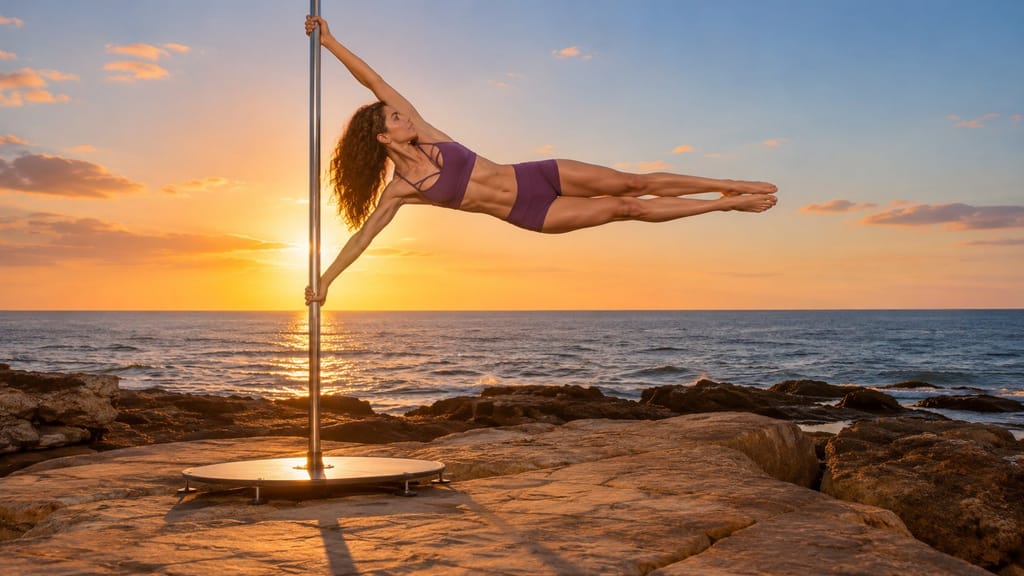
An athletic woman in a purple sports bra and shorts holds her body horizontally from a freestanding metal pole on a rocky shoreline. The sun is setting behind the pole over the sea, casting orange light across the rocks and clouds. What the check saw. A staged athletic portrait pairs a horizontal strength pose with a warm seaside sunset and a clearly layered rocky foreground.
With other styles
The opposite: Low-key pole and aerial studio photography. The same dancers and tricks, but the studio idiom removes the place with darkness and strobes; here keep the daylight and let the landscape or skyline stand behind the whole figure.
The opposite: Contemporary levitation photography. Both put a body in the air in a real place, but levitation hides or removes its support; here the pole stays in the picture and nothing is composited.
Pairs with Tropical influencer travel photography. Borrow its golden-hour backlight, beach and rooftop locations and feed sequencing, but replace the relaxed traveller with a dancer at full stretch on the pole.
The opposite: Dramatic sportrait photography. Sportraits light the athlete with gelled flash against a darkened venue; here the sun and a reflector do the work and the place stays bright and readable.
Sources
- https://abc17news.com/entertainment/cnn-style/2023/03/08/an-elegant-portrait-of-a-pole-dancer-in-oman-celebrates-a-womans-strength-in-nature/ (Jacqui Palumbo, CNN Style, 8 March 2023: Eman Ali's portrait of Nusaiba Al Maskari, instructor at the Rock & Rhythm studio, on a portable pole by the Bousher dunes ('Urooq') in Muscat with the Hajar Mountains behind, on a sweltering morning; the pole got too hot to touch; Ali calls having such a studio in Oman 'highly unusual'; no date given for the portrait; series shown at Paris Photo)
- https://anothermag.com/art-photography/14517/eman-ali-paris-photo-the-earth-would-die-if-the-sun-stopped-kissing-her (Sarra Alayyan, AnOther, 11 November 2022: the series came from a month-long road trip through Oman in the spring of 2022, shown at Paris Photo 10–13 November 2022, including a portrait of Nusa, 'a professional hijabi pole dancer performing with Muscat in the background')
- https://photo.johanneshjorth.se/tag/pole-dance (maker's blog: dated outdoor pole sessions in and around Stockholm, 2016–2021)
- https://photo.johanneshjorth.se/pole-position/ (31 August 2016: portable pole from Vida Pole at the Blue Lagoon, Ekerö; legs dug into sand, pole in the water; overcast, partly black and white or low-contrast blue-green-grey; picnickers removed in editing)
- https://photo.johanneshjorth.se/?p=18946 ('On the Rocks', 28 May 2017: pole borrowed from Anna-Maija Nyman, moved by Uber and sack barrow, carried up a rock, base wedged with branches and stones, moved back from the edge; sun behind the pole, a silver reflector, golden hour and sunset)
- https://photo.johanneshjorth.se/?p=18970 ('Queen of Clouds', 31 May 2017: Enebyberg, harsh sun, reflector held high to light faces from above, photographer lying on the ground, sheer skirt, smoke bombs and rose petals)
- https://photo.johanneshjorth.se/splash-dancing/ (13 July 2018: X-Pole lent by Vida Pole, carried into the sea at Golö; natural light to just after sunset, a reflector in one frame; a wet pole is slippery)
- https://photo.johanneshjorth.se/millenial-towers/ (23 March 2019: X-Stage pole on a 16th-floor roof terrace in Råcksta, evening)
- https://photo.johanneshjorth.se/meant-to-be/ (1 August 2021: portable X-Pole balanced on a rock at Kalkbadet, Norrtälje, kept level with the horizon; dancers climb high to clear the horizon)
- https://polepassion.blogspot.com/2010/09/jass-foley-photos-in-swiss-alps.html (Pole Passion UK, 22 September 2010: an announcement of shoots by Jass Foley, 'driving with my crew from Ireland', with a portable R-Pole around Zurich and in the Swiss Alps, at sunrise, sunset or night; dates available to shoot 30 September to 4 October 2010, in Zurich 29 September to 5 October; a €500 package of six images; no finished photographs shown)
- https://xpoleus.com/x-stage-pro-portable-pole-stage/ (X-Pole: the X-Stage Pro portable pole stage is 'suitable for indoor and outdoor use')
- https://commons.wikimedia.org/wiki/File:Aguarde_o_Sinal.jpg (Ellen Pederçane, dated 31 March 2019 by EXIF (the description also gives 2018), project 'Compasso Urbano', Rio de Janeiro, CC BY-SA 4.0; EXIF Nikon D5100, 35 mm, f/4.5, 1/250 s, ISO 100)
- https://commons.wikimedia.org/wiki/File:Streetpoleplaca.jpg ('Pole dance street, realizado numa placa de trânsito', Elislike, dated 2009-04-13, CC BY-SA 3.0)
- https://commons.wikimedia.org/wiki/Category:Pole_street