Styles / Fashion & commercial
High-key pole and aerial studio photography
One of four ways to photograph pole dance: compare them side by side.
- Key: a softbox, about 40° to the camera’s left, high, soft.
- Rim or hair light: a spot or bare head, from behind, to the camera’s right, high, hard.
- Reflector: a white card or reflector, about 55° to the camera’s right, soft.
- Background light: a softbox, from behind the subject, soft.
Key high: about 30–45° above eye level, angled down.
Schematic, not to scale: worked out from the style’s choices. No set-up of this style has been rendered yet.
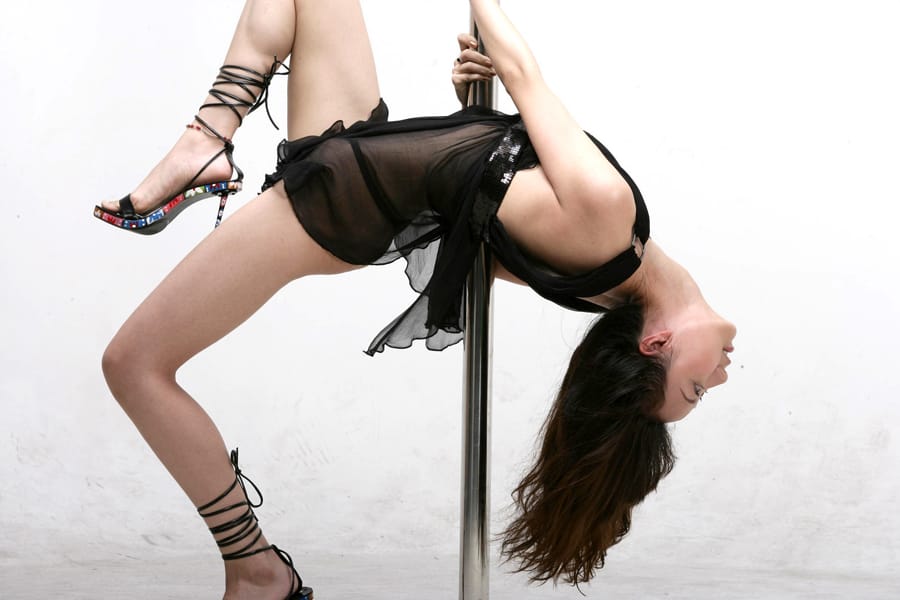
Designs for my friends studio (Commons title: Asian model bending backwards with pole)
Sherry Zhang, Designs for my friends studio, 2006. Wikimedia Commons, CC BY 2.0. Source: Designs for my friends studio (Commons title: Asian model bending backwards with pole) at Wikimedia Commons (from the photographer's Flickr)

A pole dancer or aerialist photographed whole, mid-trick, on a chrome pole, hoop or silks, set in a field of white. Lights on the backdrop burn it out and spill round the edges of the body, so the dancer reads as a slightly darker, softly modelled shape with every line and grip legible. The camera stands back with a normal lens and leaves white space beyond the toes. Some makers, Denyer among them, finish the whole set in one lifted, desaturated grade with the corners eased to grey.
Built on two systems: Body in flight and Sweet retouch. What systems are.
Shoot sheet for your kit A prompt for an image model The photographs
How the look is made
- Light the ground before the dancer: put one or two lights on the white backdrop or wall and push it just past white, enough to burn it out but not so far that flare washes over the body.
- Let the white wrap the body: keep the dancer close enough to the bright ground that its light outlines the legs, arms and pole, and add a large soft light in front only to open the shadows, not to flatten them.
- Keep the whole trick in a field of white: stand back at middle distance with a normal lens, level with the figure, centre or angle the shape, and leave clear space beyond toes and fingertips; crop tight only for detail frames of shoes, hands or grips.
- Agree the trick list with the dancer, photograph each shape at its held peak with toes pointed and fingers long, show the back of the camera so they can correct a line, and keep a mat or spotter in place for inversions.
- Clear the studio out of the frame: hide mirrors, mats and posters, cover the floor in white where it can be done, and in a small studio let a clean floor show rather than clutter the frame; remove floor marks and stray objects in retouching so little but the body, the apparatus and the white is left.
- Keep one treatment across the set: a neutral grade, or, as in Denyer's sessions, a lifted, slightly desaturated grade with the corners eased down to grey; retouch skin and pole marks only as far as the dancer agrees.
Shoot sheet for your kit
Fill in your camera, lenses and lights, and the sheet says which light plays each part, what to work around and where to start on your camera. Without a kit it starts on a full-frame camera.
Light
Key: a softbox, about 40° to the camera’s left, high, soft.
Rim or hair light: a spot or bare head, from behind, to the camera’s right, high, hard.
Reflector: a white card or reflector, about 55° to the camera’s right, soft.
Background light: a softbox, from behind the subject, soft.
- Key high: about 30–45° above eye level, angled down.
- Shadow edges
- Shadows that fade gradually from light to dark, cast by a large or diffused light: a window, a softbox, a cloudy sky.
- Shadow depth
- Shadows kept light and full of detail by a reflector, a fill light, bounce or bright surroundings (a low lighting ratio, up to about 3:1: the shadow side at most a stop and a half darker).
- Shape & form
- Light turning gradually into shade across faces and objects, so their volume shows.
- Highlights
- The brightest parts burn out to pure white with no detail, on purpose or because the light was too strong.
How the style is lit
- Backlit white ground: one or two strobes in softboxes or reflectors behind the dancer aimed at a white backdrop or wall, set about one stop above the subject so the ground burns out and its light wraps round the body; the dancer stays a little darker than the white, softly modelled, and the corners are eased down in the edit.
- Even high-key front light: a large softbox or octabox in front of the dancer as key, with the white walls or a reflector as fill, plus a light on the backdrop and, where the floor shows, one on the floor in front, so the body is evenly lit with open shadows and the ground stays white (a common studio set-up; Hjorth's two flashes, one through an umbrella and one on the floor, in front of a white wall are a small version).
- Daylight or room light on a white studio wall, the pale floor and walls bouncing light back, for makers without strobes; mirrors facing the dancer are covered or turned away.
This plan is worked out from the style’s choices, so it is drawn as a schematic. One way to get the light, not a record of how any photograph was lit.
Lens and settings
Start at
On a full-frame camera: the same depth of field and exposure as the style’s own numbers, in the same light. Then meter and adjust.
- Then
- 35–125 mm · f/5.6–f/14 · 1/250–1/125 s · ISO 100–200 on full frame, inferred from the gear and the look. Inferred from studio strobe practice: base ISO, flash-sync speed and a mid to small aperture so the whole body and the pole are sharp. The only file with camera data is Zhang's 2006 precursor, made at 125 mm, f/14, 1/200 s, ISO 100 on a full-frame Canon EOS-1Ds Mark II. Denyer's and Hjorth's published files carry no camera data, and the full-figure frames suggest a normal lens from middle distance.
- White balance
- Flash or daylight balance keeps the backdrop white and skin neutral; makers who grade the set (Denyer) then desaturate it and warm or cool it slightly.
- Focal length
- Roughly the eye’s own perspective; no visible distortion.
- Angle
- The camera at the height of a standing person or of the subject.
- Distance
- Whole figures and their immediate surroundings.
- Balance
- The subject in the middle, the frame balanced around it. Tilted lines and oblique movement drive the picture.
- Crop & fill
- A small subject in a large empty field.
- Instant
- Movement stopped dead by a fast shutter or flash.
Direct
The dancer chooses tricks they can hold safely (inversions, splits, handsprings, laybacks and sit-ons on the pole, hangs and arches in the hoop or silks) and holds each at its peak for a few frames, with toes pointed, legs long and fingers spread; in the airborne shapes the face usually turns up, away or back. Standing, seated and floor shapes at the foot of the pole (lunges, back arches, lying stretches) are as common, and in these the dancer often faces and smiles at the lens; doubles shapes and an occasional group pyramid fill out a session, and the photographer adjusts only angles and lines.
- Whole body
- MustHold each trick at its peak for a few frames: inversions, splits, handsprings, laybacks and sit-ons on the pole; hangs and arches in hoop or silks.Subject chooses. On white, the outline is the picture; it must be complete and still.
- MustWhole figure in the frame, centred or on a diagonal, with plenty of white around it.Photographer directs.
- MustBring a list of tricks you can hold on demand, simple ones included (a pole sit, a layback, a crucifix, a leg hang, a butterfly or extended butterfly, a Superman), plus one or two harder shapes; hold each at its peak for a few frames.Subject chooses. A clean beginner or intermediate shape looks better on camera than a strained advanced one, and the photographer will ask for repeats while finding the angle (Pole Fit Freedom; The Polept).
- MustAgree the trick list first, keep holds short, and keep a crash mat or spotter in place for inversions; never ask for a trick, a longer hold or a repeat the dancer has not offered.Safety and consent. Holds tire the grip, and a slip from an invert can injure.
- MustAdults only, with written consent for every use and platform; children who train at the studio are never part of this style.Safety and consent.
- UsuallyFor horizontal shapes (a Superman, a flag, an extended butterfly) step back or go wider and frame across, giving the reach room on both sides.Photographer directs. Horizontal moves can come out better with a wide lens or a background that runs with them (Stardust).
- UsuallyBefore the lights go on, agree which side and direction faces the camera for each trick; on a static pole in front of a backdrop the camera cannot circle, so the dancer picks the starting side or a helper turns the spinning pole a few degrees.Photographer directs. Moves often end facing away from the lens; settling the side first saves holds (The Polept; Stardust).
- OptionalShoot the move between the moves as well as the held peak: a spin, a body wave or the swing into an invert, at 1/500 s or faster or with flash.Photographer directs. Transitions carry feeling that a static hold lacks (IPIA, from PoleCon's photographer).
- Head and neck
- UsuallyTry the gaze in more than one direction for the same shape: up the pole, along the extended leg, down to the floor, out to the light, and once to the lens.Photographer directs. Where the eyes go changes the whole picture more than small changes in the body (The Polept).
- Face and eyes
- UsuallyBreathe through the hold and keep the breath only for the moment of the frame; let the face stay easy.Subject chooses. Held breath shows as a red, strained face (Pole Fit Freedom; PoleCon).
- Hands
- UsuallyIn laybacks, planks and Supermans, turn the free palm away from the camera and lengthen the fingers.Photographer directs. A flat palm facing the lens catches the eye and breaks the line (Pole Fit Freedom).
- Torso and hips
- UsuallyStanding, seated and floor shapes at the foot of the pole (lunges, back arches, lying stretches) between the airborne tricks; in these the dancer may face and smile at the lens.Subject chooses. They rest the grip and give the set its portraits.
- OptionalShoot some shapes from behind or three-quarters behind: the arch of a layback, the line of the back in a split, the head turned back over the shoulder.Photographer directs. The back shows the grip and the bend that the front hides.
- Legs
- MustLegs long, knees locked where the trick allows, toes pointed, every limb clear of the pole.Photographer directs. Against white every bent knee and flexed foot shows as a dark notch in the outline.
- OptionalDrop low for climbs and high splits so the dancer rises against white.Photographer directs.
- Feet
- OptionalBetween full-body frames, take a close detail: the grip of hand or heel on the pole, a pointed foot against the backdrop.Photographer directs. Details round out a set and need no long hold.
- Together
- OptionalDoubles shapes, or a small group pyramid around one pole.Subject chooses.
Must: the look depends on it · Usually: what the style does most of the time · Optional: one possibility among others.
- With the sitter
- The subject performs for the camera and shapes the picture.
Style the set
Pole wear chosen by the dancer: shorts and crop tops, leotards and lace bodysuits that leave legs and arms bare for grip, often platform heels on the pole, bare feet or ballet shoes for aerial and floor work, sometimes a flowing skirt or fabric for one concept. Hair loose or tied, make-up polished. The set is only the chrome pole, the hoop or the silks and the white ground; mirrors, posters and mats are kept out of frame; the floor is covered in white or, in smaller studios, left showing (as in Hjorth's North Pole Studio frames).
- Set & props
- A painted, cloth, paper or seamless backdrop behind the subject.
- Look of the styling
- Few, simple elements on clean surfaces, with space around them.
Finish
- Colour
- Colour held back towards grey. White balanced to the light, so whites stay white and skin, food and products keep their real colour, with no overall cast.
- Digital & other
- A modern digital camera: clean, detailed, neutral.
- Texture
- Smooth tones with no visible grain.
- Post-production
- Perfected skin and surfaces.
- Shown as
- Pictures made and shown as a set.
Stay away from low-key & chiaroscuro, deep shadows, black shadows, coloured gels, direct on-camera flash, environmental, real, lived-in place, candid & unobserved, fisheye, silhouette and shallow depth of field.
Before you shoot it
The pictures show real adult dancers, often ordinary students and instructors in little clothing, posed in shapes that can be read sexually, and the bright, clean finish makes them easy to repost out of context. Publish or share only with each dancer's written consent for each use and platform; many keep pole photographs private because of the stigma attached to pole and its strip-club roots, and some face consequences at work or at home if they are recognised. Do not assume or imply that a dancer is or is not a stripper or sex worker, and do not erase the strippers who developed the moves. Never ask for a trick the dancer cannot hold safely, keep holds short, and use a mat or spotter for inversions. Adults only: pole and aerial studios teach children, who are not part of this style and must never be shown in it. Stock 'pole dancer on white' images are not exemplars.
A prompt for an image model
A ready prompt that describes this look to an image model: where the lights stand, the lens, the framing and the colour. It starts on the style’s own choices; change any of them and the prompt and the notes follow.
The prompt
Notes on this prompt
- How the style uses it: light the ground before the dancer: put one or two lights on the white backdrop or wall and push it just past white, enough to burn it out but not so far that flare washes over the body. Image models put the light in the wrong place more often than anything else, so the prompt says where each light stands: which side of the picture, and how high. Keep to one light pattern per prompt, or the model splits the difference.
- Heavy retouching: ask for smooth skin that keeps its pores, or the model makes it look like plastic.
The model makes a new picture, not a photograph of anything that happened. Label it as AI-generated, and don’t pass it off as the style’s history or as a real person.
Where to see it
From open collections, shown whole with their credits. Later photographs are linked, not shown, while they are in copyright.
In copyright, so linked
- First Class Pole Fitness Photoshoot, twisty-grip handspring, frame 153 , Denyer (denyer.pro), 9 August 2014. Denyer.pro, galleries.
- Bliss Dance – Nuneaton, frame 1506 , Denyer (denyer.pro), 26 July 2015. Denyer.pro, galleries.
With other styles
The opposite: Low-key pole and aerial studio photography. Keep the same whole-trick framing and dancer-led tricks, but light the backdrop instead of killing it, so the body reads darker than its ground rather than carved out of black. Within Denyer's galleries the white look followed the dark one (dark from November 2013 to June 2014, white from August 2014, with dark sessions continuing beside it), so the pair is a change of approach by one maker, not two separate scenes.
Pairs with E-commerce packshot on white. Borrow its separately lit white ground and clean retouching, but keep soft modelling on the body and let the backlight wrap the edges rather than flattening everything to a cut-out.
The opposite: Korean body-profile fitness portraiture. Body profiles sculpt a grounded torso with side light on a dark ground; here the trained body is suspended whole on an apparatus in soft white light.
The opposite: Boudoir photography. Boudoir reclines a client close up for a private album; this idiom puts the body to work on a pole at middle distance and publishes the session as a gallery.
The opposite: Contemporary levitation photography. Levitation fakes flight in a real setting with a composite; here the dancer really hangs from the pole and the setting is erased by white.
Sources
- https://www.denyer.pro/galleries/ (maker's gallery index, one list whose descriptions label shoots dark ('A dark theme', 'A darker look'), moody or dramatic, white ('White backdrop style images', 'A smaller white-themed pole photoshoot'), or live events)
- https://www.denyer.pro/galleries/first-class-pole-fitness-photoshoot-2014/ ('White backdrop style images from a great shoot at 1st Class Fitness'; files dated 2014-08-09, alt texts naming pole moves and aerial hoop shapes)
- https://www.denyer.pro/galleries/bliss-dance-2015/ ('A smaller white-themed pole photoshoot at Bliss Dance'; files dated 2015-07-26)
- https://www.denyer.pro/galleries/pole-athletes-epic-3-day-photoshoot/ (poledance and aerial hoop shoot in Chesterfield; files dated 2014-11-22; white ground)
- https://www.denyer.pro/galleries/flight-fitness-pole-photoshoot-july-2015/ (aerial arts and poledance shoot at Flight Fitness; files dated 2015-07-10; white ground)
- https://www.denyer.pro/galleries/emilys-pole-fitness-instructor-shoot/ (instructor shoot; files dated 2016-11-16; white ground, including a group pyramid and aerial hoop)
- https://www.denyer.pro/galleries/flight-fitness-instructor-shoot-2014/ ('A dark theme for the instructors pole photoshoot at Flight in Leicestershire'; files dated 2014-06-07: the dark counterpart two months earlier)
- https://www.denyer.pro/galleries/flight-fitness-poleshoot-spring-2015/ ('A poledance student photoshoot … at Flight Fitness in Leicester'; files dated 2015-03-14; white ground, earlier than the Bliss session)
- https://www.denyer.pro/galleries/legends-march-2016/ (Legends – March 2016; white ground)
- https://www.denyer.pro/galleries/flight-fitness-instructors-november-2015/ (Flight Fitness Instructors – Winter Edition; files dated 2015-11-15; white ground)
- https://www.denyer.pro/galleries/first-class-pole-october-2015/ ('A darker look for the performers over at 1st Class Fitness'; files dated 2015-10-03: dark sessions continued beside the white)
- https://www.denyer.pro/galleries/pole-athletes-november-2013/ ('Shooting a dramatic themed look…' at Pole Athletes; dark ground, the earliest dated sessions in the index)
- https://www.denyer.pro/galleries/pole-athletes-march-2014/ ('A moody theme for a poledance group photoshoot up in Chesterfield'; dark ground)
- https://www.denyer.pro/galleries/flight-fitness-may-2014/ (Flight Fitness poledance photoshoot; files dated 2014-05-17; dark ground)
- https://photo.johanneshjorth.se/?p=18600 (Johannes Hjorth, 'Above it all', 20 March 2017: doubles pole shoot at North Pole Studio, Stockholm, the afternoon before; mirrors on two walls; 'one white wall in one corner which provided a nice clean backdrop'; two flashes, one through an umbrella on a stand and one on the floor)
- https://www.flickr.com/photos/60033858@N00/142102036 (Sherry Zhang, 'Designs for my friends studio', taken 23 April 2006, CC BY 2.0)
- https://commons.wikimedia.org/wiki/File:Asian_model_bending_backwards_with_pole.jpg (the same picture on Commons; EXIF: Canon EOS-1Ds Mark II, 125 mm, f/14, 1/200 s, ISO 100, manual, camera flash not fired)
- https://neilvn.com/tangents/lighting-a-white-seamless-studio-backdrop/ (Neil van Niekerk, 26 March 2017: a white seamless needs its own light pushed to the edge of the histogram, not so far that it causes lens flare or a halo round the subject; a large softbox in front)
- https://www.diyphotography.net/dramatic-lighting-pole-dancing-fitness-instructors/ (JP Danko, 29 May 2014: mirrors and a light-coloured floor as the problem of pole studios for dark lighting)
- https://en.wikipedia.org/wiki/Pole_dance (strip-club origins of the athletic moves, pole as fitness from the 2000s)