Styles / Fashion & commercial
Latex fetish fashion photography
- Key: a softbox, about 40° to the camera’s left, high, soft.
- Edge light: a strip softbox, from behind, to the camera’s left, soft.
- Edge light: a strip softbox, from behind, to the camera’s right, soft.
Key high: about 30–45° above eye level, angled down.
Schematic, not to scale: worked out from the style’s choices. No set-up of this style has been rendered yet.
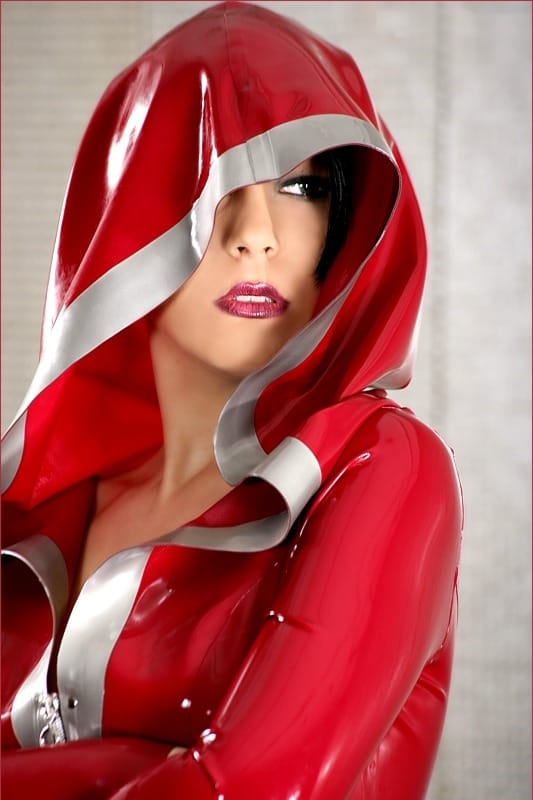
Photomodel MissLatex wearing rubber / latex outfit
MissLatex.eu, CC BY-SA 3.0, via Wikimedia Commons. Source: Photomodel MissLatex wearing rubber / latex outfit at Wikimedia Commons

Adults dressed in latex, rubber, PVC and corsetry, photographed as a surface: the garment is a second skin and the picture is its reflections. A tall, still figure stands on a plain or club ground, lit, by one practitioner's advice, with strip and rim lights that run long, controlled highlights down the glossy limbs. No smile, no story; stance, gaze and shine carry the picture, for fetish magazines, labels and club culture.
Built on three systems: Glamour studio, Stage light and Gloss and curve. What systems are.
Shoot sheet for your kit A prompt for an image model The photographs
How the look is made
- Treat the garment as a still life: decide where each reflection falls before the model moves, and control the highlights instead of trying to eliminate them.
- Light with strips: place long thin strip boxes at an acute angle to run a specular line down each arm and leg, and a larger soft source close in for the torso.
- Add a rim light from behind on both sides so the black or coloured material separates from the ground; keep the plain ground dark, grey or one saturated colour.
- Clear the room of anything you do not want mirrored: black flags, no bright clothes on the crew, no clutter in front of the glossy surface.
- Pose the figure statuesque and square: straight or contrapposto stance, elongated line, a hand on the hip, a direct, intent gaze and no smile.
- Prepare the latex and the skin before the shoot: polish the surface, remove dust and fingerprints, then keep the retouch clean and limited to the highlights.
Shoot sheet for your kit
Fill in your camera, lenses and lights, and the sheet says which light plays each part, what to work around and where to start on your camera. Without a kit it starts on a full-frame camera.
Light
Key: a softbox, about 40° to the camera’s left, high, soft.
Edge light: a strip softbox, from behind, to the camera’s left, soft.
Edge light: a strip softbox, from behind, to the camera’s right, soft.
- Key high: about 30–45° above eye level, angled down.
- Shape & form
- Light turning gradually into shade across faces and objects, so their volume shows.
- Highlights
- Small, bright glints where the light reflects off wet, oily or polished surfaces: glistening food, dewy skin, the sparkle of jewellery or chrome. Clean, controlled reflections of strip lights or panels running along glass, metal and glossy packaging, drawing the object’s edges as bright or dark lines.
How the style is lit
- Two long strip boxes at an acute angle either side of the figure, behind the line of the body, for long specular lines on arms and legs, with a large soft source close to the front for the torso.
- A rim or edge light from behind on each side with black flags on the camera side, against a seamless black, grey or saturated paper ground.
- Club or industrial location: coloured practical lights and a camera flash kept off the glossy surface, with the room's reflections checked in the frame; this flash and club variant is outside the genome.
This plan is worked out from the style’s choices, so it is drawn as a schematic. One way to get the light, not a record of how any photograph was lit.
Lens and settings
Start at
On a full-frame camera: the same depth of field and exposure as the style’s own numbers, in the same light. Then meter and adjust.
- Then
- 70–135 mm · f/8–f/11 · 1/160–1/125 s · ISO 100–200 on full frame, inferred from the gear and the look. Worked out from the studio look and the strobe lighting practitioners describe: a short telephoto, stopped down to hold a full figure sharp, at a flash-sync shutter speed and base ISO so the ambient light stays out of the glossy surface. No source gives typical settings.
- White balance
- Flash or daylight balance (about 5500 K) set from a neutral card: skin stays warm, black and chrome latex neutral to cool, and any gel cast stays on the ground only.
- Angle
- The camera at the height of a standing person or of the subject.
- Duration
- An unmoving scene, exposed slowly and carefully.
Direct
Pose adults standing tall: weight on one leg or both feet planted, spine long, a hand on the hip or resting at the side, chin level or a little down, and a direct, intent or cool gaze without a smile. Turn the body three-quarters to show the shine of the long line of the garment, and hold still between frames so each reflection can be set and checked. Agree each pose with the model and the maker.
- Whole body
- MustAgree each pose with the model and the maker of the garments; photograph only with their explicit consent, credit them, and publish nothing that would out or expose a person.Safety and consent. The pictures show real adults who may be identifiable in a living subculture.
- MustKeep to what fashion editorial shows: no explicit nudity, no bondage or restraint, no pain or non-consent, and nobody who looks under 18.Safety and consent. The entry's caution: the look can sexualise bodies, and the community is not an exotic costume.
- MustNever generate a real person, and never present a generated image as a real fetish-scene photograph or as a named magazine's or maker's work.Safety and consent.
- MustPose the figure standing tall and still, the spine long: statuesque, with no story to act out.Photographer directs. Stance, gaze and shine carry the picture.
- MustHold still between frames while the reflections are set and checked; move only when the photographer asks.Comes with the activity. The garment is treated as a still life: every highlight is placed before the shot.
- MustThe model and the maker choose the latex catsuit, dress, corset, gloves, hood or boots; polish them and clear dust and fingerprints before each set.Subject chooses. The garment is the subject, and every mark on it shows in the highlights.
- OptionalLengthen the neck, back and legs into one line, so the strip lights draw an unbroken highlight down each limb.Photographer directs.
- AvoidKeep the figure upright; no lying or reclining poses.Photographer directs.
- Head and neck
- UsuallyKeep the chin level or a little down.Photographer directs.
- UsuallyStrong, graphic make-up and sleek hair: dark lips, a clean line.Photographer directs.
- Face and eyes
- MustA direct gaze into the lens.Photographer directs.
- UsuallyMake the look cool and intent, the jaw set.Photographer directs.
- AvoidNo smile and no playful faces.Photographer directs. The look is cool and dominant; the pin-up's smile is its foil.
- Arms
- UsuallyHold the arms a little away from the body so the strip light can run a line down each one and the rim light can separate it from the torso.Photographer directs. One practitioner's advice: long thin strips for long highlights on limbs; rim light almost compulsory.
- Hands
- OptionalA hand on the hip, or resting at the side.Photographer directs.
- Torso and hips
- UsuallyTurn the body three-quarters to the lens to show the shine along the long line of the garment.Photographer directs. A body square to the lens shows a flat front; the turn sends the highlight down the side.
- Legs
- OptionalPut the weight on one leg, or plant both feet; either way keep the legs long and straight under the shine.Photographer directs.
Must: the look depends on it · Usually: what the style does most of the time · Optional: one possibility among others · Avoid: works against the look.
- With the sitter
- The subject performs for the camera and shapes the picture.
- The set-up
- A scene staged and directed like a film still or a painting.
Style the set
Dress the model in latex catsuits, dresses, corsets, gloves, hoods and boots, polished until they shine, in black, red, chrome or one saturated colour. Make-up and hair are strong and graphic (dark lips, sleek hair), set against a plain seamless ground or a bare club or industrial location. Keep props few; nothing explicit, no restraint scenes.
- Clothes
- Period dress, fancy dress, stage costume or someone else’s clothes, worn to play a part rather than as one’s own. Clothes from a designer’s collection, chosen, fitted and pinned by a stylist for the shoot.
- Hair & make-up
- Visible artifice: sculpted brows, strong lips, lashes, contouring and set or sculpted hair.
- Set & props
- A painted, cloth, paper or seamless backdrop behind the subject.
- How much is styled
- Clothes, hair, make-up, props and set all chosen and placed by a team to one idea.
Finish
- Colour
- Strong, dense colours. The colour of ordinary things treated as the point of the picture.
- Digital & other
- A modern digital camera: clean, detailed, neutral.
- Texture
- Smooth tones with no visible grain.
- Post-production
- Perfected skin and surfaces.
- Shown in
- Pictures made for magazine pages and spreads. Pictures made to sell, shown large.
Stay away from smiling, cute & playful faces, playful, reclining & lying, window light, direct on-camera flash, candid & unobserved, unstyled, as found, natural face & hair and document & record.
Before you shoot it
The photographs show real adults who may be identifiable in a living subculture: fetish and BDSM communities, their makers, magazines and clubs (Skin Two, Marquis, Atsuko Kudo, Torture Garden are living brands and practitioners). Photograph only with the explicit consent of the models and makers, credit them, and never out or expose a person in an image they did not agree to publish. Keep to what fashion editorial shows: no explicit nudity, no bondage or restraint scenes, no depiction of pain or non-consent, and nobody who looks under 18. The look can sexualise and fetishise bodies; do not use the community as an exotic costume. The specimens show real, identifiable adults, and a Commons licence does not replace their consent for new uses. Prompts must not imply a named magazine's or maker's house look.
A prompt for an image model
A ready prompt that describes this look to an image model: where the lights stand, the lens, the framing and the colour. It starts on the style’s own choices; change any of them and the prompt and the notes follow.
The prompt
Notes on this prompt
- How the style uses it: light with strips: place long thin strip boxes at an acute angle to run a specular line down each arm and leg, and a larger soft source close in for the torso. Image models put the light in the wrong place more often than anything else, so the prompt says where each light stands: which side of the picture, and how high. Keep to one light pattern per prompt, or the model splits the difference.
- Describe an invented person by age, clothes and pose. Never name a real or famous person, and never write “looks like”.
- Heavy retouching: ask for smooth skin that keeps its pores, or the model makes it look like plastic.
The model makes a new picture, not a photograph of anything that happened. Label it as AI-generated, and don’t pass it off as the style’s history or as a real person.
Where to see it
From open collections, shown whole with their credits. Later photographs are linked, not shown, while they are in copyright.
With other styles
The opposite: 1970s provocative fashion photography. Choose that for scenes told on location with hard flash and cast shadows; here the glossy material on a plain ground is the picture.
The opposite: Photographic pin-up (cheesecake) photography. Both pose the full figure; the pin-up smiles and flirts in key-fill light, this look is cool and dominant with strip and rim lights.
The opposite: Boudoir photography. Boudoir is a private session in soft window light and matte lingerie; this look is a studio build around reflective clothing.
Pairs with Glossy beauty retouch. Both manage specular highlights and clean finish; use its skin and gloss craft for the face, and strips for the full figure.
Sources
- https://en.wikipedia.org/wiki/Skin_Two
- https://en.wikipedia.org/wiki/Marquis_(magazine)
- https://en.wikipedia.org/wiki/Fetish_fashion
- https://en.wikipedia.org/wiki/Valerie_Steele
- https://www.talkphotography.co.uk/threads/lighting-shiny-latex.468966/
- https://commons.wikimedia.org/wiki/File:Misslatex_wearing_latex_rubber_outfit.jpg