Styles / Digital & social
Miniature-faking tilt-shift photography
- Key: the sun, about 45° to the camera’s left, high, hard.
Key high: about 30–45° above eye level, angled down.
Schematic, not to scale: worked out from the style’s choices. No set-up of this style has been rendered yet.
The photographs that define it are still in copyright, so they are linked below rather than shown.
Photograph a real city or landscape from a high viewpoint, keep a thin band of the frame sharp and let the rest fall away into blur, then lift saturation and contrast. Cars, roofs and trees begin to read as painted model-railway pieces under a toy-shop light. The effect comes from a tilt-shift lens or a digital blur gradient, not from projection distortion or a drone's straight-down view.
Built mostly on one system: Telephoto colour. What systems are.
How the look is made
- Climb for the picture: shoot from a rooftop, observation deck, bridge or hillside, looking down at 30 to 60 degrees, because a model is something you look down on.
- Choose a scene full of small, countable things such as cars, roofs, trees, boats or crowds-as-dots, and keep it far enough away that detail repeats and none stands out.
- Put one thin band of the frame in focus, tilted across the subject, and let the top and bottom blur quickly; a wide aperture or a digital gradient blur does the same job.
- Lift saturation and contrast and choose low, warm side sun or a clear sky, so the colours look like paint and plastic; dusk or dull light still works but reads more muted.
- Freeze everything: use a fast enough shutter that cars and people read as stopped figurines, and keep verticals and horizontals straight so the scene looks built, not photographed.
Shoot sheet for your kit
Fill in your camera, lenses and lights, and the sheet says which light plays each part, what to work around and where to start on your camera. Without a kit it starts on a full-frame camera.
Light
Key: the sun, about 45° to the camera’s left, high, hard.
- Key high: about 30–45° above eye level, angled down.
- Shape & form
- Shadows thrown away from what casts them (a figure’s long shadow, railings on a wall) that become shapes of their own in the composition.
How the style is lit
- Low sun, morning or late afternoon, raking across roofs and streets so every building throws a shadow like a lamp on a model table; warm low light at dusk also works but gives a more muted, darker picture.
- Clear sky from a high deck: bright, even colour with short shadows; haze is avoided because it makes the scene look far away and real.
This plan is worked out from the style’s choices, so it is drawn as a schematic. One way to get the light, not a record of how any photograph was lit.
Lens and settings
Start at
On a full-frame camera: the same depth of field and exposure as the style’s own numbers, in the same light. Then meter and adjust.
- Then
- 45–90 mm · f/8–f/11 · 1/200–1/80 s · ISO 100–200 on full frame, inferred from the gear and the look. Inferred from the two specimens' EXIF data: both are digitally faked, shot stopped down and blurred afterwards (Willis Tower: 32 mm on APS-C, f/8, 1/200 s, ISO 100, a 48 mm equivalent; Turku: 35 mm on APS-C, f/11, 1/80 s, a 52 mm equivalent, ISO not recorded). A real tilt-shift lens gets its blur optically and the aperture would then be chosen freely; no specimen here records that, so the range is a planning guide. The shutter stays fast enough to freeze traffic.
- White balance
- Daylight balance, kept slightly warm so low sun stays golden on walls and roofs; sky and water stay cool and saturated, with no overall grade.
- Focus
- A tilted plane of focus that makes real scenes look like models. One plane sharp, the rest melting into blur and bokeh.
- Angle
- Looking down on the subject.
- Distance
- Standing well back; people are small.
- Crop & fill
- The subject shown small within its setting, which explains it.
- Depth
- Depth collapsed into pattern and flat shapes.
- Instant
- Movement stopped dead by a fast shutter or flash.
Direct
Nobody is posed: people appear, if at all, as tiny dots and figures on pavements and in squares, too small for faces or gestures. Do not direct strangers; keep them far enough away that they read as model figures.
- Without a pose
- No people at all, or people so small or far off that their pose does not read (hands alone are Hands alone).
Style the set
Leave the city as found: choose it for its roofs, roads, cars and trees. Nothing is dressed or moved; the model look is made by viewpoint, blur and colour, not by arranging the scene.
- Set & props
- A real place picked for its look as the setting for a shoot, not the subjects’ own: a street, a field, a palace, a hotel room.
- How much is styled
- Nothing dressed, made up, moved or added for the picture.
Finish
- Colour
- Strong, dense colours.
- Digital & other
- A modern digital camera: clean, detailed, neutral.
- Post-production
- Perfected skin and surfaces.
- Shown as
- Each picture stands on its own.
- Shown in
- Pictures made for a scrolling feed.
Stay away from low angle, fisheye, deep focus, corrected perspective, motion blur, high-contrast black & white, visible grain, cameraless and testimony & advocacy.
Before you shoot it
A high viewpoint can show windows, balconies, rooftops and people who never agreed to be photographed; keep figures too small to identify and avoid private homes and sensitive sites. Credit living makers (Olivo Barbieri, Ben Thomas and others) and never prompt in a named practitioner's name or copy an individual composition. A miniature look can make real places of war, disaster or poverty seem like toys and trivialise harm; do not apply it to such scenes.
A prompt for an image model
A ready prompt that describes this look to an image model: where the lights stand, the lens, the framing and the colour. It starts on the style’s own choices; change any of them and the prompt and the notes follow.
The prompt
Notes on this prompt
- How the style uses it: lift saturation and contrast and choose low, warm side sun or a clear sky, so the colours look like paint and plastic; dusk or dull light still works but reads more muted. Image models put the light in the wrong place more often than anything else, so the prompt says where each light stands: which side of the picture, and how high. Keep to one light pattern per prompt, or the model splits the difference.
- Image models read “shallow depth of field” better than an f-number; the camera settings in the prompt are a guide to the look, not an order.
- Heavy retouching: ask for smooth skin that keeps its pores, or the model makes it look like plastic.
The model makes a new picture, not a photograph of anything that happened. Label it as AI-generated, and don’t pass it off as the style’s history or as a real person.
Made by an AI model
An image gpt-image-2 made from this style’s choices, then checked against them by a vision model. Not a photograph, and not part of the style’s history. All generated images
-
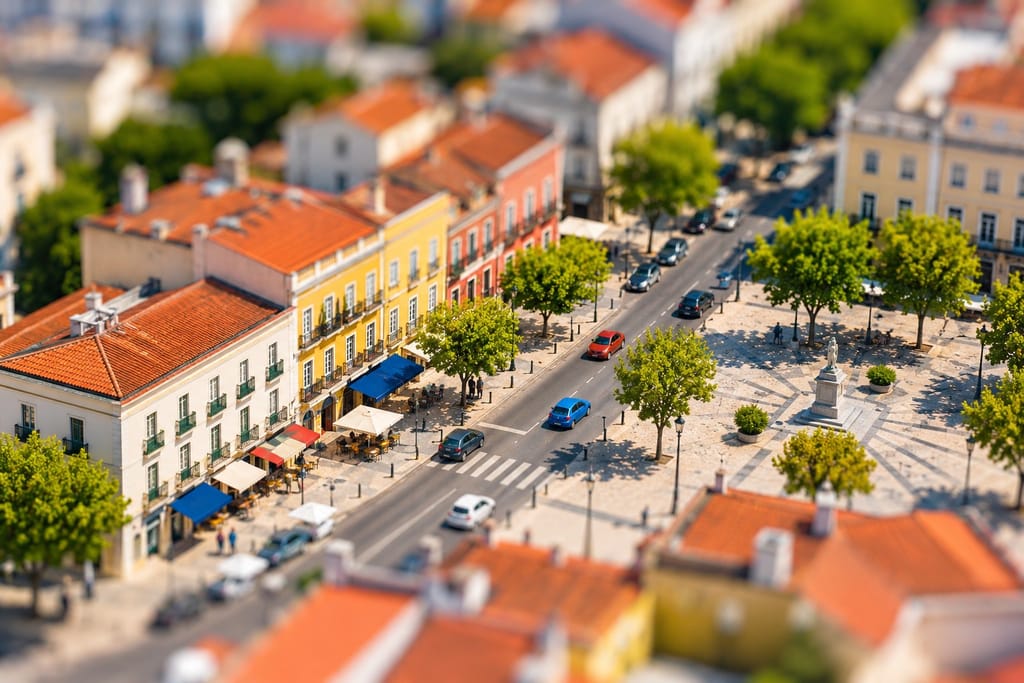
An elevated view shows a street lined with pastel buildings and orange tiled roofs beside a tree-filled paved square with a statue. Cars, café tables and tiny pedestrians occupy the scene, while strong blur across the foreground and background makes the city look miniature. What the check saw. Bright sunlight, saturated colours and a narrow band of focus give this elevated city photograph a pronounced tilt-shift miniature effect.
With other styles
The opposite: Tiny-planet photographic panoramas. Both make a real place look like a toy, but the planet remaps a full sphere into a globe while this keeps an ordinary rectilinear frame and fakes scale with blur.
The opposite: Drone top-down photography. Both look down, but the drone picture points straight down with everything sharp; here the camera stays oblique and the blur does the miniaturising.
The opposite: Real-estate HDR and flambient interiors. Both lift colour and sharpness, but real-estate work keeps everything in focus and believable; here selective blur breaks realism on purpose.
Sources
- Wikipedia, Tilt-shift photography: https://en.wikipedia.org/wiki/Tilt%E2%80%93shift_photography (fetched: miniature faking, Barbieri in the 1990s, Smallgantics first seen in the 2006 Harrowdown Hill video, Ben Thomas's Cityshrinker and the 2014 Tiny Tokyo book; Cityshrinker is undated there; digital post-processing can produce a similar effect).
- Wikipedia, Olivo Barbieri: https://en.wikipedia.org/wiki/Olivo_Barbieri (fetched: tilt-shift city photographs and films, Site Specific from 2003, Rome, Shanghai, Las Vegas, Seville; Site Specific monograph, Aperture, 2013).
- Wikimedia Commons, Miniature Turku.jpg (CC BY-SA 2.0, Johan, 2007-04-01) and View from the Willis tower (8154808541).jpg (CC BY 2.0, Miguel Mendez, 2012-09-29; description says Photoshop CS6 tilt-shift filter): licences, dates and EXIF data from the Commons API; both images were downloaded and inspected. A first specimen, Marina Bay Sands Hotel, was dropped because it shows a low-viewpoint tilt-shift lens picture, not the miniature look.
- Wikimedia Commons, Category:Tilt-shift miniature faking: https://commons.wikimedia.org/wiki/Category:Tilt-shift_miniature_faking (fetched: many files of city and landscape views from towers, decks, hills and aerial points, e.g. Boston, Chicago, Melbourne, Bruges; shows the look is widely practised on Commons, not a dated survey).
- Research boundary: Wikipedia's 1990s date for Barbieri's miniature work is not confirmed here; the series dated here starts in 2003; Barbieri's birthplace was not verified and is not stated; a date for Cityshrinker was not found, so it is not dated. No independent source was found that phone apps drove the web spread, which is inferred from the Commons examples. The Wikipedia claim that Smallgantics is a motion-picture technique was not checked against a second source. Parent and influences are empty because no direct lineage to an existing atlas style was verified.