Styles / Digital & social
Rooftopping photography
- Key: the sun, from the camera’s left, at the side, low, hard.
- Lamp in the scene: a lamp, sign or screen, from the camera’s left, at the side, hard.
Low sun: shoot near sunrise or sunset.
Schematic, not to scale: worked out from the style’s choices. No set-up of this style has been rendered yet.
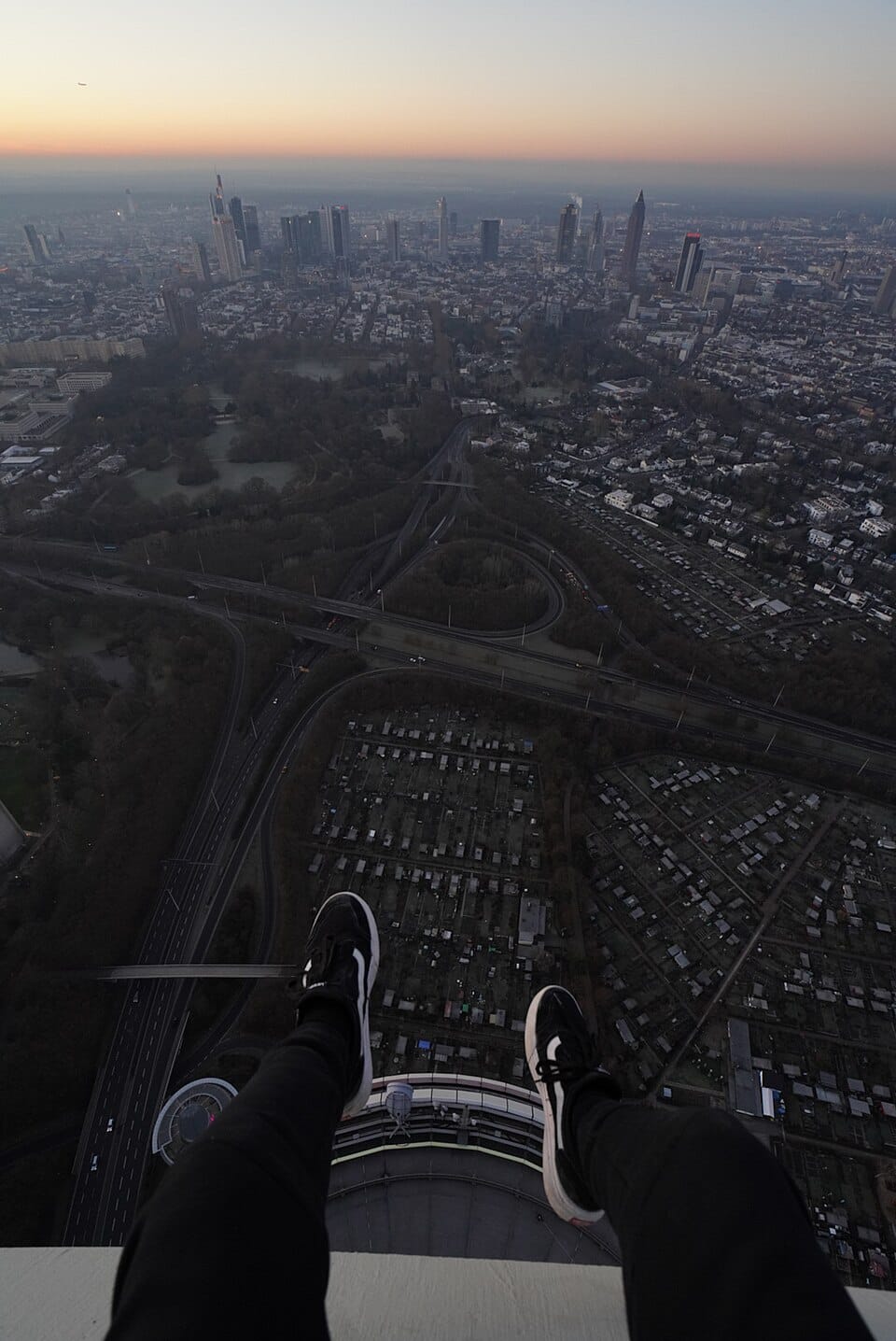
Europaturm Dangle
FreeclimbZurich, CC BY-SA 4.0, via Wikimedia Commons. Source: Europaturm Dangle at Wikimedia Commons

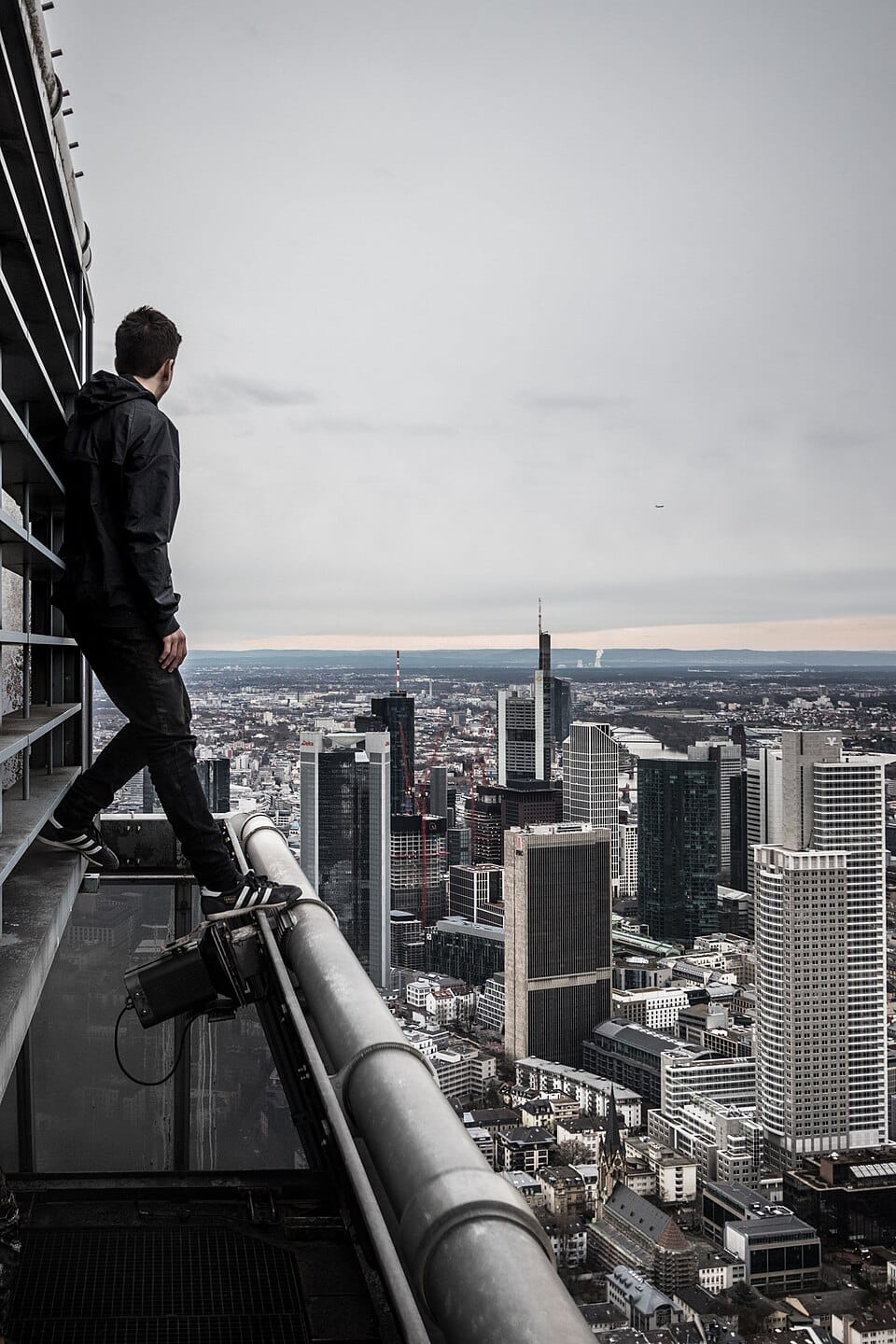
Rooftopper on Messeturm in Frankfurt am Main, Germany
FreeclimbZurich, CC BY-SA 4.0, via Wikimedia Commons. Source: Rooftopper on Messeturm in Frankfurt am Main, Germany at Wikimedia Commons

A climber's view from the edge of a skyscraper, crane or tower: feet dangling over a city far below, or a friend seated or standing on the rim against the skyline. Shot on a wide lens from the climber's own height, usually at dawn, dusk or night, with deep focus, a strong vertical drop and a polished, high-detail finish, made by the climbers themselves, often without permission, and posted to feeds.
Built mostly on one system: Cinematic colour. What systems are.
Shoot sheet for your kit A prompt for an image model The photographs
How the look is made
- Put the drop in the picture: keep a ledge, rail, antenna or your own boots in the foreground and the city far below, so that height can be read at a glance.
- Shoot wide, typically 16-24 mm equivalent, close to the climber and from the climber's own level, and stop down to f/8 or so so that foreground steel and distant towers are both sharp.
- Time the climb for the blue hour, dawn or night: the sky holds colour and the city lights are on; use a tripod or a rail for a long exposure at night.
- Photograph a friend or yourself seated, leaning or standing at the rim, back to the camera and looking out, small against the skyline, or point the camera down past your feet in a first-person shot.
- Keep the climber in the frame and in ordinary clothes: dark jackets and trainers, hood or cap, nothing dressed for the camera.
- Finish for the feed: lift shadows, add contrast and colour, sharpen the detail; vertical or square crops fit a phone screen.
Shoot sheet for your kit
Fill in your camera, lenses and lights, and the sheet says which light plays each part, what to work around and where to start on your camera. Without a kit it starts on a full-frame camera.
Light
Key: the sun, from the camera’s left, at the side, low, hard.
Lamp in the scene: a lamp, sign or screen, from the camera’s left, at the side, hard.
- Low sun: shoot near sunrise or sunset.
- Shadow depth
- Dark shadows that still hold some detail (a high lighting ratio, about 4:1 to 8:1: the shadow side two to three stops darker).
- Highlights
- Even the brightest parts (clouds, white cloth, snow) keep texture and detail.
How the style is lit
- Blue-hour or dawn sky behind the city, with the skyline lights already on and no added light (a tripod and a few seconds at night).
- Golden-hour sun low across the roofs, the climber backlit or lit from the side.
- Overcast daylight on the roof, flat and cool, the drop and the distance carrying the picture.
- The aircraft warning lights and building floodlights of the roof as the only lights at night, left in the picture.
This plan is worked out from the style’s choices, so it is drawn as a schematic. One way to get the light, not a record of how any photograph was lit.
Lens and settings
Start at
On a full-frame camera: the same depth of field and exposure as the style’s own numbers, in the same light. Then meter and adjust.
- 1/8 s: on a tripod.
- Then
- 16–35 mm · f/4.5–f/8 · 1/250–5 s · ISO 320–1600 on full frame, inferred from the gear and the look. Read from the EXIF data of three Commons photographs (a 16 mm view past dangling feet at dawn, 1/100 s f/8 ISO 1600; a 35 mm equivalent view of a climber on a tower rim in dull light, 1/125 s f/4.5 ISO 320; an 18 mm night view on a tripod, 5 s f/8 ISO 800) and from the wide, stopped-down look of the genre. Night shots need a tripod or a rail; hand-held at dusk push ISO up. Typical figures, not rules.
- White balance
- Daylight or auto balance left cool: let the dusk sky stay blue, the city lights and the aircraft warning lamps stay warm or red against it.
- Focal length
- A wide view; near things loom and lines stretch towards the edges.
- Focus
- Everything sharp from the nearest stone to the horizon.
- Angle
- Looking down on the subject. Straight down onto a table, floor or ground. From an aircraft, a drone or a great height.
- The photographer
- The picture shows what the viewer’s own eyes would see.
- Crop & fill
- The subject shown small within its setting, which explains it.
- Depth
- Separate events in the foreground, middle ground and background. A strong horizon splits the frame into bands.
- Instant
- Movement stopped dead by a fast shutter or flash.
- Duration
- An unmoving scene, exposed slowly and carefully.
Direct
Not directed in the studio sense: the climber sits on the rim with legs over the edge, stands at the edge, leans on a rail or hangs from a mast, mostly back to the camera and looking out at the city, relaxed in a place that is not. In first-person shots only the boots and legs appear. Pose to be small in the picture. Never ask anyone to take a risk, hold on with one hand or stand closer to an edge for the shot.
- Body position
- Slouched, sprawled, cross-legged or perched on a step, an armrest or the floor.
- Turn to the camera
- Seen from behind, facing into the scene, so the viewer looks with them.
- Head & gaze
- Attention on what the hands are doing or on a thing (working, reading, eating, playing), not on the camera.
- Line & energy
- Loose and unforced, as people stand and sit when they forget the camera, whether caught or coaxed by prompts.
- The moment
- People photographed as they are, unaware or unconcerned.
Style the set
Nothing is dressed or arranged: dark hoodies, jackets, jeans and trainers as worn for the climb, hoods or masks, a backpack, no props but the roof itself with its rails, antennas, lamps and steel. The set is the roof as found, left unlit and unmoved.
- Clothes
- What people happened to be wearing; nothing chosen for the picture.
- Set & props
- A real place picked for its look as the setting for a shoot, not the subjects’ own: a street, a field, a palace, a hotel room.
- How much is styled
- Nothing dressed, made up, moved or added for the picture.
Finish
- Colour
- The colour of ordinary things treated as the point of the picture. Strong, dense colours.
- Digital & other
- A modern digital camera: clean, detailed, neutral.
- Texture
- Every surface resolved, more than the eye would see.
- Post-production
- Shadows and highlights both opened up, with a processed look.
- Shown as
- Each picture stands on its own.
- Shown in
- Pictures made for a scrolling feed.
- Frame
- A tall frame made for phones and screens.
Stay away from full glamour make-up, deadpan, soft studio light, soft focus & diffusion, eye level, visible grain, shallow depth of field and straight print.
Before you shoot it
The photographs show real, often named, people at risk of death: climbers have died while rooftopping, including Wu Yongning in 2017 and Remi Lucidi in 2023 according to the Wikipedia article on rooftopping, and the pictures can glamorise an act that is dangerous and usually trespass. Do not recommend, depict or pose anyone doing it, or ask a person to go to an edge; use the look from legal viewpoints (an observation deck, a public roof or a safely railed roof) and keep the risk out of the image. Do not identify climbers or publish a way into a named building; many are living people who face arrest, and some belong to a community that depends on not being named. Credit and ask before reusing a climber's pictures.
A prompt for an image model
No prompt for this style
Behind its pictures: real people risking death and trespassing.
Caution says never depict or pose anyone doing it.
Do not recommend, depict or pose anyone doing it, or ask a person to go to an edge; use the look from legal viewpoints and keep the risk out of the image. Do not identify climbers or publish a way into a named building; many are living people who face arrest, and some belong to a community that depends on not being named. Credit and ask before reusing a climber's pictures.
Work with photographers of this tradition, or take only its light and lens (the shoot sheet above) without its people, places or rituals.
Photographs that define it
From open collections, shown whole with their credits. Later photographs are linked, not shown, while they are in copyright.
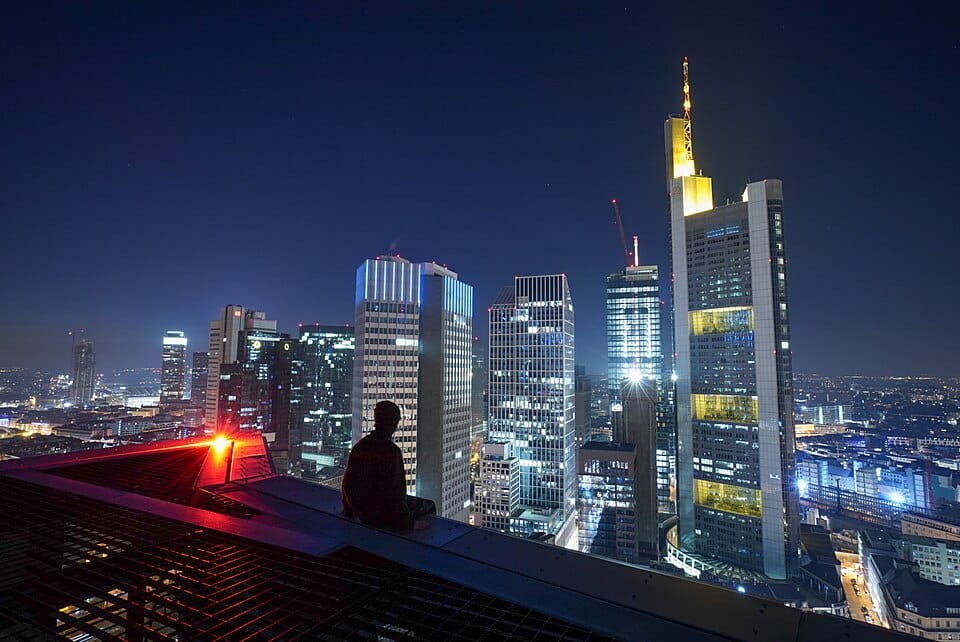
Rooftopper Winx Frankfurt
FreeclimbZurich, CC BY-SA 4.0, via Wikimedia Commons. Source: Rooftopper Winx Frankfurt at Wikimedia Commons

With other styles
Pairs with Skate photography. Both are made with the performer, by insiders, in a city spot, with the wide lens close to the body; the skate picture freezes a move while rooftopping shows a held, still drop.
The opposite: Drone top-down photography. The drone looks straight down at the ground with nobody in the frame; here a person at the rim holds the camera and the climber's boots or body stay in the picture.
The opposite: Tiny-planet photographic panoramas. A tiny planet bends the whole sphere into a disc; rooftopping keeps the verticals and the horizon of a normal wide frame and gets drama from the drop.
Pairs with Computational smartphone look (deep-focus HDR). Many rooftop pictures are phone pictures; use its deep focus and HDR for dusk skylines.